


Purines As Anti-Cancer Drugs
Description
This section is from the book "Chemistry Of Chelation In Cancer", by Arthur Furst. Also available from amazon: Chemistry Of Chelation In Cancer.
Purines As Anti-Cancer Drugs
Since the introduction of 8-azaguanine and the study of its mode of action as well as its clinical effectiveness, many purines have been introduced for human cancer chemotherapy. Most of these purines are chelating agents, as is the original 8-azaguanine (LX). Considered among the most active purines experimentally and clinically (152, 233) is 6-mercaptopurine (6MP) (LXI). This molecule does form at least two complexes with bivalent copper, cobalt and manganese. The order of avidity of this compound for transition metal ions is: Cu+ + > Ni+ + >Pb+ + >Co+ + = Zn+ +. This series is somewhat unusual in that the affinity for Co++ and Zn++ are the same. The platinum and palladium derivatives of 6MP were made recently and found quite effective as anti-tumor agents. Other purine derivatives have been tested against experimental neoplasms with limited success. These include 6-aminopurine, 2,6-diaminopurine, thioguanine, and 6-chloropurine. Only the latter is not a chelating agent.
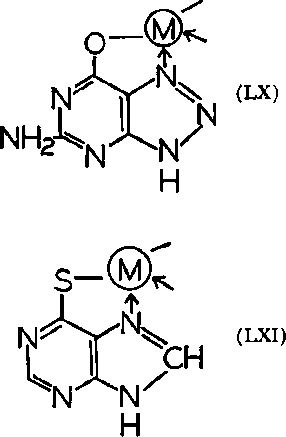
Because of its activity, a number of s-substituted derivatives have been made of 6-mercaptopurine; the activity of s-methyl-6-mercaptopurine has been reported, but it is less active than 6MP itself. Based on a chelation theory, it could be predicted that the activity of this derivative would be directly proportional to the rate of hydrolysis of the s-methyl group to give the original 6-mercaptopurine. In a sense, this may hold for other sulfur derivatives as well. Most recently reported active congener of 6MP is 6(I-methyl-4-nitro-5-imidazolyl thio) purine. It is an effective agent, and predictably in the host tissue it is converted to 6MP.
An interesting group of compounds which can be considered with the purines are the pyrazolopyrimidines. The adenine analog, 4-animopyrazolo(3,4-d)pyrimidine (LXII), which significantly increases the life span of mice with certain transplanted leukemias, is not a chelating agent. In this series only a few compounds with minor activity can be considered to be structurally related to the chelating agents. Isomers of the pyra-zolo(4,3-d)pyrimidine series wherein the 7-atom is nitrogen and the 9-atom is carbon are in the main inactive. The only one with activity is the guanine isomer, a chelating agent.
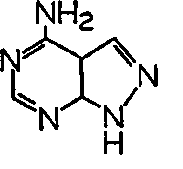
(LXII)
As in the case of the hydrocarbons, electronic force calculations were made for the purines and pyrimidines; but metal-binding potentialities were not considered.
Continue to:


My Books

