


Pyrimidines And Triazines
Description
This section is from the book "Chemistry Of Chelation In Cancer", by Arthur Furst. Also available from amazon: Chemistry Of Chelation In Cancer.
Pyrimidines And Triazines
Only a few of the substituted pyrimidines reported to be active as chemotherapeutic agents seem to fit the chelate hypothesis. It should also be noted that only a few of the pyrimidines have been found clinically useful. The most useful is 5-fluorouracil (5 FU). The 5-halogenated pyrimidines have been extensively investigated as potential anti-cancer drugs in man and animals. Two compounds in this series, 5-bromo- and 5-iodo-2'-deoxycytidine, were logical choices from a biochemical point of view as having selective action on tumor tissue but no marked activity was noted. The iodo derivative of a related compound, iodouridine (IUR), proved to be a better antitumor agent in rodents, though some activity has been reported in man. The riboside, 5-iodo-2'-deoxyuridine (IUDR), was more effective in rodents. The chemical addition of the deoxy-ribose portion converted the non-chelating precursor into a potential metal binder; it also enhanced activity of the drug.
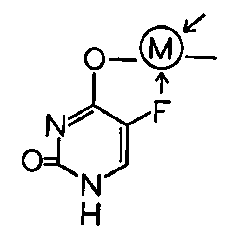
Three fluoro pyrimidines were introduced in 1957 ( 250). One, 5-fluorouracil, was selected for clinical trial. This proved to be quite effective in solid human tumors and in conjunction with x-ray. In contrast to the bromo or iodo pyrimidines, the 5-fluorouracil should be able to chelate trace elements (LXIII).
(LXIII)
A metal complex study of 5-fluorouracil, 5-fluorocytosine or 5-fluoroorotic acid should prove interesting. No such study was found reported in the literature.
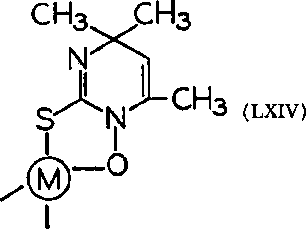
In other structure-action studies of a large series of 2-mer-captodihydropyrimidines, only the potential chelating agent of the 2-thiol-4,4,6,-trimethyldihydropyrimidine (LXIV) series was active in extending the life span of mice with Ehrlich ascites tumor.
The non-chelating pyrimidines have also been extensively investigated.
Other active pyrimidines include the aza analogs of the naturally-occurring bases. Azathymine is not a chelating agent. Its deoxyriboside should complex with trace element ions. In a comparison of the activity of 6-azauracil with its riboside, 6-azauridine, it was found that the riboside was ten to twenty times more active. Again, the introduction of a group with a potential for metal-binding enhanced the anti-tumor activity of the original compound.
A series of derivatives of pyrimidines were made with amino groups in various positions on the molecule, and in those which contained 4,5,6 triamino groups, strong antimitotic activity was noted. However, the sulfates of similar compounds did not show activity when tested against the L1210 leukemia in mice.
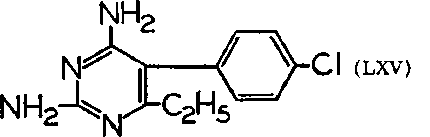
Pyrimethamine (Daraprim), the 2,4-diamino-5-(4'-chloro-phenyl)-6-ethylpyrimidine (LXV), which has been extensively investigated, has toxic effects similar to amethopterin and gives rise to folic acid deficiency. Analogs of pyrimethamine also have growth inhibitory properties.
No chelation is possible with this molecule because all four of the possible positions have been substituted. If a hydroxy group were introduced in the 2' position of the phenyl group, chelation still would not be possible, for between the amino and hydroxy groups would be four carbon atoms. A series of triazines, especially 1,2-dihydro-s-triazines, which are similar to pyrimethamine in structure, are also biologically active and are also folic acid antagonists.
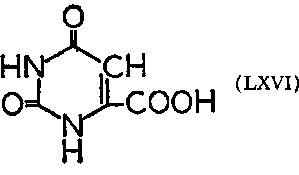
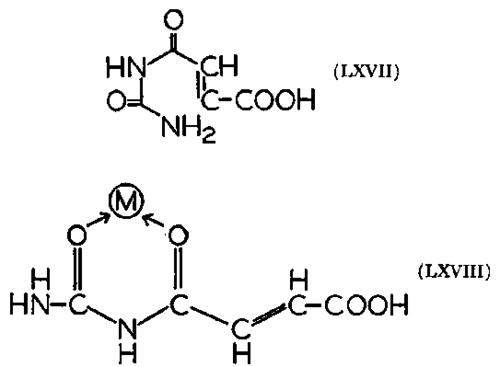
An open model of orotic acid, maleuric acid has tumor damaging properties as shown by its cytological effects on the Ehrlich ascites carcinoma. A relationship between orotic acid (LXVI) and maleuric acid (LXVII) can be seen from the structures. However, when maleuric acid is written with an open structure (LXVIII), it can be considered as a chelating agent with various possibilities.
Continue to:


My Books

