


Natural Products
Description
This section is from the book "Chemistry Of Chelation In Cancer", by Arthur Furst. Also available from amazon: Chemistry Of Chelation In Cancer.
Natural Products
The structures of many of the natural products found active against tumors have not been elucidated. These include many plant extracts, such as alkaloids from Vinca rosea Linn, the periwinkle plant, which are now being evaluated clinically. Again, the structures have not as yet been determined. Indications show these to be dimeric indole-dihydro-indole molecules. Will these alkaloids complex metals? Antitumor yeast extracts should also be included in natural products of unknown structure. Flavonoids are of known structure, and they are chelating agents.
Historically, colchicine was one of the earliest antimitotic agents found. The structure, as now accepted, is the methyl ether of one of the tautomeric forms of colchiceine (LXIX), the chelating agent. It must be noted, however, that colchicine, the ether, is a more active mitotic inhibitor than colchiceine. Biologically active derivatives are also known. A portion of the molecule of colchiceine, a tropoline derivative, 4-acetylaminotropolone (LXX), is a radiomimetic substance which is possibly mutagenic.


Shear's polysaccharide, considered one of the first natural products with tumor-necrotizing properties, was isolated from cultures of Serratia marcesens (Bacillus prodigiosus). It caused hemorrhage in human sarcomas. As a polysaccharide it should be able to bind metals, as should other anti-tumor saccharides like inositol and 2-deoxy-D-glucose. Metal-binding studies with these compounds have not been done as yet.
Another natural product which showed early promise in animal tumors is a steroid, cortisone. Later it was shown that cortisone aided formation of metastases. This compound is also a chelating agent. Its presence seems to influence the number of sites available for copper-binding by some enzymes. A review of the hormonal regulation of tumor growth is available. As a class, hormones are not metal binders, but they may influence metal-binding properties of proteins as cortisone does.
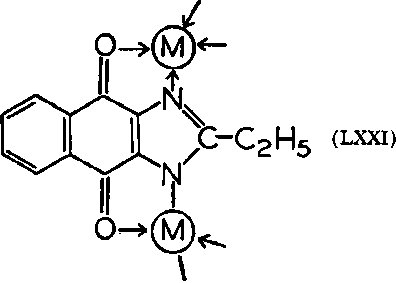
Of the naturally occurring vitamins, only B12, the cobalt-containing vitamin, has some beneficial effect on tumors. Children with neuroblastomas have responded favorably to massive doses of this preparation. In this field synthetic modifications or analogs of vitamins have been reported to have anti-tumor activity. Antimetabolites of B12, a benzimidazole naphthaquinone (LXXI) with chelating properties inhibited experimental tumors. Riboflavin analogs, too, were reported as having anti-tumoral activity in rats, particularly when the zinc chelate was made. Metals may play a major role in the catalytic activity of certain vitamins. This may be especially true of pyridoxal.
Major emphasis in the field of natural products centers around antibiotics produced by various fungi. In the majority of cases where structure has been determined, it can be shown that these compounds have centers that can chelate or complex trace elements. One example is the antibiotic stylomycin (Puromycin) and some of its analogs.
Filtrates of Actinomyces cultures were quite active against animal tumors. Actinomycin C and actinomycin D have been tried in clinical cancer cases. The structure assigned to this antibiotic shows some chelate sites; the molecule can be represented as in LXXII. A fair number of anti-tumor antibiotics have been found. These are in the main by-products of streptomyces. A few will be discussed in light of the chelate hypothesis. Amino acid antibiotics have been isolated. Both DON (6-diazo-5-oxo-L-norleucine) and azaserine (LXXIII) can chelate trace elements in more than one possible way as seen from the formula of the latter compound. Sarkomycin, an anticancer substance produced by streptornyces has the structure seen in LXXIV. This compound is not a chelating agent per se, but it may be able to exist in an enol form and complex with iron salts as does cyclopentadiene. Although sarkomycin is not an amino acid, it is similar to the synthetic cycloaliphatic amino acid, 1-amino-cyclopentane-1-carboxylic acid, an anti-tumor agent. Naturally occurring is the cyclopropane analog; it also should be tested in a spectrum of tumors.


Some synthetic analogs of amino acids, for example,β-2-thi-enylalanine, are also active. These variants may also be considered as anti-amino acids which may inhibit growth by the theory of antimetabolites. However, the more active congeners may be those unnatural amino acids which possess a chelating center in addition to having the usual amino carboxyl cation interaction. Amino acid derivatives of nitrogen mustards have already been discussed. Related derivatives like peptides of these compounds are also showing inhibitory properties.
Newer antibiotics are constantly being reported. Among these is carzinophilin, which is effective in animal tumors even at doses of 1 µ./kg.. It is being tested in humans. The nature of this compound has not yet been reported. There are numerous references to the fact that trace elements do combine with and influence the activity of antibiotics.
Continue to:


My Books

