


Ulcers, Scars, Draining Sinuses, And Fistulas. Squamous Cell Carcinoma, Basal Cell Carcinoma
Description
This section is from the book "Early Detection And Diagnosis Of Cancer", by Walter E. O'Donnell. Also available from Amazon: Early Detection And Diagnosis Of Cancer.
Ulcers, Scars, Draining Sinuses, And Fistulas. Squamous Cell Carcinoma, Basal Cell Carcinoma
Ulcers, Scars, Draining Sinuses, And Fistulas
A number of cases of skin cancer have been reported in conjunction with these conditions. The exact relationship is not clear, and the best that can be said is that cancer associated with any of these conditions is a very uncommon occurrence.
Xeroderma Pigmentosum
This is a rare hereditary intrinsic abnormality of the skin which renders the skin extraordinarily sensitive to the effects of exposure to sunlight or other sources of ultraviolet rays. The unhappy consequence is the development of multiple, recurrent skin cancers distributed diffusely over the exposed parts of the body.
Clinical Features
Differentiation between squamous cell and basal cell cancer is often possible on clinical grounds, but the ultimate distinction rests on pathologic review of biopsy material. The latter is the province of the trained pathologist and will not be dealt with here. From a practical standpoint, the principal reason for wishing to make the distinction between squamous cell and basal cell cancer is the known difference in the potential for metastasis and local invasion between the two and the obvious implications this holds with regard to both treatment and prognosis. A few remarks about the similarities and dissimilarities of the two lesions are worth noting here.
Squamous Cell Carcinoma
1. May begin as a papule or nodule which increases in size and ulcerates, leaving a flat or somewhat elevated granular crusted surface which may or may not have sharp indurated edges.
2. May arise from areas of pre-existing keratosis, radiation dermatitis, leukoplakia, etc.
3. Most commonly located on the ears, temples, cheeks, lips, preauricular and malar regions, and the dorsum of the hands (Fig. 34).
4. May occur in the external auditory canal masquerading as a chronic infection.
5. As time goes on, the lesion continues to increase in size and infiltration and fixation of adjacent tissue are noted. Metastasis to regional lymph nodes or even distant spread of the disease may take place relatively early. Local tissue invasion may occur but is a rather late phenomenon. This is in contrast to the behavior of basal cell carcinoma wherein this is a prominent and relatively early feature of the disease process and metastasis virtually never occurs.
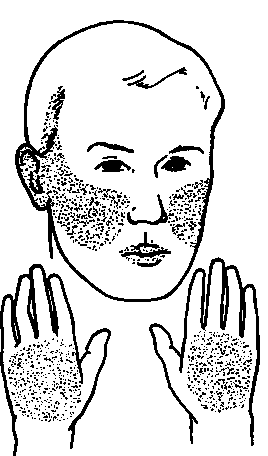
Squamous cell

Basal cell
Fig. 34. Most common sites of occurrence of squamous cell and basal cell carcinoma.
Basal Cell Carcinoma
1. May occur as a small discrete nodule sometimes described as waxy or translucent in appearance.
2. Or it may present as a small papular, excavated or craterlike lesion covered by a brownish crust and having a pearly, rolled margin. This is the so-called "rodent ulcer."
3. Most commonly located on the scalp, nose, nasolabial folds, eyelids, skin of the upper and lower lips, chin, and forehead (Fig. 34). May occur in external auditory canal.
4. Lesions may be multiple.
5. Metastases virtually never occur.
6. Gradual growth and progression of the primary tumor with invasion and erosion of adjacent skin, soft tissue, cartilage, and bone is the characteristic natural history. However, when basal cell carcinoma encroaches upon and invades mucosal surfaces, it behaves in a far more aggressive manner, simulating squamous cell carcinoma.
Continue to:


My Books

