


Δ^5-3-Ketosteroid Isomerase
Description
This section is from the book "The Scientific Contributions Of The Ben May Laboratory For Cancer Research", by The University of Chicago. Also available from Amazon: The Scientific Contributions Of The Ben May Laboratory For Cancer Research.
Δ^5-3-Ketosteroid Isomerase
The structure of cholesterol and other related sterols is characterized by the presence of an alcoholic hydroxyl group at C-3 and a double bond at C-5. In contrast, many hormonally active steroids, although ultimately derived from cholesterol, contain the Δ4-3-ketone grouping. The biogenesis of the latter structural unit involves two separate enzymatic processes, namely, the oxidation of the 3-hydroxyl group by a pyridine nucleotide-linked hydroxysteroid dehydrogenase and the translocation of the double bond by a separate Δ5-3-ketosteroid isomerase. The isomerase activity was first demonstrated in extracts of P. testosteroni grown on a medium containing testosterone (181). A similar enzyme has been found in many animal tissues. The reaction may be assayed simply by observing the increase in ultraviolet absorption (at 248 mµ in aqueous solutions) which accompanies the conversion of 5-androstene-3,17-dione to 4-androstene-3,17-dione:
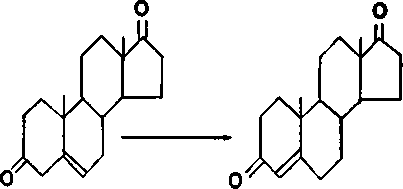
The steroid isomerase of P. testosteroni was recendy crystallized (121, do).' The protein appears to be homogeneous by a number of criteria. Certain aspects of the purification procedure are of special interest. Seventy liters of culture, grown on a medium containing testosterone and yeast extract, provided about 140 grams of acetone-dried bacteria. A six-step procedure resulted in a 3,000-fold purification. In one purification 14 mg. of crystalline enzyme (elongated, birefringent platelets, Fig. 19) were isolated, and 70 per cent of the initial enzyme activity was preserved. The enzyme is freely soluble in 70 per cent ethanol, and considerable purification was achieved by taking advantage of this property. The enzyme sedi-mented as a single homogeneous peak in the ultracentrifuge. Its molecular weight was determined by the approach to equilibrium method. The value obtained by this procedure was 40,800, which was in good agreement with the minimum molecular weight calculated from the amino acid composition. The catalytic activity of crystalline steroid isomerase is remarkably high. At least 3 X 10^6 moles of 5-androstene-3,17-dione are converted per minute per mole of enzyme at 25 and pH 7. Steroid isomerase is therefore one of the most active of the known enzymes.
Hydrochloric acid hydrolysates of three times recrstallized isomerase have been analyzed (d9) with the automatic amino acid analyzer of Moore and Stein. Of the approximately 389 amino acid residues in each molecule, the most common constituents are: 66 alanines, 40 valines, 38 aspartic acids, and 38 glutamic acids. The aromatic amino acids are represented by 25 phenylalanine and 10 tyrosine residues. The protein contains neither cysteine nor tryptophane. The ultraviolet absorption spectrum of isomerase exhibits a sharp maximum at 277 mµ (tyrosine) and a minimum at 255 mµ. A great deal of fine structure is also present in the absorption spectrum of the intact protein, and additional minor bands characteristic of both phenylalanine and tyrosine are observable (do).
1 References designated with the prefix "d" refer to dissertations, listed on p. 129.
Steroid isomerase appears to be a pure protein, and no evidence for the participation of metal ions or other cofactors has been obtained. The enzyme undergoes denaturation in solutions of concentrated urea (6-10 M), but nearly full activity may be restored by dduting or removing the urea by dialysis. The mechanism of the isomerase reaction has been investigated with the aid of deuterium. The enzymatic conversion of 5-andro-stene-3,i7-dione to 4-androstene-3,i7-dione in a medium containing nearly 100 per cent D30 occurs without incorporation of isotope from the medium. Since the same lack of incorporation of isotope is observed even when the enzyme has been thoroughly exchanged with D,0 or reversibly denatured in the presence of deuterated urea (ND,CONDa), it may be concluded that the enzymatic reaction involves a direct migration of hydrogen from C4 to C6 (181, do). In contrast, the acid or base-catalyzed isomerization of 5-androstene-3,i7-dione in DaO results in the acquisition of the anticipated quantities of deuterium by the product. The enzyme mechanism is apparently fundamentally different from the acid or base catalyzed reaction. The stereospecificity of the enzymatic reaction and whether the mechanism involves a proton shift or a hydride group transfer have not been resolved.
Continue to:


My Books

