


Seminal Fructose
Description
This section is from the book "The Scientific Contributions Of The Ben May Laboratory For Cancer Research", by The University of Chicago. Also available from Amazon: The Scientific Contributions Of The Ben May Laboratory For Cancer Research.
Seminal Fructose
The main reducing and yeast-fermentable sugar in the seminal fluid of most mammals is D-fructose (Mann, T. The Biochemistry of Semen. London: Constable & Co., 1954). Depending on the species, seminal fructose originates either from the seminal vesicles or from one or more lobes of the prostate gland. The levels of fructose in seminal plasma, and in the secretions of the accessory glands, are strictly dependent upon androgenie hormones. In a study of the hormonal control of the growth and differentiation of the accessory glands of guinea pigs (149), the concentrations of fructose (and citric acid) were used as indices of secretory activity. In contrast to most other species, the histological differentiation of the accessory glands of young guinea pigs is not completely prevented by castration, and the regression of the glands in adults after orchiectomy is extraordinarily sluggish. It was found (149) that prepuberal castration of guinea pigs completely inhibited the formation of fructose and citric acid. In adults, castration stopped secretion of these substances despite the fact that the reduction in the height of the epithelial cells was slow, incomplete, or absent. Observations on prepuberal castrates showed that androgen administration did not induce precocious secretion of fructose and citric acid, although this treatment stimulated growth and histological differentiation. In normal guinea pigs, the vesicular fructose levels at the twenty-fourth day of age were more than double those in ten-day-old animals, and reached adult levels by the fortieth day of age. The same was true of citric acid concentrations. These chemical studies established that, in this species (as in many others), the onset of secretory activity of the accessory glands precedes the appearance of spermatogenesis at seventy-five days of age.
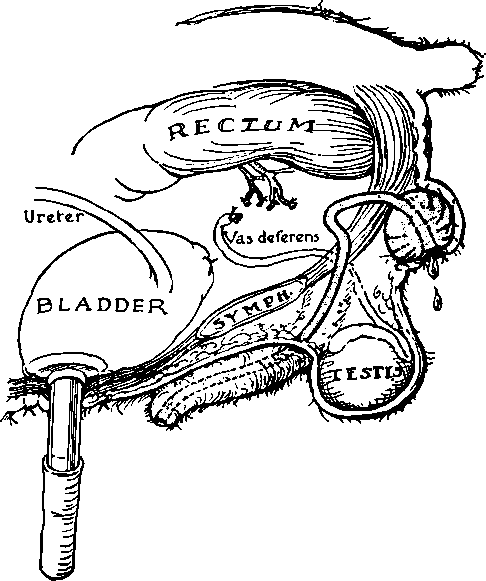
Fig. 17.-The canine prostatic translocation operation (65).
There is abundant evidence that seminal fructose is synthesized from blood glucose in the accessory glands. Mann (loc. cit.) and others suggested that this process involved an initial phosphorylation (by hexokinase and ATP) of glucose to glucose-6-phosphate, the isomerization of the latter substance to fructose-6-phosphate by the enzyme phosphohexose isom-erase, and then the liberation of free fructose by dephosphorylation of fructose-6-phosphate. It had been shown that the accessory glands contained an alkaline phosphatase that attacked the 6-phosphate esters of both glucose and fructose at about the same rate. In order to account for the sole presence of fructose in the accessory gland secretions, it was postulated that glucose formed by the action of the phosphatase was reutilized, whereas fructose liberated in this manner was not, and thus appeared in the secretion.
Experiments in this laboratory confirmed that the activity of these glycolytic and dephosphorylating enzymes in the accessory glands was sufficient to account for the rates of fructose biosynthesis by these tissues. Moreover, it was shown that at low-sugar concentrations the hexokinase in these organs phosphorylated glucose at a faster rate than fructose and also that the phosphorylation of fructose was inhibited by low levels of glucose. However, fructose-secreting accessory tissues were found to contain about the same levels of the enzymes involved in this phosphorylative pathway for the conversion of glucose into fructose as those glands which did not manufacture fructose. Attempts to demonstrate in the accessory glands enzymes that catalyzed the preferential dephosphorylation of fruc-tose-6-phosphate, or the direct isomerization of free glucose to fructose, were entirely unsuccessful.
In the course of these studies it was observed that extracts of some of the accessory glands which secreted fructose catalyzed the oxidation of DPNH by fructose (but not by fructose-6-phosphate) and also the reduction of DPN by sorbitol (195). These reactions were shown to be catalyzed by a DPN-specific dehydrogenase (polyol dehydrogenase or ketose reductase) that was localized in the soluble fraction of the cytoplasm. This enzyme promoted the reversible oxidation of sorbitol to fructose and also the DPN-dependent oxidation of a number of 5-, 6-, and 7-carbon polyols to ketoses:
Sorbitol + DPN+ ⇋ fructose + DPNH + H+
The ketose reductase was partially purified from the coagulating gland and seminal vesicle of the rat (195,197). Its properties, and its specificity toward various polyols and ketoses, resembled closely those of a similar enzyme purified from rat liver. The enzyme obtained from liver and the accessory glands did not react with TPN (although the liver enzyme reacted with the 3-acetylpyridine and other analogues of DPN very rapidly); it was inhibited by low concentrations of many heavy metals and of dimercaptopro-panol but not by cysteine.
It was considered that ketose reductase might play a role in the manufacture of seminal fructose if the accessory glands also contained an enzyme that catalyzed the reduction of glucose to sorbitol. Such an enzyme, aldose reductase, was indeed later demonstrated in the seminal vesicle of the sheep by H. G. Hers (Biochim. et biophys. acta, 221203,1956). Aldose reductase catalyzes, inter alia, the reversible reduction of glucose to sorbitol with TPNH as the hydrogen donor. Hers provided many lines of evidence that, in the sheep seminal vesicle, fructose is synthesized by the combined actions of aldose and ketose reductases, as follows:
Glucose + TPNH + H+ ⇋ sorbitol + TPN+ Sorbitol + DPN+ ⇋ fructose + DPNH + H+ |
Glucose + TPNH + DPN+ ⇋ fructose + TPN+ + DPNH |
The presence of aldose reductase in the fructose-secreting coagulating gland of the rat was confirmed in this laboratory. This tissue was also found to contain, unlike the liver or blood of the rat, relatively large amounts of free sorbitol as well as fructose. The sorbitol was estimated by a specially developed enzymatic method based on the reduction of DPN in the presence of highly purified, soluble polyol dehydrogenase of rat liver (192, 205). Mann and his co-workers recendy confirmed the presence of sorbitol, alongside fructose, in the seminal plasma of many species (King, T. E., and Mann, T. Proc. Roy. Soc. London, B., 151:226, 1959) and found that the level of fructose production in the accessory glands could be correlated with the activities of aldose and ketose reductases (Samuels, L. T.; Harding, B. W.; and Mann, T. Fed. Proc., 19:169, i960).
Continue to:


My Books

