


Copper. Sans. Continued
Description
This section is from the book "The Materia Medica Of The Hindus", by Udoy Chand Dutt. Also available from Amazon: The Materia Medica Of The Hindus.
Copper. Sans. Continued
Tάmresvara.2 Take of prepared copper, mercury, borax, and iron, sulphur, and long pepper, equal parts, soak in the decoction of the leaves, bark, fruit, root, and flowers of Azadirachta Indica (nimba), of the pulp of Cassia fistula and of the three myrobalans. Dose four grains, in skin diseases of various sorts. During the administration of this medicine a cooling regimen should be observed.
Sans.

Tuttha. Vern. Tutia.
Sulphate of copper was known m India from a very remote period. It is prepared by roasting copper pyrites, dissolving the roasted mass in water and evaporating the solution to obtain crystals of the sulphate. It was known as a salt of copper, for the Bhavaprakasa says it contains some copper and therefore possesses some of the properties of that metal.* It is described in this work as astringent, emetic, caustic, and useful in eye diseases, skin diseases, poisoning etc. It is purified for internal use, by being rubbed with honey and ghee and exposed to heat in a crucible. It is then soaked for three days in whey, and dried. Sulphate of copper thus prepared is said not to produce vomiting when taken internally. Dose, one to two grains.

Sulphate of copper dissolved in hot water is administered in insensibility from poisoning to excite vomiting. It enters into the composition of some medicines for remittent fever, such as the Jvar-ankusa mentioned in Bhάvaprάkάsa, but arsenic is the active ingredient in these preparations. In quartan fever the following, called Chάturtliakάri,1 is recommended by many writers. Take of orpiment, realgar, sulphate of copper, burnt conch-shell and sulphur, equal parts, rub them together with the juice of Aloe Indica and roast in a covered crucible. When cool extract the powder and make into four-grain pills with the juice of Aloe Indica. They are administered with powdered black pepper and ghee. Butter-milk should be taken before these pills which relieve the fever by inducing vomiting.
Grahanikapάta rasa.2. Sulphate of copper is used in chronic bowel complaints along with other medicines, as for example in the following called Grahanikapata rasa. Take of sulphate of copper, orpiment, mercury, iron, iron pyrites and borax, each five mashas. Prepared couries two and a half tolas and sulphur one tola. Rub them all together with lemon juice and roast the mass lightly. This medicine is given in chronic bowel complaints, consumption etc.

Garbhavilάsa rasa.1 Sulphate of copper enters into the composition of some medicines for diseases of the pregnant and puerperal state, such as, the Sutikάvinoda or Garbhavilάsa rasa. To prepare it take of mercury, sulphur and sulphate of copper, each one part, rub them together with lemon juice for three days. Then take of cumin seeds, kalajira, long pepper, black pepper and ginger each one part, mix and make into eight-grain pills. They are used in bowel complaints and indigestion during the puerperal and pregnant state.
Sulphate of copper is applied to sinuses and fistula-in-ano with the object of stimulating and healing them. It is added to ointments for foul ulcers.2 A solution of sulphate of copper is poured into the eyes in opacity of the cornea.3 The following compound powder is applied to chancres. Take of mercury, sulphur, sulphate of copper, cinnabar, and sulphate of iron, equal parts, powder and mix. This composition may be used in the form of powder or paste.
Sans.

Vanga. Vern. Rάng.
Tin, though not indigenous to India, has been known from a very ancient period and is mentioned by Susruta. Dr. Royle observed "But the Hindoos like the Egyptians have employed tin for various purposes from very ancient times. And though there is no proof of its being found in the present day in the peninsula of India yet it is abundant on the opposite coast of the Bay of Bengal as in Burma, Tenasserim, Junkseylon and Malacca. There must in very ancient times have been a trade between India and these places." Tin is purified by melting it over the fire and pouring the melted fluid into the milky juice of Calotropis gigantea ( arka ). It is prepared for medicinal use by melting it in an iron cup, adding to it one-fourth part of its weight of yavakshara (impure carbonate of potash) and powdered tamarind shells, and agitating with an iron rod till the mass is reduced to a fine powder. It is then washed in cold water and dried over a gentle fire. The resulting product is a greyish white powder consisting chemically of oxide of tin with some impurities. It is chiefly used in urinary disorders in a variety of forms. Thus the simple powder may be given in four-grain dose every morning with honey, or one of the following preparations may be used.

Trinetra rasa.1 Take of prepared tin, mercury and sulphur equal parts, rub them together in an iron mortar and soak seven times respectively in the juice of Cynodon dactylon (durva) and the decoc-tions of liquorice root, gum of Bombax Malabaricum (Mocharasa), and Tribulus terrestris (gokshura). Then roast in a covered crucible, again soak in the above mentioned fluid medicines and make into four-grain pills. This medicine is given with a decoction in milk of the above named vegetable drugs, in painful micturition.
Vangesvara rasa.2 Take of the preparation of mercury called
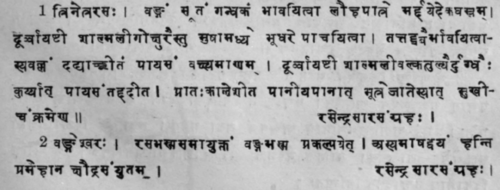
Rasasindura, and of prepared tin, equal parts and mix. Dose about four grains with honey in urinary diseases and diabetes.
Vrihat Vangesvara rasa.1 Take of prepared tin, mercury, silver and talc, sulphur and camphor each two tolas, prepared gold and pearls, each half a tola, mix them together, soak the mixture in the juice of Eclipta prostrata (kesaraja), and make into four grain-pills. This medicine is said to cure all sorts of urinary diseases, and to act as an alterative tonic. It is given in diabetes with the juice of the ripe fruit of Ficus glomerata (udumbara).
Svamavanga.2 Take of mercury, sulphur and tin, equal parts, andrub them together, then take sal-ammoniac in quantity equal to all the above ingredients and rub together in a mortar. Introduce the mixture in a glass bottle and expose to heat in a sand-bath. The resulting powder called Svarna Vanga or golden preparation of tin has a beautiful golden lustre and flaky texture. It is given in urinary complaints in doses of five to ten grains with honey and the juice of emblic myrobalans. This preparation is the bisul-phuret of tin or mosaic gold "used in the arts as a bronze powder especially for the manufacture of paper hangings." It is noticed by Pereira. . The Sanscrit text for its preparation quoted below, is taken from a manuscript compilation in the possession of Kaviraja Benod Lal Sen. It is evidently a recent innovation if not an imitation of the European preparation.

Continue to:


My Books

