


Nat. Order. Nymphaeaceae Nelumbium Speciosum. Nymphaea Lotus Etc
Description
This section is from the book "The Materia Medica Of The Hindus", by Udoy Chand Dutt. Also available from Amazon: The Materia Medica Of The Hindus.
Nat. Order. Nymphaeaceae Nelumbium Speciosum. Nymphaea Lotus Etc
These beautiful aquatic plants had attracted the attention of the ancient Hindus from a very remote period, and obtained a place in their religious ceremonies and mythological fables; hence they are described in great detail by Sanskrit writers. The flowers of Nelumbium speciosum, called Padma or Kamala, are sacred to Lakshmi, the goddess of wealth and prosperity. The white variety of this plant is called Pundarika, the red, Kokanada and the blue, Indivara. The entire plant including root, stem and flower is called Padmini. The torus or receptacle for the seed is, called Kamikάra, and the honey formed in the flowers, Maharanda. The filaments round the base of the receptacle, pass by the name of Kinjalka and the leaf-stalk by that of Mrinάla. The species of Nymphoea described, are as follows: -
Nymphoea Lotus, Kumuda, Sans. Sάluka. Beng. Koi. Hind. Nymphoea stellata. Nilotpala, Sans. Nilsaphalά, Beng. Nymphoea rubra. Raktotpala, Sans. Raktakambal, Peng.
The root-stocks of these water plants contain a sort of starch, and are eaten by the poorer classes. Daring the famine of 1866 in Orissa, they were much sought after by the starving people.
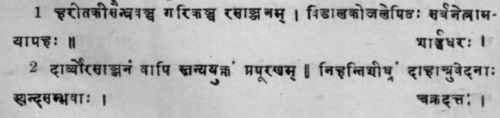
The seeds of Nelumbium speciosum are eaten raw. The small seeds of Nymphaea Lotus, called bheta, are fried in heated sand and used as a light easily digestible food. The seeds of Euryale ferox called makhάnna is Sanskrit, are also used in the same manner, and are regarded as light, invigorating food suited for sick people.
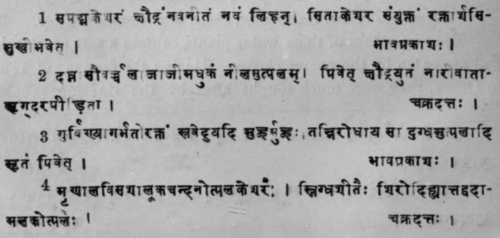
The filaments of these plants are used medicinally. They are considered astringent and cooling, and useful in burning of the body, bleeding piles and monorrhagia. In bleeding piles the filaments of the lotus are given with honey and fresh butter or with sugar.1 In menorrhagia the filaments of Nymphoea stellata are given with the addition of sonchal salt, nigella seeds, liquorice powder, curdled milk and honey.2 A compound decoction is thus prepared.
Utpalάdi sritam3 Take of the filaments of Nymphoea Lotus, N. stellata and N. rubra, of the white variety of Nelumbium speciosum and liquorice root, equal parts, in all, two tolas, and prepare a decoction in the usual way. This decoction is said to be useful in thirst, burning of the body, fainting, vomiting, hemorrhage from the internal organs, and bleeding from the womb during gestation.
A cooling application4 for external use is prepared as follows. Take of the filaments and leaf-stalks of Nelumbium speciosum, Nym-phoea stellata, and Nymphaia Lotus and of red sandal wood, equal parts, and rub them together into a thin paste with cold water. This is applied to the forehead in cephalalgia. A paste made of emblic myrobalans and the filaments of the lotus is also used for the same purpose. Similar compositions are recommended for external inflammations, erysipelas etc.
The large leaves of Nelumbium speciosum are used as cool bed-sheets, in high fever with much heat and burning of the skin.1
Continue to:


My Books

