


Nat. Order. Papaveraceae. Papaver Somniferum. Sans
Description
This section is from the book "The Materia Medica Of The Hindus", by Udoy Chand Dutt. Also available from Amazon: The Materia Medica Of The Hindus.
Nat. Order. Papaveraceae. Papaver Somniferum. Sans

Ahiphena. Vern. A'phim.
Opium appears to have been brought into India by the Mussulmans, as its Sanskrit name is evidently derived from the Arabic Afyun, and as it is not mentioned by the older Sanskrit writers.
The capsules of the poppy are called Khάkhas, and the seeds, Khasatila, in Sanskrit. The seeds yield a bland oil, which is used for culinary purposes and in lamps. The seeds themselves are innocuous and used as food. They are boiled, mixed with a little oil and salt, and taken as a curry with rice, or they are made into balls and formed with tamarind, into an acid curry. Poppy seeds are sprinkled over some sorts of native sweetmeats.
Sanskrit writers describe poppy seeds as demulcent and nutritive, and useful in cough and asthma. The capsules of the poppy are regarded as light, astringent, and narcotic. They promote talkativeness and destroy or diminish the sexual power. The properties of opium are said to be analogous to those of the capsules. Opium is used as an astringent and narcotic in bowel complaints, cough, external inflammations, urinary diseases, fractures, skin diseases etc.
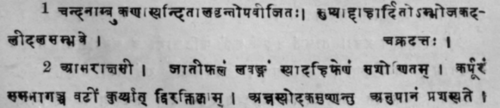
In diarrhoea and cholera the following, called A'marάkshasi,2 is used. Take of opium, nutmeg, cloves, cinnabar and camphor, equal parts. Beat them into a mass with water, and make into four-grain pills.
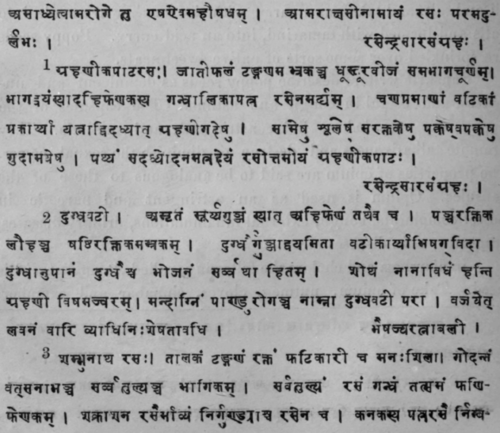
In chronic diarrhoea and dysentery, the following called Graham hapata rasa,1 is recommended. Take of nutmeg, borax, prepared talc and datura seeds, each one part, opium two parts, and make into two-grain pills with the juice of Paederia foetida (prasάrani). In diarrhoea with anasarca the following, called Dugdhavati, is much used by the Kavirajas.
Dugdhavati.2 Take of opium and aconite, twenty-four grains each, prepared iron ten grains, prepared talc twelve grains. Beat them into a mass with milk and make into four-grain pills. One pill is to be given every morning with milk. The diet is restricted to milk alone, water and salt being prohibited. In fever with diarrhoea, opium is used in combination with arsenic, as for example in the following preparation.
Sambhunάtha rasa.3 Take of orpiment, realgar, cinnabar, white arsenic, borax, aconite and alum each, one part, mercury, sulphur and opium, each seven parts. Soak them for seven days in each of the following fluids, namely, juice of the leaves of Cannabis sativa, Vitex Negundo, datura and nim. Make into two-grain pills. These are given with ginger juice in diarrhoea with high fever.
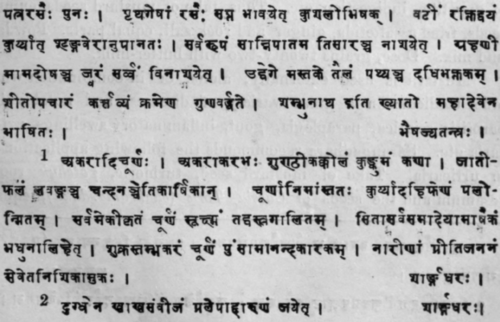
Akarάdi churna.l Take of pellitory root, ginger, seeds called (kakkola), saffron, long pepper, nutmeg, cloves and red sandal wood, each two tolas, opium eight tolas. Rub them together and pass the powder through a cloth. Then add sugar, equal in quantity to all the above ingredients. Dose grains six to twelve, with honey. This medicine is used as an aphrodisiac.
Opium enters into the composition of some external applications in the form of paste, along with other medicines. A poultice made of poppy seeds with milk is prescribed by Saran-gadhara in porrigo of the scalp.2
The Amritasagar recommends the following preparation of opium in diabetes. Take of camphor and musk, each one part, opium and mace, each four parts. Make into two-grain pills. They are administered with the juice of betel leaves.
Continue to:


My Books

