


Nat. Order. Piperaceae. Piper Nigrum. Linn. Sans
Description
This section is from the book "The Materia Medica Of The Hindus", by Udoy Chand Dutt. Also available from Amazon: The Materia Medica Of The Hindus.
Nat. Order. Piperaceae. Piper Nigrum. Linn. Sans

Maricha,

Ushana.
Vern. Golmarich, Beng. Kalimarich, Hind.
The use of black pepper as a condiment is too well known to require any notice here. Medicinally it is much used in combination with long pepper and ginger, under the name of trikatu or the three acrids. In fact, as any reader who has gone through these pages must have noticed, very few compound prescriptions are free from the three myrobalans, and the three acrids, which seem to be added often without reason, and sometimes for the sake of rhyme. Black pepper is described as acrid, pungent, hot, dry, carminative and useful in intermittent fever, haemorrhoids and dyspepsia. Externally it is used as a rubefacient in alopecia and skin diseases.
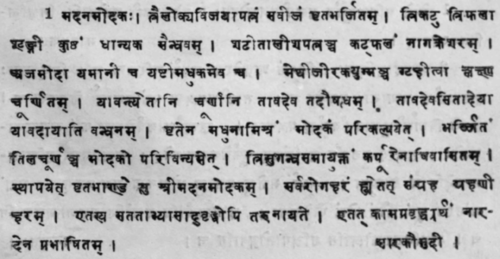
In intermittent fever, black pepper in doses of about a drachm, is recommended to be given with the juice of the leaves of Ocimum sanctum (tulasi), or Leucas linifolia (dronapushpi).1 It enters into the composition of numerous prescriptions for dyspepsia, piles and indigestion. The following is an example.
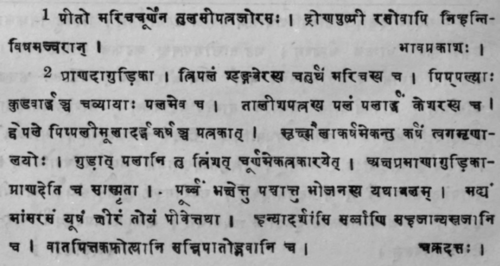
Prάnadά gudikά.2 Take of black pepper thirty-two tolas, ginger twenty-four tolas, long pepper sixteen tolas, Piper Chaba (chavya) eight tolάs, leaves of Pinus Webbiana (tάlisa) eight tolas, flowers of Mesua ferrea, (nάgakesara) four tolas, long pepper root sixteen tolas, leaves called tejapatra and cinnamon one tola each, cardamoms and the root of Andropogon muricatus, (usira) two tolas each, old treacle two hundred and forty tolas; rub them together. Dose, about two drachms. This confection is given in haemorrhoids. When there is costiveness and a sense of heat, chebulic myro-balan is substituted for the ginger in the above prescription.
The bald patches of alopecia are recommended to be rubbed with some rough leaves as of Streblus asper (sάkhota) and then sprinkled over with powdered black pepper.1
Continue to:


My Books

