


Trichosanthes Dioica, Roxb. Sans
Description
This section is from the book "The Materia Medica Of The Hindus", by Udoy Chand Dutt. Also available from Amazon: The Materia Medica Of The Hindus.
Trichosanthes Dioica, Roxb. Sans

Patola. Vern. Palwal, Hind.
The Trichosanthes dioica is extensively cultivated as an article of food in Bengal. The unripe fruits are much used by the natives as a culinary vegetable and are considered very wholesome and especially suited for the convalescent. In fact they constitute one of the most palatable vegetables grown in this country. The tender tops are also used as a pot-herb and are regarded as tonic and vermifuge.
The leaves, fresh juice of the fruits and the root are all used medicinally. The leaves are described as a good, light and agreeable bitter tonic. The fresh juice of the unripe fruit is often used as a cooling and laxative adjunct to some alterative medicines such as the preparation called Rasa sindura, etc. The bulbous root is called Ramyaha in Sanskrit and is classified amongst purgatives by Susruta.
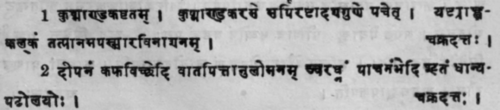
In bilious fever, a decoction of patola leaves and coriander, in equal parts, is given as a febrifuge and laxative.2 The leaves enter into the composition of several compound decoctions for fever. The following called Patolάdi kvάtha is an illustration. Take of patola leaves, red sandal wood, root of Sanseviera Zeylanica (murvά),Picrorrhiza Kurroa (katuki), Stephania hernandifolia (pάthά) and gulancha, each one drachm, water half a seer, boil together till reduced to one-fourth.1
Patola enters into the composition of several compound decoctions for boils and other skin diseases for which it is considered a very efficacious remedy. The following is an illustration. Take of patola leaves, gulancha, mustaka, chiretά, nim bark, catechu, root-bark of Justicia Adhatoda (vasaka), and Oldenlandia herbacea (parpata), equal parts, in all two tolas, and prepare a decoction in the usual way. This decoction is regarded as a valuable alterative, tonic and febrifuge.2
The root is used in combination with Ipomaa Turpethum and other adjuncts as a drastic purgative in jaundice, anasarca and ascites. The following called Patoladya churna is an illustration. Take of the root of Trichosanthes dioica (patola), turmeric, baberang seeds, kamala powder, and the three myrobalans, two tolas each, cinnamon, and the root of the indigo plant, three tolas each, Ipomaa Turpethum (trivrit) four tolάs; powder the ingredients finely and mix. Dose, about one drachm with cow's urine. After the use of this medicine, light food only (such as gruel) should be taken.3

The fresh juice of the leaves of Trichosanthes dioica is recommended by several writers, to be applied to the bald patches of alopecia.1
Continue to:


My Books

