


Caffeina
Description
This section is from the book "Laboratory Manual Of Pharmacology", by A. D. Bush. Also available from Amazon: Laboratory manual of pharmacology.
Caffeina
Caffeine is a xanthine compound derived from the dried seeds of Coffea arabica (Fam. Rubiacecc), a native of Arabia. It is also obtained from the leaves of Thea sinensis (Fam. Ternstraemiaceac); an Asiatic shrub. It also occurs in other plants, and may be prepared synthetically.
By treating Caffeine with citric acid in hot water there results a substance of loose chemical structure known as Citrated Caffeine.
Properties: | |
Caffeine: | Citrated Caffeine: |
Appearance....................................................................................... | Appearance........................._............................................................... |
Color ......................................................................................................... | Color ......................................................................................................... |
Odor ......................................................................................................... | Odor ......................................................................................................... |
Taste........................................................................................................ | Taste ......................................................................................................... |
Solubility: | Solubility: |
4 H2O............................................................................................... | 4 H2O................................................................................................ |
8 H2O ................................................................................................ | 8 H2O ................................................................................................ |
25 H2O............................................................................................. | 25 H2O............................................................................................. |
50 H2O............................................................................................. | 50 H2O............................................................................................. |
Hot H2O ....................................................................................... | Hot H2O ....................................................................................... |
C2H5OH .......................................................................................... | C2H5OH.......................................................................................... |
Caffeine is a stimulant to respiration, kidney activity, and cerebrospinal reflexes. It also seems to improve vascular conditions when the circulatory system is functionally enfeebled. Dose of Caffeina, 0.15 Gm.; of Caffeina Citrata, 0.3 Gm.
Other Official Preparations.
Caffeina Citrata Effervescens. Dose, 4 Gm.
Caffeinae Sodio-Benzoas. Dose, by mouth, 0.3 Gm.; hypodermic, 0.2 Gm.
This latter substance is a mixture of about 46% anhydrous caffeine and about 54% sodium benzoate.
Two other xanthin products are the official Theophyllina, found in small amounts in tea leaves, and also made synthetically; and Theobromine, derived from Theobroma Cacao, with an official salt, Theobrominae Sodio-Salicylas. These two substances are both dimethylxanthine. They possess but little advantage over the trimethylxanthine Caffeine, though a more marked diuretic action, with no cerebral effect, is claimed for theobromine.
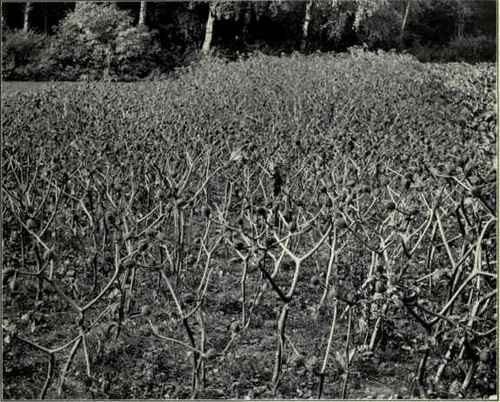
By permission of Burroughs Wellcome Co.
Stramonium Plants In Fruit (Datura Stramonium).
Continue to:


My Books

