


Caffeine. Part 2
Description
This section is from the book "Materia Medica: Pharmacology: Therapeutics Prescription Writing For Students and Practitioners", by Walter A. Bastedo. Also available from Amazon: Materia Medica: Pharmacology: Therapeutics: Prescription Writing for Students and Practitioners.
Caffeine. Part 2
Medulla
Caffeine stimulates strongly the respiratory center, and slightly the vasoconstrictor and the vagus centers.
Spinal Cord
Caffeine stimulates the motor cells and promotes the passage of impulses through the spinal cord in the same manner as strychnine, but to a much smaller degree. (See Strychnine for more detailed study of this property.) It therefore increases reflex activity, and tends to improve the "tone" of muscle; and in marked amounts may cause twitching of the limb and face muscles. In the laboratory it is often noticed that an animal lightly anesthetized with ether or chloroform will become conscious and recover its reflexes if a hypodermic of caffeine is administered.
Muscle
If the gastrocnemius of a curarized frog is painted with a weak solution of caffeine, or if caffeine is injected into its supplying artery, the muscle will contract more promptly and to a smaller stimulus, and will lift a heavier load, i. e., its irritability and its strength are increased by the direct action of the drug. The total work of the muscle before fatigue sets in is also increased. Such direct stimulation occurs in both striated and cardiac muscle, but not to any great extent, if at all, in smooth muscle, though the latter may be improved in tone (Sollmann says that smooth muscle is stimulated). From overdoses the typical phenomena of fatigue come on early, the muscle being poisoned. In frogs, large doses induce a stiffening of the muscle like that of rigor mortis; in mammals this effect is not seen, as death takes place before this stage is reached.
Power And Endurance
Human experiments with the ergo-graph show greater power and greater endurance of the finger muscles. In comparative experiments with whole companies of soldiers on the march under like conditions, Leistenstorfer, for the German government, found that when the soldiers were well supplied with food, those that were given tea or coffee could endure more prolonged and more severe marches than those that did not get tea or coffee. If no food was supplied, fatigue appeared first in the tea- and coffee-drinkers. That is to say, tea and coffee increased the power for continuous physical work so long as the supply of nutritive material was ample, but caused early exhaustion when food was withheld.
Caffeine thus may act to increase the capacity for work in several ways, viz.: 1. By increasing mental vigor. 2. By stimulating the motor areas of the brain and so increasing the range and control of voluntary acts. 3. By increasing the motor activity of the cord and so improving the tone of muscle. 4. By directly stimulating the voluntary muscles themselves.
Circulatory System
In the isolated heart, the beats under caffeine are increased in frequency and are stronger, i. e., the heart will contract against a greater aortic pressure. As this is the result whether the vagus and accelerator endings have been paralyzed or not, it must be due to direct stimulation of the heart muscle. In the intact mammal, after a good-sized dose, the rate is not much accelerated and may even be slowed, the effect being the resultant of a mild stimulation of the vagus center and mild stimulation of the muscle. Repeated medicinal doses, like the habitual drinks of tea and coffee, have, as a rule, little if any effect on the rate, the force, and the output of the heart.
In some cases the heart muscle stimulation is pronounced after a single dose or a cup or two of coffee; and it is possible that in these cases the increased heart action is largely due to increased flow through the coronary arteries. But sometimes the only results in human sickness are nervousness, wakefulness, cardiac discomfort, and palpitation. Pilcher says that in shock the danger of cardiac death is increased by caffeine.
Enormous doses bring about depression of the heart muscle with slowing, and partial heart-block has been reported in animals. But the author has some clinical evidence that caffeine opposes the good action of digitalis in impairing conduction in cases with auricular fibrillation; and in cold-blooded animals, C. C. Lieb has repeatedly, with caffeine, removed a heart-block that had been produced with cocaine. Barton has recently reported the removal by caffeine of various digitalis arhythmias and heart-block.
Arteries
The vasoconstrictor center is moderately stimulated, so that the arteries may contract and raise arterial pressure. Sollmann (1910) says that there is a general peripheral vasodilator action that overcomes the effect of stimulation of the vasoconstrictor center. A hypodermic injection of 5 grains (0.3 gm.) of the citrated caffeine, or of the caffeine and sodium benzoate, has usually resulted in a slight slowing of the pulse with no measurable effect on arterial pressure. Rarely the pressure rises as much as 10 mm. of mercury. Whether or not it would have greater power than this to bring a low blood-pressure to normal is problematic. At the same time this dose of 5 grains sometimes induces undesirable nervous effects, and cannot be repeated at very close intervals without risk of overstimulation of the cerebrum and spinal cord.
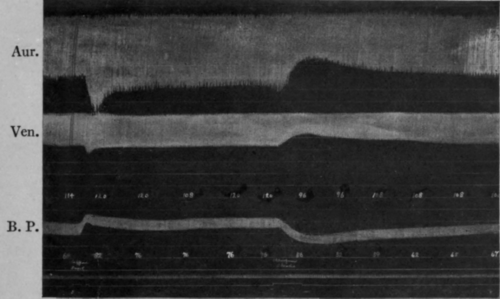
Fig. 33. - Caffeine, 5 mg. per kilo, resulted in increased contractility of auricle and ventricle (down-stroke), and a rise in blood-pressure from 68 to 82 mm. The effect was somewhat lasting. Chloroform, 10 breaths, diminished the contractility of both auricle and ventricle, and caused a fall in blood-pressure from 76 to 56 mm. (Tracing made by Dr. C. C. Lieb.)
Caffeine never constricts the arteries that are not under the control of the vasoconstrictor center, viz., those of the lungs, the cerebrum, and the heart. Pilcher and Sollmann find that the systemic arteries are dilated by a peripheral action. In experimental work the coronary arteries are regularly dilated, and this may be an important factor in the emergency stimulation of the heart. Cushny suggests that the dilatation may be secondary to the direct cardiac stimulation. The arteries of the kidneys are also dilated. Means and Newburgh have shown that caffeine increases the blood flow in humans; yet Christian {verbal communication) got no change in the blood-flow in the arm after 15 grains (1 gm.) given to students.
Continue to:


My Books

