


Administering Powders
Description
This section is from the book "The Art Of Dispensing", by Peter MacEwan. See also: Calculation of Drug Dosages.
Administering Powders
It is the practice of many parents to give powders mixed with jam to children ; there is no objection to this, provided the ingredients are compatible with the jam ; but it should be borne in mind that many children's powders contain magnesia or bicarbonate of sodium, and the acid present in all jams would combine with and alter the action of a portion of these ingredients. The simplest way to give a powder is to make a small draught of it with sugar and water. Treacle is sometimes recommended, but is objectionable in some cases owing to its alkalinity. These old remarks in regard to administration bring us to a topic which it was vain to write about thirty years ago, viz:
Cachets.
The late Mr. Henry Groves, of Florence, writing to The Chemist and Druggist, July 27, 1888, remarked:
We have coated our pills and we are now thinking of starch shirts for our powders, in the wafers used for that purpose for so many years on the Continent. Until a few years ago people were content to wrap up the powder themselves, depositing it in the centre of a damped wafer and folding over the edges so as to form a sort of oyster, which, floated in a spoon with a little water, was as easily swallowed as the bivalve itself. Now, however, under the auspices of elegant pharmacy, the shirt is often put on by the pharmacist himself in the form of a 'cachet,' . . . the result being an elegant morsel which, moistened with water, is taken as in the old system.
Cachets were invented by Limousin, of Paris, in the early 'seventies, and many attempts were made to introduce them into this country up to the time Mr. Groves wrote; but it was not until 1891, when the 'Morstadt' cachet-closing apparatus was offered, that the advantages of cachets began to be appreciated, and since then they have so grown in favour that no dispensing-counter is complete without a cachet-apparatus.
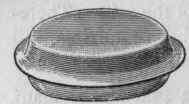
Closed Cachet.
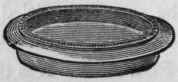
Half Of A Koseal.
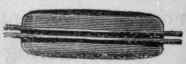
Closed Koseal.
The one illustrated on page 177 is the 'Morstadt.' A cachet is made of two plate-shaped forms of rice-paper and when filled looks as shown in the first of the above figures. 'Koseal ' is the name given to a cachet with a raised rim, the advantage of which is that the edges do not get such a superfluity of moisture as to curl. The first step in filling cachets is to place the halves in the holes of the apparatus. This is being done in the first of the annexed figures, b being the bedplate which holds those that are to receive the powder, a for those which will make the cover, and c covering-plate which is placed over b while the cachets are being filled with powder, in the manner shown in the second of the figures. This prevents the powder getting on the edge of the cachets, c is then lifted up as shown in the next figure and the lids moistened with a damp roller. A considerable nicety is required in damping cachets : too much moisture makes the edges curl, and if the moisture is insufficient the two halves will not adhere.
A good plan is to dip a piece of paper in water, drain it, shake off superfluous moisture two or three times vigorously, lay it upon the upper halves of the cachets, press once with the roller, remove the paper, and quickly turn over the top of the machine and press steadily for a few seconds. Then remove the cachets as shown in the next illustration. If the damping of the rim be carefully performed, the edges need not get any moisture, and, in addition to not curling, they offer the advantage of becoming soft more quickly than the double edge of the cachet when moistened for swallowing.

Putting In The Cachets.

Filling With Powder.
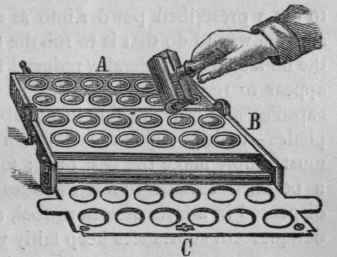
Moistening The Lids.

Pushing Out The Finished Cachets.
Cachets are made of various sizes. It is the dispenser's duty to get a prescribed powder into as small a cachet as possible, and the way to do that is to rub the substance well in a mortar, the bulk being considerably reduced thereby. Some prescribers appear to regard cachets much in the same way as they do capsules, and order deliquescent substances- e.g., glycerophosphates- to be put up in them. When that happens the dispenser must simply make the best of it; fortunately the cachets have a polished surface which excludes air well, and if they are dispensed in a layer of cotton-wool, a small number containing deliquescent substances keep fairly well for a few days.
Continue to:


My Books

