


Finishing And Coating Pills
Description
This section is from the book "The Art Of Dispensing", by Peter MacEwan. See also: Calculation of Drug Dosages.
Finishing And Coating Pills
The massing of the ingredients constitutes the more important part of pill-making, and the rest reflects the dispenser's manipulative dexterity. The work of rolling, cutting, and rounding is not arduous, and it is unnecessary to describe these operations in detail, for deftness in respect to them can only be acquired by practice; but a few hints to students of pharmacy will not be out of place.
A pill-mass is not finished until it is perfectly uniform in appearance. The best mass is one which comes out of the mortar leaving little on the mortar and pestle.
Weigh the mass as soon as it is ready for rolling. This is a good check, and is necessary when the mass is to be divided into more than the number of pills which the machine cuts at a time.
See that the bed of the pill-machine, the roller, and cutters are free from adhering pill-mass, which is detrimental to a good finish.
In rolling, reverse the pipe two or three times, so that the left side may not be thicker or thinner than the right side. (Few people have a left arm as powerful as the right, hence greater pressure is exerted with the latter.)
The pipe should be exactly of the length to cover the number of grooves required. The ends should not be within the last cutting edges but slightly upon them.
Avoid French chalk alone in rolling, and use as little powder as possible. (A pepper-caster is best for sprinkling.)
The cutters should be free from jagged edges and not blunt. The finish greatly depends upon this condition.
Try to round the pills as much as possible during the cutting process by using the cutter gently and at moderate speed.
Check the result by putting the two pills from the ends of the lot on one scale-pan, and the two from the centre on the other scale-pan. See how they balance. Also count the pills.
In finishing with the rounder, press gently and turn as if making the figure 8, but do not reverse the turning.
Pills containing much resinous matter should not be subjected to great friction. Pills otherwise perfect sometimes acquire their falling faculty in the rounding process, owing to friction working changes.
The lid of a chip box furnishes a fair makeshift pill-rounder.
Use the minimum of sprinkling-powder. An excess, especially of fluffy vegetable powder, may provide the patient with a distressing insufflation as well as a pill.
Never silver pills unless so ordered, but varnish as often as permissible and possible. Pills containing deliquescent substances should invariably be varnished.
Varnishing Pills.
The pills should be thoroughly well rounded and free from powder. Ensure the latter by shaking them on a muslin sieve (page 168), Place in a covered pot a few drops of the varnish, sufficient to wet all the pills, drop the pills in, and rotate the pot so as to cover all the pills equally. The pills are then transferred to an earthenware developing-dish, so that they may be detached from each other, and occasionally turned until the coating is quite hard.
To give the varnished pills a bright polish, they may be transferred from the covered pot to a brass pill-finisher, such as the one devised by Mr. F. W. Goodess, of Leicester (The Chemist and Druggist, 1894, II. 640). This is a warming-pan 6 inches in diameter and 2 inches deep, with a spout, and fitted with hinged lid and handle. It should be made of copper, tin-lined. Immediately on transferring the wet varnished pills to the finisher, the latter is rotated quickly over a Bunsen or spirit-lamp flame (the heat being adapted to the kind of pill), and in a minute or so the pills dry with a bright polish. A good and cheap drier for pills is made by soldering a shallow porcelain evaporating-dish into a small tin pan with side tube for pouring in water and letting off steam, and provided with a handle. Water is put in the pan, and brought to the boil, while the mass is being rolled and made, and the varnished pills are transferred to the dish and gently shaken to dispel solvent. The following are the best varnishes:
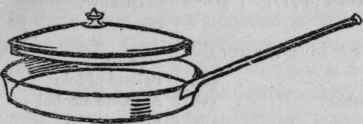
The Goodess Pill-Finisher.
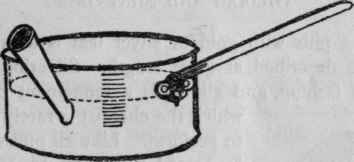
Water-Bath Pill-Drier.
I. | |
Tolu-syrup residues................ |
|
Ether (meth.).......................... |
|
Dissolve and filter or decant after standing. | |

 iij.
iij.11. | |
Balsam of tolu (old)............. | 3ss. |
Gum sandarac.......................... | 3v. |
Ether .............................................................. |
|
 vj.
vj.Dissolve and filter.
[Tr. tolu. 3ij. may take the place of the balsam, in this case reducing the ether to half.]
III. John Bell & Co.'s Formula. | |
Sandarac ....................... | . |
Methylated chloroform | • |
Methylated ether (0.717) | • |
Dissolve. | |


IV. Squire & Sons'formula. | |
Sandarac ....................... |
|
Absolute alcohol .............. | • |
Ether .................................... | • |
Dissolve. | |


v. | |
Sandarac ............................. | • |
Alcohol (90-per-cent.) . ..... | • |
Dissolve. ...................... | |


VI. | |
Mastic ........................... | 5 parts |
Balsam of tolu ................. | 15 parts |
Absolute alcohol .............. | 25 parts |
Ether ................................. | 80 parts |
All by weight. Dissolve.
The varnishes containing ether are the quickest driers. Martindale's varnish is like No. V., but has absolute alcohol 1 ounce by weight.
Continue to:


My Books

