


Pills And Their Excipients General Observations. Part 2
Description
This section is from the book "The Art Of Dispensing", by Peter MacEwan. See also: Calculation of Drug Dosages.
Pills And Their Excipients General Observations. Part 2
Rolling
The pill-tile and the pill-machine are the next instruments required in pill-making, for the purpose of dividing the mass into the requisite number of parts. The tile is an exceedingly useful bit of apparatus in the hands of some dispensers, for they can with the spatula roll and cut a tiny mass on it quicker than with the machine. Where little dispensing is done, so that there is not a variety of rolling-machines, the tile is virtually indispensable. The form of pill-machine almost universally used is also illustrated. The kind with adjustable edges and the tray movable is the best. For oval pills the cutters are made wider and shallower. In cutting the roll should occupy fully the number of spaces actually required.
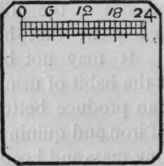
Pill-Tile.
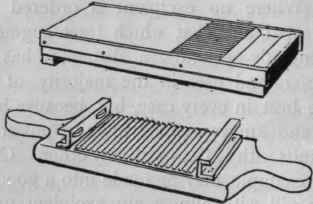
Pill-Machine.
It is difficult to roll a mass for 1 or 2 grain pills upon a 4 or 5 grain pill-machine. To meet this disadvantage the pill-roller next figured in section has been suggested. This little instrument is a roller made of hard wood 3 inches broad, and as long as desired, the handle being securely fixed into the bottom piece with glue.

Another good idea for a roller is a piece of beechwood about 3/8 inch thick, 6 inches long, and 4 inches broad. A leather strap is nailed to each side, and goes across the top. Under this four fingers of the hand are placed, and the thumb fits on one side to steady it. For working up masses or rolling weighed portions into pipe it is excellent, because the pressure can be applied as desired.
Still another idea has been put forward. It is to insert into the bed of the machine a piece of mahogany board (about 1/8 inch thick) made the required size so that it may slip into the machine and be a tight fit. By this arrangement the ordinary roller can be used, and 1-grain pills are rolled out quite easily. The same end is attained by the machine with adjustable sides; the disadvantage of it is that the cutters are too wide, and each pill has to be rounded with the fingers.
Rounding
Pills are generally rounded with a pill-rounder. Rounding pills with the fingers is only permissible in such a case as has just been mentioned or when the mass crumbles under the rounder- which is not good pharmacy. The ordinary rounder has a deep and a shallow side, so that large and small sizes may be rounded with it; but if either side is too deep, a piece of cardboard may be inserted. The French pill-roller shown below can be adjusted to suit any size of pill. The cut pills are laid on the tray, sprinkled with a little powder, and, when covered by the roller, are rapidly, and with slight pressure, revolved.
Powder is used to prevent pills sticking to each other, and, to some extent, to conceal their taste. When no particular powder is ordered, lycopodium is used in Germany. Cinnamon, liquorice, magnes. carb. levis, French chalk, and a mixture of starches are all used- the French chalk, perhaps, more than any other. The objection to it is that it makes the slab very slippery; but this can be overcome by the addition of a little powdered starch. Two parts of powdered starch and one of French chalk make a good pill-powder; another is a mixture of equal parts of powdered sugar and cornflour. Use a powder-dredger for distributing. A pill-sieve is sometimes employed to remove excess of powder.
Pills with hygroscopic, strong-smelling, or volatile ingredients should always be dispensed in bottles.

Small Quantities of ingredients, such as a fraction of a grain of a powerful medicament (strychnine, mercury perchloride, &c), should be intimately mixed with sugar of milk and massed with soft manna. Sugar of milk, in crystals or coarse powder, is most useful for dividing any active ingredient when making pills. A mortar and pestle with perfectly smooth grinding-surfaces should be selected, and the strychnine (for example) lightly powdered; an equal quantity of coarse sugar of milk should be added, and lightly triturated until none adheres to the mortar; then powder carefully, add a little more coarse sugar of milk, triturate lightly until mixed and detached from the mortar, then powder, and mix thoroughly with any other powders that may be ordered in the pill.
Hot-plate - A casserole water-bath (see page 184) is convenient for evaporating certain pill-masses to suitable consistence, adding a little tragacanth if necessary. Many operations in pill-making, especially in the case of large masses, are greatly facilitated by the use of a smooth slab of iron- say, 9 inches square of 1/4-inch boiler-plate; it is quickly warmed over a gas-furnace, and as soon as the plate is hot enough (as may be judged by the ringer) the gas is put out, and the mass placed upon it. The mass is then thoroughly kneaded with a spatula. The illustration given here shows the hot-plate kneader made by Pindar and the manner of using it. Pill-manufacturers employ this apparatus for massing some kinds of pills, such as those containing much aloes, colocynth, asafetida, or galbanum. It is useful to employ heat in massing resinous substances, which are hard and brittle in the cold. They may be rolled on the hot iron slab and made into pills without the aid of a liquid excipient, but most of them require the addition of fibrous material, such as liquorice powder or lycopodium, to prevent their falling.
The hot-plate should not be used for masses containing aromatic or other volatile active principles.

Hot-Plate For Pill-Masses.
Substances which are decomposed by iron, such as corrosive sublimate, calomel, silver nitrate, copper and bismuth salts, must not be mixed in an iron mortar.
Salts easily soluble in water require very careful addition of any aqueous excipient, and excipients containing glycerin should be avoided or used very sparingly with soluble salts.
Soft Masses
Crystallised salts, fluid acids, and soft extracts, with a vegetable powder, often make a mass of pasty consistence, which may right itself on standing ten to fifteen minutes. Time should always be given for a vegetable powder to imbibe moisture. For soft masses a desiccator, such as that in use for drying precipitates, etc, in the laboratory, is a most useful adjunct to the dispensing-counter. A very soft mass, cut into pills, and placed in a desiccator over strong sulphuric acid for twelve hours, has frequently turned out well. This treatment is especially applicable when pills contain deliquescent salts. It rarely happens, however, that one can wait a day in order to get a pill of suitable consistency, and such soft masses can more conveniently be dispensed in capsules.
Continue to:


My Books

