


Suppositories, Bougies, And Pessaries. Part 2
Description
This section is from the book "The Art Of Dispensing", by Peter MacEwan. See also: Calculation of Drug Dosages.
Suppositories, Bougies, And Pessaries. Part 2
Methods of Preparation. Suppositories are made either by pouring the liquefied mass into a suitable mould or by pressing a powdered mixture of the ingredients into the mould (cold method). In the former way it is not advisable to melt the basis by the direct heat of a spirit-lamp or Bunsen burner, the temperature of a water-bath sufficing and being safer. An earthenware casserole is the simplest dish to use for melting the basis; this may be heated over a flame if asbestos mill-board is placed between the two, but better over a simple water-bath, such as the one figured below, which is made of copper, the outside diameter being 4 inches, the depth 1 1/2 inch, and the rim 1/2 inch wide. Learoyd's suppository-pan is a water-bath, but is more adapted for the manufacturing scale than for the dispensing-counter. The extemporised arrangement figured here consists of a 1-lb. vaseline tin, supported by a tripod. An ordinary porcelain evaporating-dish is used for melting the fat, but a casserole may also be employed. Another method of using the casserole is shown in the next figure. This consists of a casserole (or evaporating-dish to which a handle is secured) with a tin rim to support the dish when it is put into the tin pan containing the water.
An improvement upon this is the Martindale suppository-pan, made entirely of tinplate.
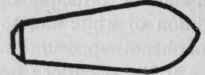
Wellcome Shape.
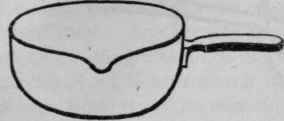
Earthenware Casserole.
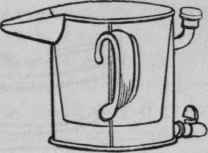
Learoyd's Suppository-Pan.
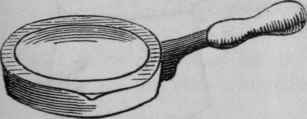
Copper Water-Bath.
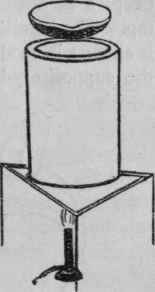
Extemporised Water-Bath.
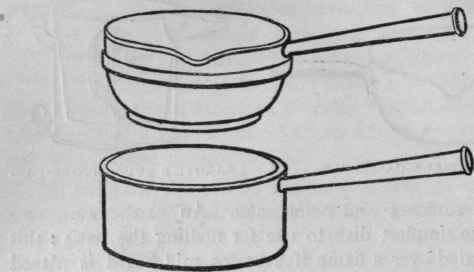
Casserole Water-Bath.
The pan on the right is the water-bath, which is 1 1/2 inch deep, 2 inches diameter at the bottom, and 1 13/16 inch at the top. The handle is 3 1/2 inches long. Half an ounce of water is all that is needed for this pan. The lipped pan for holding the suppository-basis is 1 1/2 inch deep, 2 inches diameter at the top, and 1 1/2 inch at the bottom. The spout of the pan is 3/4 inch wide where it joins the pan, 1/4 inch deep, and it narrows to 1/4 inch, so that it is easy to fill the mould- in fact, this is a perfect suppository-pan for the dispensing-counter. (See The Chemist and Druggist, 1892, II. 273.)
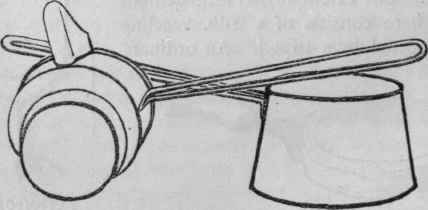
Martindale Suppository-Pan.
The Mould is the next requisite in suppository-making. Metal moulds are the best, but it is a good pharmaceutical accomplishment to be able to make a mould of any size when wanted. The French do that by twisting paper into cones (as in making a paper bag), and sticking each cone into a box of linseed meal. Another way is to make some suppositories of white wax ; then take a box of suitable size, about 1 inch deep, and nearly fill it with plaster of Paris, made very thin with water. Next place the wax suppositories at equal distances apart along one side of the box, leaving them half above the plaster; allow to set hard, and oil the surface of the plaster well. Now raise the sides of the box by rolling brown paper round it, then pour in more plaster. After the plaster has properly set separate the parts, trim them up with a knife, and boil for at least half an hour in linseed oil to toughen them. In trimming the edges of the mould two notches should be made on each side so as to fix them properly when the mould is required. After casting and cooling the suppositories the top half is lifted off first, and the suppositories pushed out from the bottom.
Another plan, as in making bougie-moulds, is carefully to wrap tinfoil round an elastic bougie, and place the foil with its mould in a box of chalk. As the elastic bougie is of the same thickness nearly all its length, there is considerable difficulty in drawing off the mould from the model, and the sides of the mould are drawn together. This trouble may be obviated by using a piece of glass tubing the size of a No. 8 bougie. First draw out the end to a point and cut it off about 1/8 inch from where the narrowing begins, then fuse again until the end is rounded off as the bougie is to be, taking care not to allow the aperture to close. This tube now forms the model upon which to shape the tinfoil moulds. The tinfoil slips more easily from the glass than from elastic gum, and the little hole at the apex allows air to enter as the tube is withdrawn. The late Dr. H. Bowman Brady had a gunmetal mould made for him in 1865, but it is claimed that Chapman, a Cincinnati pharmacist, made one in 1854. Brady's mould is shown on page 189. It is made in two pieces, which are hinged together at the base. This is the form now generally in use.
Continue to:


My Books

