


Suppositories, Bougies, And Pessaries. Part 3
Description
This section is from the book "The Art Of Dispensing", by Peter MacEwan. See also: Calculation of Drug Dosages.
Suppositories, Bougies, And Pessaries. Part 3
An American style consists of a circular metal box pierced with holes into which thimbles fit (see illustration). The box can be filled with iced water or a freezing-mixture. The thimbles are filled with the suppository-mixture, dropped into the box, and owing to the chill the contents of the mould contract, and are easily tapped out when solid. A much better idea is the 'Cygnet' mould, in which the mould consists of two nickelled metal plates so formed that each is the mould for half a suppository, and two together make the whole. The pair (or as many pairs as are required) are fitted into a holder as shown in the illustration. The whole apparatus is made to rest upon a tin bath which can be filled with water or ice and water to chill the suppositories. The moulds are made in several shapes ; two are illustrated, one of them being pear-shaped. An excellent idea was once put forward in The Chemist and Druggist for modifying the Brady mould- viz., to keep it the same diameter as for a 15-grain suppository, but to double its length.
The mould thus becomes a nasal-bougie mould but can be used for any smaller size of suppository.

The Cold Method of suppository-moulding is one of pressure. The old-fashioned or French mould is formed of two hollowed-out pieces of metal or hard wood, wedgeshaped externally, so as to fit into a stout ring. The weighed quantity of material is pressed well into the mould by means of the stopper, as shown.
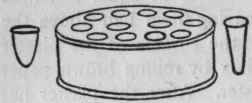
Parrish's mould.
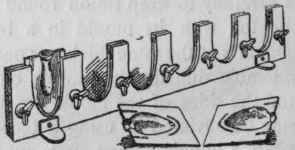
'Cygnet' Mould With Removable Matrices.
Much more elaborate apparatus is now obtainable for cold moulding. In this case the medicament is powdered and mixed well in a mortar with shredded or granulated cocoa-butter (which can be bought in the granulated state). The mass is placed in the cylinder of the machine, b, to the bottom of which a circular mould is attached; by screwing the lever the mass is pressed into the holes of the mould. By removal of the bedplate e and giving the screw a turn, the finished suppositories are pressed out of the mould. The apparatus illustrated is one of several on the market.
Bougies are made in these machines by attaching to the base of the cylinder a plate in which there is a circular orifice about 1/8 inch diameter. On turning the lever the mass comes out through this orifice as a pipe, and is cut into the requisite lengths. If the dispenser cannot get such special apparatus, suppositories can be made by cold compression thus: insert a brass screw-nail (with head of less diameter than an ordinary metal suppository-mould) in an awl-handle; also take two pieces of card the length of the suppository-mould, and bend back at the level of the mould to an angle of 450; put a piece each side of the mould, and protect the ends similarly.
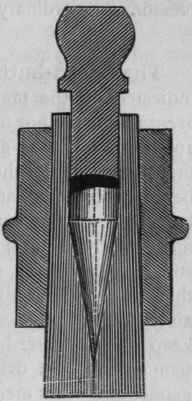
French Mould.
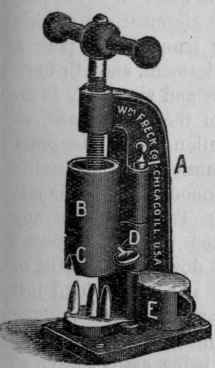
' Freck ' Suppository-Moulder.
Tie round with string, put the powdered mass into this trough, and fill each of the holes by pressing with the screw-nail compressor. The ordinary mould-lubricants should be used.
The Cocoa-butter Basis is used when none is specially indicated on the prescription. The following is the modus operandi for the hot method :Weigh the basis (using at least 16 grains for a 15-grain suppository), and melt as already indicated ; then, if the prescribed medicament allow, it should be finely powdered, and rubbed down with a little of the melted basis to a creamy consistence on a pill-tile which has been made nearly as warm as the hand ; transfer this mixture while still creamy to the suppository-pan, stir until it begins to thicken, then pour into the mould. If an aqueous extract is an ingredient, proceed as follows: Melt the cocoa-butter, and keep on the water-bath until required (it must be kept at a temperature just over its melting-point); rub the aqueous extract and other medicament with a little water on a cold pill-tile to creamy consistence, transfer to an ointment-slab (which has been warmed in water to the body temperature), pour a little of the melted basis upon the medicament, and stir until it begins to thicken ; manipulate rapidly and vigorously as an ointment, gradually adding the whole of the melted basis, so as to produce a perfectly uniform preparation before it becomes harder than a soft ointment; quickly transfer the whole to the dish, and warm cautiously, stirring continuously, until it is just fluid enough to pour into the mould.
Tannic acid, or any other incompatible, must not be mixed with the aqueous extract: it should be separately rubbed down with a little of the melted basis on a slightly-warmed slab, and added just before pouring into the mould. Some dispensers use a quinine-bottle for melting the basis by putting it into a pan of hot water. This receptacle has the advantage of being easily shaken so that the contents can be well mixed.
To get the proper quantity of mass into the mould when it is to be partly filled, have a small sewing-thimble of the requisite capacity, soldered to a bit of wire as a handle, and use the thimble as a ladle for the melted mass.
A well-made suppository will slip readily from the mould, it has a perfectly uniform appearance throughout, and a fine polished surface. To secure this result, careful attention must be paid to the lubrication of the mould and to the method of pouring. If the mould be cold, and its surface highly polished and quite free from grease, no lubricant is needed, or perhaps the inner surface may be breathed upon just before filling ; in either case, the mould should not be opened until plenty of time has been allowed for the suppositories to become thoroughly hard. When this involves too much delay, the mould should be wiped with a piece of lint dipped in olive oil, or it may be coated slightly with a mixture of soap liniment (1 part) and glycerin (2 parts), or a solution of soft soap 1 drachm in an ounce of weak spirit. Too much soap in the lubricant emulsifies the surface of the suppository, and gives it a whitened and uneven appearance ; too little prevents the glycerin from remaining thinly distributed- then the suppositories adhere to the mould, and may break in extracting. The melted suppository-mixture should be poured into the mould just as it is beginning to solidify; if too hot, any medicament not in solution may subside and accumulate at the apex of the suppository.
In very hot weather it will be found necessary to put the filled mould on the floor of a cold cellar for half an hour to cool; but it is usual, when suppositories are urgently required, to place the mould on a plate and surround it with lumps of ice, as shown on page 189. Never put the mould under water until after the suppositories have set.
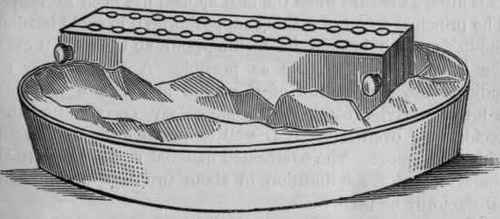
Mould Cooling On Ice.
Continue to:


My Books

