


The Influence Of A Meat Diet On The Kidneys. Part 3
Description
This section is from the book "Food And Feeding In Health And Disease", by Chalmers Watson. Also available from Amazon: Food and Feeding in Health and Disease.
The Influence Of A Meat Diet On The Kidneys. Part 3
The result of this behaviour is that in the case (C) of bread and milk, which contains much less protein, 141 grammes of food had to be consumed, as against 37 grammes by a flesh-fed animal (B) of nearly the same weight.
A | 7786 | grammes. |
B | 7.527 | " |
C | 7.500 | " |
3. The distribution of excreted N between urine and faeces is, however, materially affected by difference in the diet. On a diet of bread and milk much more of the N appears in the fasces than with flesh-feeding. The urinary N bears to the faecal N the following proportion in the three cases: -
A | 16.3 | |
B | 15.8 | |
C | 6.2 | Bread and milk. |
The bulk of the faeces in the animal C was very much greater than in the other two. The same is true of the volume of urine passed. This is seen from the following figures.
A | B | C | |
Cubic centimetres of urine | 15 | 11 | 23 |
Faecal pellets (number of) | 24 | 12 | 52 |
With a flesh diet, therefore, the urine is more concentrated. This was obvious from its high-coloured appearance, as much as from the relatively small quantity passed. On bread and milk there was much more diuresis, and the urine was notably paler in hue. In no case were any abnormal constituents present. It was noticeable, however, that in the meat fed animals the mine had a much Stronger odour As regards the faeces, they were ill-formed, scanty, and very dark with the meat-fed animals, but pale, bulky, and well formed on bread and milk.
General Conclusions
I The prolonged administration of a flesh diet (horse-flesh and ox-flesh) to rats is followed by hypertrophy of the kidneys.
II. This hypertrophy is more pronounced in the second generation of meat-fed subjects.
III. The horse-flesh diet induces in the great majority of animals definite histological changes which affect mainly the epithelial structures of the kidney. These changes are similar to those seen in recognised toxic conditions.
IV. Similar changes of a less pronounced type are present in a small proportion of the ox-flesh-fed subjects.
V. In the kidneys of ox-flesh-fed animals which appear histologically normal by ordinary staining methods, the application of Muir's stain reveals a striking alteration in the secretory granules of the renal epithelium.
VI. There is a noteworthy absence of cirrhotic change in the flesh-fed animals, both in the first and second generations.
VII. The observations on nitrogen metabolism show that the flesh diet throws a special strain on the functional activity of the kidneys, so far as regards nitrogen excretion.
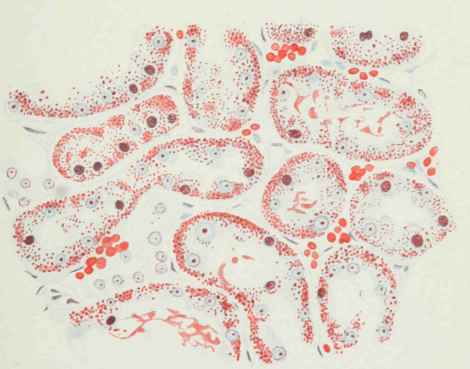
Description Of Plate
Fig. 1. - Kidney of rat fed on a bread and milk diet. Muir's stain. Magnified 400 diameters. Note the size and distribution of the secretory granules in the epithelium of the convoluted tubules. The granules are of uniform size and limited to the deeper part of the cell (compare Fig. 2).
Fig. 2. - Kidney of rat fed on an ox-flesh diet. Muir's stain. Magnified 400 diameters. The granules are not confined to the deeper part of the secrecting cells as in the bread-and-milk-fed animal (Fig. 1), but are irregularly distributed throughout the cell and are also present in the lumen. The granules are considerably larger than in the control subject. Note also the deeper staining of the nuclei.

The Influence of a Meat Diet on the Kidneys.
[face p.586].
Continue to:


My Books

