


Fat
Description
This section is from the book "Chemistry Of Food And Nutrition", by Henry C. Sherman. Also available from Amazon: Chemistry of food and nutrition.
Fat
In digestion the fat is split into fatty acids and glycerol which, however, upon absorption are recombined into neutral fat. It is believed that this recombination occurs during the passage of these digestion products through the intestinal wall. The fat thus absorbed is taken up by the lymph vessels rather than the capillary blood vessels, and is poured with the lymph into the blood. The fat which renders the blood plasma turbid at the height of absorption will usually have passed from the blood into the tissues after a few hours. The fat thus leaving the blood may be burned as fuel, or stored for use as fuel in the future, and a part may be transformed into tissue lipoid or enter into combination with proteins to form some of the chemically more complex substances of cellular protoplasm, cell membrane, or of the central nervous system. The fat burned as fuel serves as a source of energy for muscular work and other activities essentially as does carbohydrate. The average results of a very complete series of experiments by Atwater and his associates indicated that the potential energy of fat was 95.5 per cent as efficient as that of carbohydrates for the production of muscular work.
Oxidation Of Fat
The glycerol from fat is presumably oxidized to glyceric aldehyde which passes to methyl glyoxal, whose fate is doubtless the same in this case as when the same substance is formed in carbohydrate metabolism.
The fatty acid presents a separate problem. Through the work of Dakin, and of Knoop and Embden the "beta-oxidation theory" has been developed and is now generally accepted. According to this theory the fatty acid is attacked by oxidation at the ß-carbon atom with the probable formation first of ß-hydroxy, and then of ß-ketonic acids. Further oxidation at this point must then cause a separation of the α- and ß-carbon atoms; thus two carbons of the original fatty acid break away, presumably to undergo complete oxidation, and there remains a fatty acid with two less carbon atoms than the original. By such a process stearic acid would yield palmitic; palmitic would yield myristic; myris-tic, lauric; and so on to butyric acid. Beta-oxidation of butyric acid would yield successively ß-oxybutyric, and acetoacetic acid. Normally the acetoacetic acid should yield two molecules of acetic, which in turn should burn to carbon dioxide and water.
The sequence of changes from caproic acid to the final oxidation products would thus be as follows:
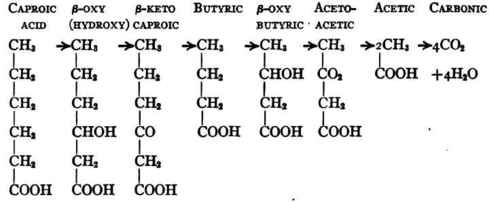
When the normal process is interfered with or overtaxed, another reaction may occur with the formation from acetoacetic acid of carbon dioxide and acetone, which latter like acetoacetic acid and ß-oxybutyric acid sometimes appears in the urine, especially in many cases of diabetes mellitus. The acidosis of diabetes is believed to be due to the ß-oxybutyric acid and acetoacetic acid thus formed. Acetone, acetoacetic acid, and ß-oxybutyric add are sometimes spoken of collectively as "acetone bodies." For further discussion of the intermediary metabolism of fat and of the evidence that the acidosis of diabetes is chiefly due to acids arising from fat metabolism, the reader is referred to Dakin's Oxidations and Reductions in the Animal Body and the chapter on diabetes in Lusk's Science of Nutrition.
Storage Of Food Fat In The Body
That fat derived from the food may be stored as body fat has already been shown (Chapter III (Proteins)) and need not be discussed further here. Recently Mills 1 has found that fatty oils injected with antiseptic precautions into the subcutaneous tissue may under favorable conditions be absorbed therefrom and used in the body in the same way as if obtained by feeding. Whether fat once deposited in the tissues will remain and accumulate, or be returned to the circulation and used as fuel, will depend upon the balance between the food consumption and the food requirements of the organism as a whole. In this respect, there is no difference between fat consumed and deposited as such and fat formed in the body from other food materials.
Can Carbohydrate Be Formed From Fat?
Glycerol is readily convertible into glucose in the body, probably passing through the form of glyceric aldehyde as an intermediate step; but the glycerol radicle represents only about one twentieth of the energy value of the fat molecule.
Whether carbohydrate is ever formed from fatty acid in the animal body is an open question. /
As evidence of such formation of carbohydrate from fat, Hill cites observations upon hibernating animals showing increase of glycogen during sleep, accompanied by respiratory quotients lower than 0.7.
1 Archives of Internal Medicine, Vol. 7, page 694 (1911).
On the other hand, in phlorizin poisoning * and severe diabetes when it would seem that all material in the body capable of transformation into glucose is being thus changed, there does not appear to be a production of glucose from fat (fatty acid). As this latter type of experimentation has been extensively employed while relatively little evidence of the sort cited by Hill has been presented, the trend of opinion is rather away from the view that the animal body can form carbohydrate from fatty acid radicles, or transform fat into carbohydrate beyond the limited amount obtainable from the glyceryl radicles of the fat. It has been suggested that the low respiratory quotients above mentioned may be due to accidental fluctuations, since the blood does not always show the same carbon dioxide content. The question of actual transformation of fat into carbohydrate is not of great practical importance in normal nu- . trition, because under normal conditions fats may be used interchangeably with carbohydrates as source of energy to a very large, though not unlimited, extent.
Continue to:


My Books

