


Lesson 23. Meat As Food What Shall We Do About Meat?
Description
This section is from the book "Food And Health: An Elementary Textbook Of Home Making", by Helen Kinne, Anna M. Cooley. Also available from Amazon: Food And Health: An Elementary Textbook Of Home Making.
Lesson 23. Meat As Food What Shall We Do About Meat?
The price of meat has risen so much in the last few years that this is an important question for everybody, both in the city and country.
Mr. Allen decided to study very carefully the raising of meat. He sent to the Bureau of Animal Industry, U. S. Department of Agriculture, for Bulletin No. 183, which gives very careful directions about butchering the different animals, curing and storing meat for winter, and making products like sausages and headcheese. When the other Pleasant Valley farmers talked about the matter at the Grange, they decided to follow Mr. Allen's example, and sent for this very valuable pamphlet.
Do we need meat as a food? When we can use milk, cheese, eggs, vegetables, fruit, and bread plentifully, there is much less need of meat than many people think. If it is our habit to eat it freely, we should not make a sudden change and leave it off immediately; but most people are much better in health when they eat meat but once a day. Meat gives us protein, fat, and mineral matter. Gelatin, which comes from the bones and tissue, is a protein, which is of use in the body. The juices of the meat which give it flavor have no food value. Some people seem to be able to digest meat more easily than the other protein foods, - fish, eggs, milk, and so on, - but this is not always the case.

Fig. 90. - Mr. Allen bought these tools for cutting meat.
When a great deal of meat is eaten, say three times a day, intestinal trouble may result, and too much acid is formed in the body. People who think that they must eat meat should drink water in large quantities and eat fruit and green vegetables.

Fig. 91 - Cuts of pork.
Little children should not be given meat; for milk, eggs, and grain foods are better for growth, and the meat may take away their liking for these foods. Most people do enjoy the taste of meat, but we can learn to be moderate in its use. There are many human beings who never touch it, and who are well nourished, with bodies strong for work.
The cost of meat. Only when our meat comes from wild animals, who find their own food, is meat an inexpensive food. Even when we kill and use our own animals, we pay for the meat in the food we give to them. The interest on the pasture land which cannot be used for other purposes, and our own labor in caring for animals, housing them, and raising food for them, taken all together make it expensive to eat them. On the other hand, the milk, cream, butter, and cheese that they give us is a less costly food than their own flesh. This is true of beef at least. You can see that it is different with the hog, whose flesh is the only product. From the sheep we have wool as well as meat, but no other product that we can use as food. All these animals make a return to the land, which is valuable. Taken as food to be raised, do you not see that the beef is the most costly to the farmer? Veal, the flesh of the calf, is less costly to the farmer than beef. Can you explain why? The calf should not be eaten when less than six weeks old. All this does not mean that we should not eat meat; but we should understand that it is not a cheap food simply because we raise it ourselves, for we pay for it in food and labor, and often can get better food value for ourselves from other things for less labor. Look on page 170 again to see the values of eggs, milk, and beef; and you can see a little more clearly still why milk and eggs are on the whole cheaper than any meat.
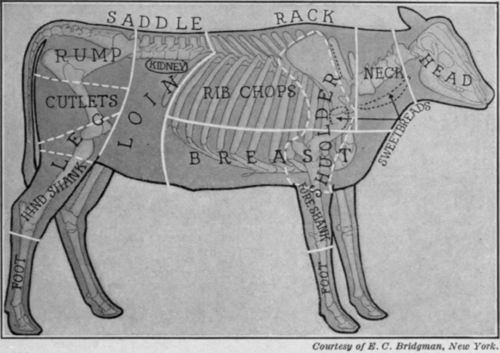
Fig. 92. - Cuts of veal.

Fig. 93. - Cuts of beef.
What to be careful about in buying meat. Mrs. Allen was careful in explaining to Mollie and Marjorie that she bought from one butcher's cart rather than another, because this butcher was careful to buy good beef, in the first place. Then, too, he had a clean place for hanging his beef, chilled by ice. His shop was very clean, scrubbed out often, and he fought flies all the time. His cart, too, was cleaned daily, screened from flies, and the meat covered from the dust of the road. The other butcher allowed flies to crawl over the meat, and his cart and shop had an unclean appearance and smell, Miss James had talked about certain dangers from meat. If the animals themselves are unhealthy, there may be tiny living creatures in their flesh, known as parasites. The terrible disease trichina sometimes found in pork is one of these. Tape-worms come from beef. We can protect ourselves from these parasites by thorough cooking of the meat. The cooked meat should be pink rather than red and raw looking. Another trouble, known as ptomaine poisoning, may occur when meat has been kept too long and has not been kept cold enough. The ptomaine is a poison formed by the bacteria that have developed in the meat. Then, again, the bacteria themselves injure us, and are now thought to be the cause of most of the sickness which has been called ptomaine poisoning.

Fig. 94. - Cuts of lamb and mutton.
There are laws that require inspection of all meat. The Woman's Club in Pleasant Valley made a very thorough study of this subject and worked with the local butchers until matters were very much improved.
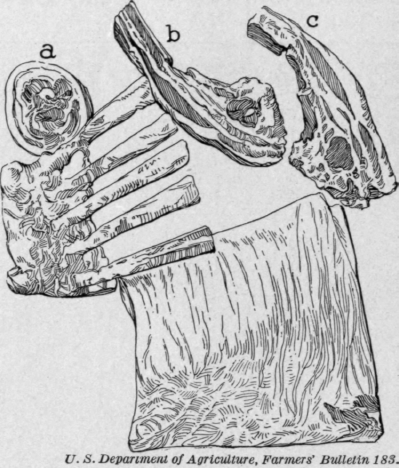
Fig. 95. - Prime ribs of beef. a. Rolled roast. b. Folded roast, c. Standing roast.
Selecting meat for cooking. The cuts of meat vary somewhat in different parts of the country. We know that meat is either tough or tender, and that the difference is caused by the amount of exercise given to the different muscles of the animal's body. The flesh of the meat is muscle. You easily see that the muscles lying along the animal's spine and underneath the body are used much less than the muscles of the neck and the legs. The tough cuts, therefore, come from the neck and legs, the tender cuts from the middle of the back, and the toughness increases toward the neck and the hind legs. The muscles of the abdomen give a tender and coarse-grained meat.
The tender meat is no more nourishing than the tough, but is easier and pleasanter to chew; and, as there is less tender meat than tough, the tender meat costs more than the tough. It is not good sense to buy porterhouse steak at 30 or 32 cents a pound, or to take it in exchange for eggs at that price. It is better to buy the round or rump steak and cook it in such a way that it loses its toughness. Can you explain why the meat of young animals is more tender than that of the full-grown creature?
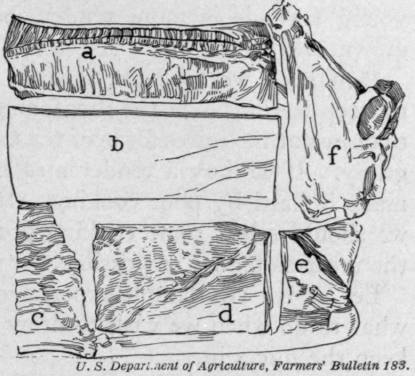
Fig. 96. - Side cuts of pork. a. Loin. b. Fat back. c. Spare ribs. d. Bacon strip, e. Trimmings, f. Leaf.
How shall we cook our meat? Sometimes we wish to keep the juices in the meat, and sometimes we wish to draw out the juices for beef tea or soup, or for making gravy. If we buy a tender meat, we do not wish to make it hard by poor cooking. If the meat is tough, we should select some cooking process that will make the meat as tender as possible.
Let us try two simple experiments that will show us what to do when we wish to draw the juices out, or to keep the juices in.
Continue to:


My Books

