


Can We Not Save Some Time And Trouble?
Description
This section is from the book "Food And Health: An Elementary Textbook Of Home Making", by Helen Kinne, Anna M. Cooley. Also available from Amazon: Food And Health: An Elementary Textbook Of Home Making.
Can We Not Save Some Time And Trouble?
Yes, indeed. Barbara Oakes reported a cleaning-up game, where the children divided the work so there was something for No. 1, No. 2, No. 3 to do, taking turns at different times. Barbara said that one was made inspector, to see that each thing was properly done. They had found that singing in chorus helped a bit, when everybody seemed a little "out of sorts."
A number of people have been studying the question of dish towels, and they tell us that the very cleanest way to finish off our dishes is to arrange them in a rack in such a way that they can be well rinsed with boiling water. If they have been thoroughly washed in the soapsuds, the hot water rinses off the suds and the dishes will drain dry. Figure 60 shows such a rack standing on the drain board at the left. A better way is to have a round rack with a handle. Place the dishes as you see them in Fig. 61. Empty the dish pan, fill it with hot water, and set it on the stove. Lower the rack of dishes into the water and let it remain until the water boils. Lift the rack, drain off the water, and set the rack where the dishes will dry quickly. A few may need polishing with a clean towel.
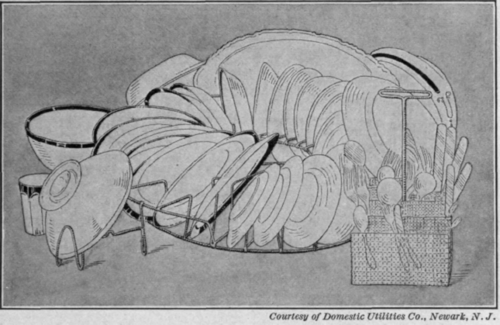
Fig. 61. - Dishes placed in a round rack.
Can we "save dishes"? This you will have to talk over with Mother. Somebody suggests using paper or wooden plates sometimes in summer, and burning them. Another way to save dishes is to put more than one kind of food on the serving dish or platter (Fig. 63), or to put the food on the table in the dish in which it is cooked, when this is possible (Fig. 64). If we use large plates at each place, we can put several kinds of food upon the plate, instead of having many small dishes. The use of heavy plated knives will save rubbing. Some people save one dish washing by rinsing off the supper dishes, piling them up, and covering them to be washed with the breakfast dishes; but perhaps this is not a good plan with a very large family where we need a large number of dishes.
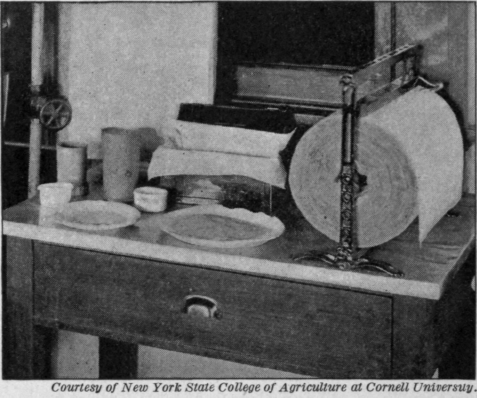
Fig. 62. - Paper dishes for saving work.
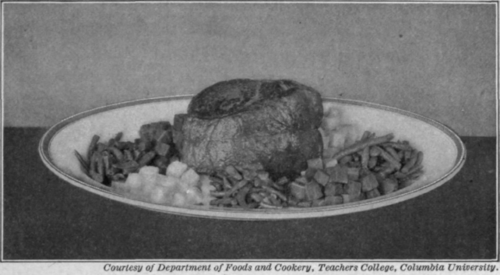
Fig. 63. - One way to save dishes is to put more than one kind of food on the serving dish or platter.
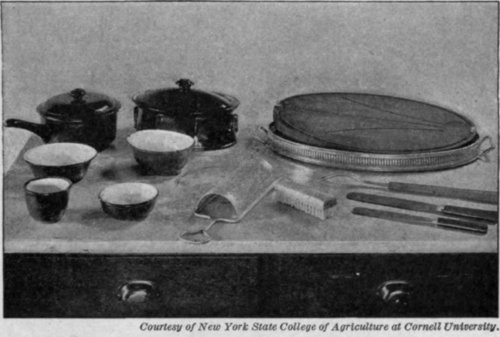
Fig. 64. - Utensils in which foods may be both cooked and served.
A dishwasher. Show your mother this picture, Fig. 65, and ask her what she thinks about having a dish-washer. There are several made for family use, which may be found a help in a large family. This would be a good question for the Woman's Club to ask Miss Travers or some one else at the State College. Can you recommend a good dish-washer?
What shall we do with our waste water? It is all very well to turn dish-water into the sink and let the water run out through the drain; but what becomes of it?
All slops from the house must be carried far away from the house and poured out in some way so that no moisture or filth collects. In the lesson on vegetables we speak of taking out the slops in dry weather for watering purposes. Drainage from the house can be carried out in pipes to the garden, provided the slope of the land is right for this. If this cannot be done, a very safe plan is to have a tank built underground into which the waste water drains and from which it is carried out. Never let slop water of any kind collect in a wet or bad-smelling spot under the window, or anywhere near the house. This is one of the most important matters in our housekeeping. Your mother and father can have pamphlets from the government telling them just what to do.

Fig. 65. - A dishwasher saves time and work.
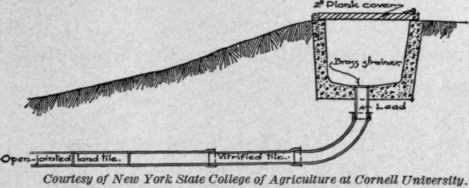
Fig. 66. - A waste water hopper prevents moisture and filth from collecting around the house.
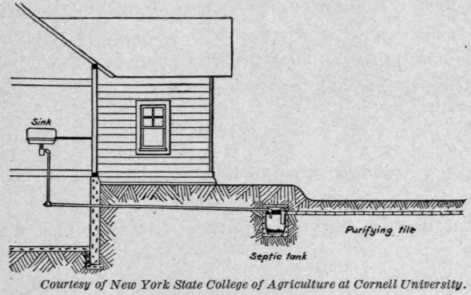
Fig. 67. - A safe plan is to have a septic tank built underground into which the waste water drains.
Exercises And Problems
1. Why may it be dangerous to have slops poured out near the house?
2. Make a plan of taking care of slop water at home.
3. How can you simplify dish washing at school and at home?
4. What are the most important points in dish washing?
5. What is the danger in a damp, old mop or a partly soiled dish towel?
6. Give some suggestions for saving dishes in the preparation of a meal.
7. It is baking day. How are you going to "save dishes" and make clearing up easy?
Review
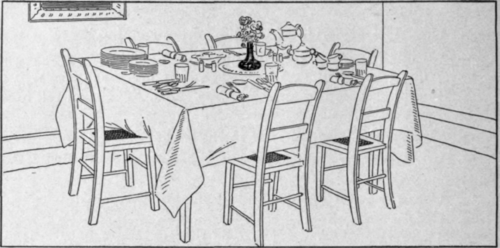
1. Make a drawing showing how to place the dishes and the silver for a home supper for six persons.
2. What do you like for supper in the winter? for supper in summer?
3. Can you think of some meat substitutes for supper?
4. What is essential to a good salad?
5. You have been told that you should not drink tea. Do you know why tea is injurious?
6. Careless cooks make very poor tea. Just how should tea be made?
7. Give the two methods for canning fruit.
8. How does preserving fruit differ from canning?
9. Outline the process of making jelly.
10. What fruits will you use when you make jelly? Why?
11. You have heard of girls' canning clubs. Can you tell how to can tomatoes or peas?
12. What is the value of fruit in the diet?
13. In what ways may apples or pears be cooked during the winter?
14. Does the potato contain any valuable food substances?
15. Describe the effect of cooking on the potato.
16. There are many good ways of cooking a potato. How many ways can you describe?
17. Have you learned anything about washing dishes?
18. What is the difference between hard and soft water?
19. Tell how you can help in preparing supper at home on Saturday.
Continue to:


My Books

