


Breakfast, Dinner, Luncheon, Supper, All Are Meals. How Do They Differ?
Description
This section is from the book "Food And Health: An Elementary Textbook Of Home Making", by Helen Kinne, Anna M. Cooley. Also available from Amazon: Food And Health: An Elementary Textbook Of Home Making.
Breakfast, Dinner, Luncheon, Supper, All Are Meals. How Do They Differ?
You have heard of light and heavy meals, have you not? When Marjorie Allen told her father that Miss Travers said in one of her lectures that bread and milk and baked apples would be good for a farmer at noon of a hot day, he laughed, and replied that he had rather have a good square meal. What did he mean? Something like this? Well-cooked corn beef, pickles, potatoes, sweet corn, string beans, pie, cake, coffee or tea? Is that a light or a heavy meal? What name belongs to such a meal?
If the Pleasant Valley School ate a meal like that at recess, would Miss James find her pupils wide-awake and quick at arithmetic? Who was right about the plum pudding, Mollie or John Stark? Is it not true that you already know something about meals; and that a "light" meal is one where less food is served, and where the food is more easily, or more quickly, digested? Luncheon is a rather "light" meal; "a slight repast" says the dictionary. If you have not already done so, look in your dictionary to find the rest of the story about the words lunch and luncheon. The other meals we will talk about as we learn about preparing them.
A luncheon, then, is a meal rather small in quantity, and, in the case of the school lunch, consisting of foods that can be carried easily, and readily prepared.
What may we add to our list of bread, milk, fruit and perhaps vegetables, cocoa or a cool fruit drink?
What can we put into sandwiches? We have already spoken of bread for sandwiches, which must be" cut of even thickness and, for the school luncheon, must have the crusts left on. When the crusts are cut off for "fancy" sandwiches, they should be saved for a scalloped dish of some kind. Brown bread may be used as well as white.
The question at the beginning of this page can be answered by saying, "Almost anything eatable." The bread should be evenly buttered, and the material used, neatly put in; and, if the sandwich is not to be very dry by lunch time, it should be wrapped in paper. If you are serving sandwiches at a fair or entertainment, put a damp napkin over them.
What does sandwich mean? "Sandwich" is another word with a story. An Englishman, an Earl of Sandwich (Sandwich being the name of a place or town), who did not want to stop to eat, used to have slices of bread with ham between, taken to him - a convenient way of having a simple meal. If you butter bread, put in it a bit of crisp lettuce or water cress, add slices of hard-boiled egg or cheese, or a bit of cold meat, and another piece of buttered bread, you have a little meal, have you not?
How can we prepare meat for sandwiches? You do not need meat for luncheon at school; but, if it is more convenient sometimes for Mother to give you that than anything else, a little will do no harm.
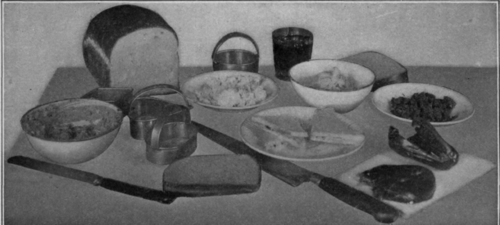
Courtesy of Department of Foods and Cookery, Teachers College, Columbia University.
Fig. 30. - Everything is ready for making sandwiches. Notice the soft butter in the bowl at the right. There is a plate of plain cheese, and a bowl of cheese mixed with chopped nuts and chopped peppers.
The meat should be sliced thin, or chopped and moistened a little, that it may be spread nicely on the bread.
Eggs for the school luncheon? Some people think hard-boiled eggs indigestible; but they are really not so. An egg cooked hard takes somewhat longer to digest; and, if we swallow it almost whole, it may not be good for us. Nevertheless a hard-boiled egg is a convenient and useful food. Sliced or chopped and seasoned pleasantly, we must chew egg if it is in a sandwich. This is a good way to take it. The egg should cook in boiling water a half hour at least. Cut it fine, moisten with a little milk, salt it, put it between the bread - and you have a very palatable sandwich.
Nuts for luncheon. We often think of nuts as something to be eaten "for fun," as somebody says, forgetting that the squirrel can thrive upon them. The squirrel is certainly a most lively and energetic little person, sometimes getting the nuts before you do. Yes, the nuts that you love to gather in the crisp autumn weather are a good food for you, provided you chew them as well as Squirrel does. Eat them with plain bread and butter at lunch time; or chop them, mix them with a little sour-milk cheese, and make them into sandwiches. You could not ask for a better meal.
We will plan for other luncheon dishes as we talk about other meals.
Exercises And Problems
1. Explain why bread, milk, and apples make a nutritious luncheon.
2. Look up the words: meal, breakfast, luncheon, dinner, supper, tea; and write the definitions in your cook book.
3. Make a list of food materials that can be used in sandwiches.
4. See if you can reason out what foodstuffs an egg contains. Do you know why an egg colors a silver spoon?
5. What are some of the foodstuffs that nuts must contain?
Continue to:


My Books

