


Lesson 12. The Canning Of Fruit And Vegetables
Description
This section is from the book "Food And Health: An Elementary Textbook Of Home Making", by Helen Kinne, Anna M. Cooley. Also available from Amazon: Food And Health: An Elementary Textbook Of Home Making.
Lesson 12. The Canning Of Fruit And Vegetables
We may have fresh fruit and berries and sometimes vegetables for supper in summer and autumn; but in winter and spring we depend upon canned and dried foods. What preserving can a girl do at home and at school?
An old-fashioned economy is storing away food when it is plenty for time of need. We have read of the early days in our own country, when the first settlers dried corn, apples, berries, salted codfish, smoked or salted beef, and made fruit preserves and pickles. Some of you may have seen the old "smokehouse," or perhaps some one has pointed out to you the hooks in the beams of some old kitchen where food was hung to dry. You are fortunate if the smokehouse is still in use on your home farm.

Fig. 44. - Canning club girls at work.
Nowadays we have many conveniences for canning and preserving; and our canneries all through the United States preserve many kinds of food in tins and glass. This industry still has a place in the home; and, as there are many fruits and vegetables to be preserved in the autumn, some of the first cooking lessons at the Pleasant Valley School were canning lessons.
A word about canning clubs. Mollie Stark had read in the local paper an account of a girls' canning club, and asked Miss Travers how such a club could be formed. You yourself can find out all about it in the pamphlets mentioned on page 296.
In the meantime, if it is not best to have a club in your own neighborhood, you all want to know how to preserve food for home use. And any businesslike girl can earn a little money by selling her products near home, if she will take the trouble.
Why does food spoil? Have you ever wondered why so many kinds of food spoil so easily, except a few that are dry like flour and meal and cereals; and even these sometimes have insects in them, or become musty? Recall what you have seen: the mold on fruit and on preserves or jelly; the "working" of canned fruit which we have already learned is caused by the presence of yeast. Not only do the molds and yeast cause the spoiling, but so do the still tinier organisms known as bacteria. Do not allow these pictures (Figs. 45 and 46) to deceive you. One of these cells may be only 1/25000 of an inch in length, and some of the larger 1/6000..
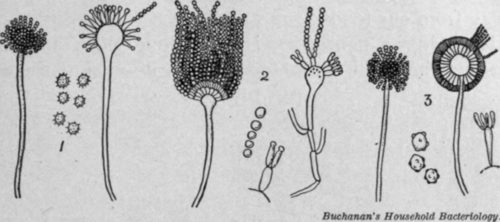
Fig. 45. - Three species of mold as seen under a powerful microscope.
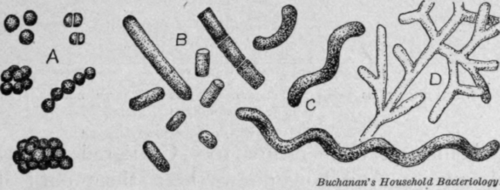
Fig. 46. - The four types of bacterial cells as seen under a powerful microscope. A, cocci; B, bacilli; C, spirilla; D, branched filamentous organism.
It is beyond our power to imagine them. How wonderful it is that we can actually see them through a micro-scope. Sometimes one, sometimes all three together, molds, yeast, and bacteria, - make all our trouble. How curious it is that because of them we have canneries and spend so much time and money in fighting them away from our food!
How do we fight them? By killing them and by keeping them out of the food. How do we kill them?
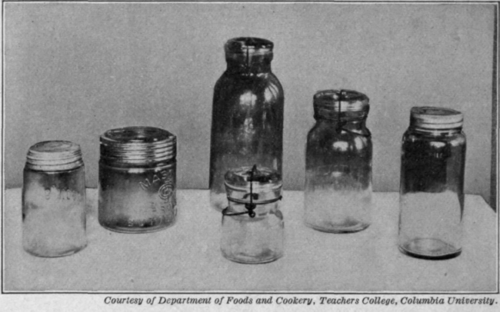
Fig. 47. - Pint jars as well as quart jars, and jars with large mouths, are convenient for canning.
By boiling at temperature 100° Centigrade, or 2120 Fahrenheit. And how do we keep them out? By sealing cans, by covering glasses, and in another way. Why is it that dried, and salted, and smoked, and sugared food, like candied fruit and vinegar pickles, keep? The tiny cells cannot live without moisture, and that accounts for drying as one way of preserving; and they cannot live where the substances just named are found, and, therefore, we put these materials into the food. Perhaps you can think of some other materials in addition to these. Sometimes chemicals are used to preserve food, but when any proves harmful, this will be controlled by pure food laws.
While the yeast cell flourishes in sugar, a large amount prevents its growth. The action of yeast is called fermentation. While alcohol and vinegar result from fermentation, they both, when strong enough, prevent the growth of the tiny living cells that cause fermentation and decay.
Preserving fruits. Notice the picture (Fig. 47) of jars and glasses for home use. Jars with large mouths are convenient, for large fruit or ears of corn can easily be put in and taken out. It is a good plan to use some pint jars, unless the family can eat a quart of stewed fruit at one meal.
Continue to:


My Books

