


Lesson 16. Clearing Up
Description
This section is from the book "Food And Health: An Elementary Textbook Of Home Making", by Helen Kinne, Anna M. Cooley. Also available from Amazon: Food And Health: An Elementary Textbook Of Home Making.
Lesson 16. Clearing Up
Have you ever wished at the end of a meal for a good fairy like one of those in the stories who waves a wand: "Presto" - and table and dishes vanish? Can "clearing up" after supper be made pleasant?
1 See Farmers' Bulletin No. 653 for this and other recipes with honey.
There are some people who like to wash dishes. For the rest of us there is nothing to do but to make an art of cleaning up thoroughly, quickly, and cheerfully. One of our great writers, Mr. William James, tells us that when we feel unhappy, if we behave as if we were cheerful, all at once we shall find that we really are cheerful! Try it when it is dish-washing time.
When dish washing is done well, it is really a pretty piece of work. When we hurry through and it is badly done, - the dishes, spoons, and forks are left "sticky," the sink greasy, the towels unclean, - what more unpleasant task!
Here is something to remember at the very beginning of our talks about cleanliness. Nothing can be half-clean. A thing is either clean, or it is not; and when it is not clean it is "dirty." If one spot of spilled food is left anywhere, how soon that one fly finds it!
The importance of cleanliness. Cleanliness is not only beautiful and comfortable, but it is an enemy of ill health, sickness, disease. When we study sanitation, which we hear about so often, we are studying how to keep clean; and that is all. The word sanitation comes from a Latin word meaning "health." You cannot see what this has to do with dish washing? Sore throats and other sicknesses will go from one member of a family to another on half-washed spoons, forks, cups; and a musty dishcloth or mop may be a source of illness.
What does cleaning up after a meal mean? It means putting the uneaten food neatly away; collecting the scraps; leaving the table in order, and the floor underneath free from crumbs; having all the dishes washed, the glasses and silver shiny and set away in order, and the sink and dish towels spotlessly clean.
What do we need for dish washing? Water, air, sunshine are nature's cleansers, always at work if we give them a chance. When we wash dishes, we need plenty of clean hot water.
Soft and hard water. Rain water is always "soft." Brook and spring water and even well water are sometimes so. When the water takes up lime or iron from the soil, we then have a "hard" water; and you know that it is hard when the soap does not make foamy suds. One kind of hard water is improved by boiling, and another is not; with either we need to use borax, ammonia, or some stronger washing powder in the water. If you are still making and using the old-fashioned "soft soap," there is nothing better to soften the water; but many people have given up doing this.
Plenty of hot water. When there is running water in the house, the easiest way is to have a boiler connected with the stove, and a water back put in for heating the water. Some stoves, either coal or wood, come with a tank at the back into which water can be poured. It is in summer weather when we do not need a hot fire that the question of water is troublesome. If you are using kerosene, you may still have plenty of hot water, with a little thought and care. Study in Lesson 26 the Atkinson and the fireless cookers, and this may suggest to you a way of having hot water for dishes without heating the kitchen. A large pail of water can be brought to a boil on a kerosene stove, and kept hot either in the Atkinson or in a fireless, ready for the next dish washing.
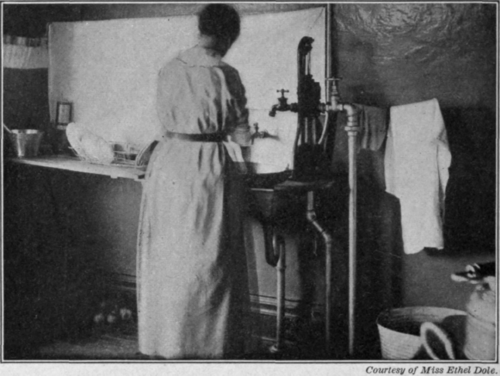
Fig. 60. - Washing dishes. Notice the rack at the left for draining dishes.
The sink is too low.
A word about soap. Soap making was always done at home in the days of our great-grandmothers. For this purpose they saved fat to be boiled with lye made from wood ashes. In these days a good soap can be purchased cheaply. Buying soap is one way of saving time and strength in the country home. It does not cost much less bought by the box than by the dozen cakes or bars, but it can be laid away to harden if we buy a large quantity at one time. Borax or naphtha soap is a help when the water is hard.
Washing the dishes. With plenty of hot water, soap, and something to soften the water, with a dish-pan and another pan for rinsing, we are ready for action. Remember to have ready a clean dishcloth and towels, - if used, - dried in air and sun, although not necessarily ironed. Perhaps you have a soap shaker, with small pieces of soap put into it. Make one from a tin can, with holes driven in by a large nail and hammer, near the bottom of the can. You also need fine sand, or a gritty cleaner or soap, and a small stiff brush.
1. The cooking utensils have been standing with cold water in them; or, if greasy, with hot water and a little washing powder.
2. Scrape and pile the dishes - dishes of a kind together. Rub greasy dishes off with soft paper, and put the paper in the stove.
3. Put water in pans, and use the shaker vigorously. How clean and sweet the soapsuds smell !
4. Wash a dish at a time, the cleanest first. Why? Do not fill the pan with dishes first. Why?
5. Rinse the dishes in the clear hot water pan and wipe; or, better still, arrange the dishes as in Fig. 61, pour boiling water over them, and allow them to drain dry.
6. Change the dishwater if it begins to look greasy and unpleasant.
7. Wash the cooking utensils as clean as the glasses and silver. This may mean a good scrubbing on the bottom. The iron pot or pan can be just as clean, and should be, as any other dish. Be doubly sure that all utensils that can rust are dry, before you put them away.
8. If there are any steel knives, leave them clean and dry.
9. Wash out the towels in clean soapsuds, rinse and hang outdoors; or, if stormy, dry them near the stove, and then put them away.
10. Wash out the dish pans and put them to dry.
11. Wash the sink, leaving it sweet and clean and dry. If there is a waste pipe, with or without running water, put some cleanser down, with some clean water. A little kerosene helps here.
12. Put all the dishes away.
13. Of course, a thoroughly good housekeeper leaves the kitchen table and stove clean, too.
Do you draw a long breath, glad that it is over? It is not so long a task as it sounds, if done promptly. If you hurry too much, see the "nicks" on the dishes.
Continue to:


My Books

