


Lesson 26. Cooking Apparatus How Can We Save Heat At Dinner Time, And Other Times?
Description
This section is from the book "Food And Health: An Elementary Textbook Of Home Making", by Helen Kinne, Anna M. Cooley. Also available from Amazon: Food And Health: An Elementary Textbook Of Home Making.
Lesson 26. Cooking Apparatus How Can We Save Heat At Dinner Time, And Other Times?
It is at noon of a hot summer day that preparing dinner seems such a burden, and oh ! how hot that stove makes the kitchen. The class talked one day about apparatus that would cook the food without heating the cook.
Different ways of having heat for cooking. How interesting it would be if, at the moment you are reading this page, you could see all the ways in which people are cooking. Some one, somewhere, has a camp fire with a kettle boiling over it; and, far away in some old-fashioned house, dinner is being cooked by the fire in the open fireplace. Somebody is turning a button, and presto! a current of electricity runs along a wire fastened to a cooking utensil, and there is all the heat needed and no more, and no ashes, and no hard work. And between these two, the newest and the oldest fashions, there are coal stoves and wood stoves, natural and manufactured gas, kerosene and gasoline stoves, and steam cookers; and we hear about fireless cookers and Atkinson cookers.
What are you using? Coal or wood in the winter for warmth as well as for cooking? It needs a well-made stove for either, for no one can be expected to do good work with a poor stove. With the coal stove you must bring in coal and take out ashes, and space must be given to the coal bin and ash pit. Large ranges, resting upon the floor, have a "dump" which empties the ashes directly into the ash box in the cellar. A range the size of the one in the picture (see over) would serve for a family of five or six. It requires from 2 to 3 hods of coal per day. A hood should be placed above a large range, whether coal or wood, with a pipe into the chimney.
Here is a picture (Fig. 109) showing a section of a coal stove that can be used for wood with a different grate.
The coal range. The coal box at (1) has a lining that keeps the iron from burning out. The air enters at (2)

Fig. 109. - A modern coal range, showing the parts and the air circulation.
and passes out at (3), when the fire is first made. When you want to heat the oven, a damper is closed at (4), and the heated air then passes around the oven in the direction of the arrows. The coal is put in at (5), and the ashes shaken down at (6).
Do you know that this kind of stove lets most of the heat go up the chimney, although less than in the old-time fireplace? We have to box in the heat to keep it.
Cooking by kerosene. On page 12 is a picture (Fig. 4) of a kerosene stove with wicks where the kerosene is made to burn with a blue flame.1
A blue flame always gives more heat than a yellow one. A yellow flame gives light, and it smokes more easily than the blue. The flame on this stove is very hot, the oil burns out slowly, and one gallon will last about 15 hours. If one is careless and raises the wick too high, then the flame grows yellow and smoky, and it spoils the wick and makes much trouble. Notice the picture (Fig. 4) of the oven which is placed on top of the stove for baking.
This was one of the first summer comforts that the Stark family tried, and they were surprised to see how seldom a fire in the wood stove was needed.
A friend who was interested in the school lunch gave a stove of this pattern to the Pleasant Valley School. The members of the Lunch Club took turns in keeping it clean, and they found that it saved time in the end to attend to it daily.
Catching heat and keeping it in a box. The picture (Fig. 110) that follows, shows one way of doing this. This plan was invented by Mr. Edward Atkinson of Boston, who wanted to teach us to save fuel and to improve some of our foods by cooking them slowly. The heat comes from a round-wicked kerosene lamp. If you try to hold your hand over the chimney of a large lamp, you realize how much heat is given off; really enough to cook with. Around the iron oven which holds the food there is a box or cover, large enough to leave a space between the inner oven and the outer box; and the outer box is made of something that does not let the heat through; so the heat is in a trap, and does the work of cooking.
1 In many parts of the country the use of gasoline is forbidden. Stoves are made especially for it.
Food cooked in this way has a fine taste, because the flavor has not gone off in the air.
A homemade Atkinson cooker. The Stark family made a cooker at home. They could not have the same kind of oven, because in the Atkinson ovens that one buys the outer box is made of a kind of fiber or pulp; but they talked the matter over at home, and Mollie and John asked this question at school, "What can be used to keep heat in or out? "Why do you have a wooden handle on a poker for the fire? Why do you use a cloth holder for a flatiron or any hot metal? Why do you want a blanket over you on a cool night? Some sub-stances become hot, carry heat, and lose heat quickly; and these are called "conductors" of heat: others heat slowly and cool slowly; and those are "nonconductors."
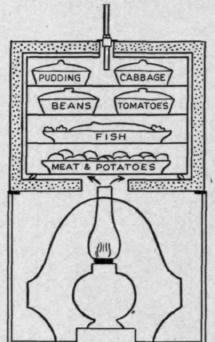
Fig. 110. - The Atkinson cooker, a plan for catching heat and keeping it in a box.
For our oven cover, then, we want a nonconductor. The Starks took such an oven as we use on a kerosene stove; they found a wooden box larger than the oven, and lined it with the kind of tin that is used for roofing. They made a hole in the bottom of the wooden box, where it would come just over the lamp, and on the bottom they put the tin both inside and outside the box, that the wood might not catch fire. As you know, wood is a poor conductor; but more covering is needed for an oven than the wooden box only.
The boys covered the box with many layers of paper, put on a neat outside cover of white oilcloth, and made a stand to hold the box, with a shelf below for the lamp. Whenever you want to keep a surface from giving off heat, paint it white or use a white cover. A shiny black surface will radiate heat. This has been proved by experiment.
Continue to:


My Books

