


Lesson 28. A Study Of 100-Calorie Portions
Description
This section is from the book "Food And Health: An Elementary Textbook Of Home Making", by Helen Kinne, Anna M. Cooley. Also available from Amazon: Food And Health: An Elementary Textbook Of Home Making.
Lesson 28. A Study Of 100-Calorie Portions
How may we know just how much food to give to the family every day, and how can we measure it?
One rainy Saturday when Marjorie Allen was looking over her notebook of lessons on foods, sanitation, and cookery, and putting together in one place everything that she had studied and learned about meals from her teacher and from her mother, she found that there were facts enough to fill several pages.
If you yourself will review the lessons in the five chapters of this book and recall the talks at school with your teacher, you will find that you have learned quite a little about the three meals a day and your own school luncheon.
When Marjorie had finished this task, however, she sat quietly a few minutes, looking rather puzzled; and then she asked the question at the beginning of this lesson.
Mrs. Allen replied that she herself had learned by experience, and that in a large family the left-overs can always be used in some good way. But Marjorie had in mind something more exact than this, as a result of the talks at school about food for body building and energy; and she already had grasped the idea that different people require not only different kinds of food, but different quantities.
"It seems to me," said Marjorie, "that there must be some way to measure just the amount for Grand-mother, for you and Father, and for all of us children."
"Why don't you ask Miss James? said her mother.
"I am so glad you wanted to ask that question," remarked Miss James, when Marjorie brought this thought to the class.
How is temperature measured by a thermometer? "How would you explain the use of the thermometer to some one who did not understand? " was Miss James' first question.
We learned long ago that the amount of heat in things around us changes from time to time, sometimes very quickly. Take water, for instance: how rapidly it heats and begins to boil over a good fire, and how soon it freezes when the weather is cold. The words in common use for the different degrees of heat are cold, cool, hot, warm, tepid, lukewarm, and so on. These words are not exact, however; and people found it necessary to measure heat in some definite way. Mercury and alcohol are substances that change very rapidly with only a slight increase or decrease in temperature. They change in bulk and expand or shrink. Look at a thermometer, and see that the mercury is inclosed in a bulb and a tube, fastened upon a scale. Who made the scale? Several people, and so we have thermometers (heat measures) of more than one kind. The Centigrade is the best because it is the simplest. The freezing point of water is called zero; and the boiling point of water, 100; and there are one hundred steps (Centigrade) between, which we call degrees. Scientists prefer to use Centigrade. We should become familiar with the Centigrade thermometer in daily life. In America, however, we are slow to change in matters of measure and weight. The French, who planned the decimal system of weights and measures, and who use them in buying and selling, are much more sensible than we. In America and England, the Fahrenheit is used. This scale was made and used by Gabriel Daniel Fahrenheit. The freezing point is at 32° above the zero of this scale, and the boiling point at 2120 above; and there are 180 degrees (Fahrenheit) between. So you see, one degree Fahrenheit is equal to § degrees Centigrade.
Here is the picture (Fig. 119) of a thermometer with both Fahrenheit and Centigrade scales. You should learn to use the latter just as soon as possible. Do you not consider decimals easier and more convenient than common fractions?
The degree on the scale of a thermometer is one kind of heat measure. We have another measure for the needs of our bodies and the energy contained in our foods; for we calculate the amount of food we need by the amount of energy it will furnish the body.

Fig. 119. - Two common temperature scales, viz. Fahrenheit and Centigrade. On the Centigrade scale the freezing point and normal boiling point of water are, respectively, 0° and 100°; on the Fahrenheit scale these points are 320 and 2120; thus 1° Centigrade is equal to 1.8° Fahrenheit.
What is a calorimeter? Scientists have learned to measure heat given off by shutting up some person, or lower animal, in a machine where he has air and is quite comfortable for a time. Here is a picture (Fig. 120) of one machine called a calorimeter (heat measure) for a small animal. You can see how elaborate and delicate a machine it is, and it does exactly record the heat coming from the body of the animal shut into this cage. When you are in high school or college, you can understand the workings of the calorimeter. But we will now accept the fact that the scientist can measure in a calorimeter the energy of our bodies and the amount of energy given off a day.

Fig. 120. - Respiration calorimeter, open. From the "Journal of Biological Chemistry".
Then, too, the scientist finds the energy in the food, by burning it in another kind of machine which also measures the amount of heat in some one kind of food. This has been done with all the common materials.
What is a calorie? The scientist can now say of a given person that he needs so much energy daily, and that a certain amount of a certain food will give so much energy. But what words can he use to tell you and me? The degree Centigrade will not measure this. So the scientist says, "I must have a heat unit, something like the degree of a thermometer scale, or the inch on a yardstick. I will take for my heat unit the amount of heat required to make one pound of water warmer by four degrees Fahrenheit; that is, the amount that will raise its temperature four degrees, or a gram of water one degree Centigrade. This unit I will call a calorie from the Latin word for heat, 'calor.'"
Miss Travers explained the calorie quite simply one day at the Mothers' Club; but one of the mothers said that her husband and sons were six feet tall, weighed about one hundred eighty pounds each, and were all satisfied with the good square meals she gave them, and that she shouldn't bother with this kind of thing. Mrs. Allen said very quietly that her husband found it convenient to study calories in feeding his pigs, and that she herself thought it might be well to try this method with her family ! So Mrs.
Allen and Marjorie had many pleasant evenings studying this way of planning meals.
Of course, no busy mother will stop to calculate calories for every meal every day, but a little study will check up her daily practice. Mrs.
Allen had been worried about her second little girl, who was under weight, and growing thinner. She studied the question of 100-calorie portions and found that the child was short some four hundred calories. Alice seemed not to be able to eat much more in bulk at one meal, but Mrs. Allen persuaded her to take more butter and cream, and also two or three eggs daily for their body-building quality. Alice had not enough building material or energy in her food before this to keep up the growth in height, and also in weight. On the other hand, Mr. Allen had been troubled at the increase in his weight, which seemed to be in the form of unnecessary fat, in spite of his exercise. So Mrs. Allen planned for him food that contained a lower number of calories but still had bulk enough to satisfy his appetite.
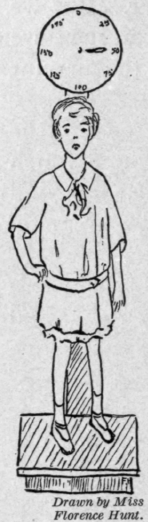
Fig. 121. - Improper weight.
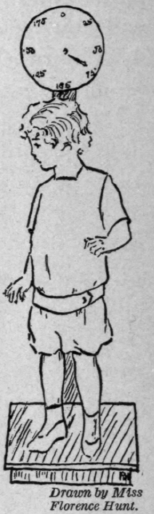
FIG. 122. - Proper weight.
What did Miss Travers mean by a 100-calorie portion? The amount of food that would give one calorie is so small that it is more practical to measure portions giving one hundred calories.
Study this picture first, for here are several of our common foods in amounts yielding energy equal to 100 calories. The egg is the exception, the energy being only 75 calories. Notice (Fig. 123) first that there is a great difference in the bulk of the different foods. Look at the lettuce, and at the half tablespoonful of butter and lumps of sugar. We could not live on a bulky food like the lettuce, or a condensed food like the butter; but we must have a mixed diet to furnish all the energy we need.

Here is a table that states what some people should have. Remember that this is an average. Have you studied averages in arithmetic ?
Continue to:


My Books

