


Lesson 27. The Care Of Food. Continued
Description
This section is from the book "Food And Health: An Elementary Textbook Of Home Making", by Helen Kinne, Anna M. Cooley. Also available from Amazon: Food And Health: An Elementary Textbook Of Home Making.
Lesson 27. The Care Of Food. Continued
Fig. 115. - Mrs. Allen's refrigerator is built with double walls made of nonconducting materials.
The farmers who sell milk, cream, and butter find that the better condition of their products makes it pay to have ice.
A well-built refrigerator. Mrs. Allen was very happy with her new refrigerator, and told Mollie that the difference between a summer with ice and without ice, was astounding. The picture (Fig. 115) shows Mrs. Allen's refrigerator, which stands in the coolest part of the pantry. It is important to have air circulating in the refrigerator. The drawings (Fig. 116) show the movement of the air in two refrigerators and the coolest place in each.

Fig. 116. - Diagram showing the circulation in two used types of refrigerator.
Mrs. Allen's refrigerator is built with double walls made of nonconducting materials, and has ten layers of such in the walls, one of them a closed-in air space. The closets for the food are enamel lined. This is nonabsorptive, and may be kept perfectly clean. A large refrigerator is more economical of ice than a small one, and in the end more than balances the few dollars extra that must be paid for the larger size. Select the coolest spot that you have for the refrigerator.
Care of a refrigerator. Always wash off the block of ice before putting it into the ice chamber. Wash out the ice chamber once a week, and pour a solution of washing soda down the waste pipe. The food chambers should be washed out once a week and dried, and no spilled food allowed to remain a moment. Do not leave the doors open. Have a strong ice pick for breaking ice.
And when we cannot have ice? Perhaps there is a well. Then you can hang very clean pails or glass fruit jars in the well that will hold some food at least. This is a simple old-fashioned way; but be sure that the ropes are strong, and the pails tightly closed. It is always a sad event when milk spills into the water.
If the water comes from a spring in pipes, you have an overflow that can be used for cooling food.
What shall we say about a cool cellar for food? For the sake of the family the cellar should be dry, well aired, and not cold and damp. Even a dry, cemented cellar is cooler than the ground floor of the house; but it is not cold in the way that the old-time farmhouse cellar used to be. When the Stark family made their old cellar into a dry new cellar, they felt that they could not plan for an ice house that year. They dug a place below the level of the cellar and cemented it; they cut a trapdoor in the kitchen floor and made a set of shelves to run up and down on pulleys from the kitchen into the small subcellar. This may seem more trouble than it is worth, but Mrs. Stark and Mollie did not think so.
A box fastened outside the window by strong iron brackets gives a handy place for cooling food, and for keeping some foods that do not spoil quickly. It is easily made from a water-tight wooden box, painted outside and in, with the opening toward the window, having a curtain of table oilcloth. A piece of wire netting set in the bottom of the box lets in the air.
Remember, too, that evaporation cools. In tropic countries water is cooled in porous earthen jars which hang in the veranda. When all other means are missing, put the food to be cooled in a jar, wrap a clean cloth around and over the jar, put one end of the cloth in a basin of water, and stand all in a window.
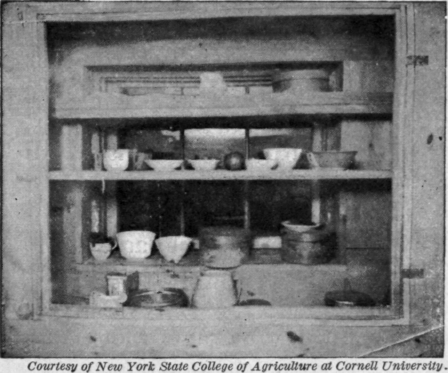
Fig. 117. - These shelves inside a window give a place for cooling food. Netting must be used to keep out flies.
Keeping food dry. This means having dry walls and floors. Have jars and boxes for keeping your materials, label them, and place them in neat rows. Even when food of certain kinds should be kept moist for a time, they still should stand in a dry place. For example, we may wish to keep bread moist by wrapping it in paper, but we must keep the bread box dry and clean.
Mice and insects. It must, indeed, be a well-built house that has no visitors of this kind. Watch for cracks and holes; and, if you find them, use metal over them. Try traps for mice and rats, and buy poison recommended by the druggist; only be careful, then, of other animals.
The Woman's Club of Pleasant Valley offered a prize for something that would actually keep off ants, and as yet no one has taken the prize. Look for ant hills outside and pour in kerosene. In the Starks' old home there were tiny red ants that had their home in some timber that could not be reached. The only trap for them was a saucer of fat in the pantry, in which they collected by thousands. Borax and other powders are recommended, but Mollie Stark remarked that the Stark ants seemed to be especially fond of borax. In one old house they could do nothing better than to put each of the four legs of a table in a pan of water, and stand the food on the table.
Cleaning off the table. Mollie and Marjorie put the scraps of food from the plates into the clean-food scrap pail to be taken out to the chickens. The pieces of bread from the bread plate were returned to the bread box to be used for toast, and the butter was put in a small bowl to be used for cooking. The left-over mashed potato was kept for potato cakes; and the meat and dessert were finally set away in the refrigerator. The sweet corn was all eaten, but the cobs were given to the chickens to enjoy. Later they were to be collected and burned.

Fig. 118. - A broad piazza for rest after work.
You know that the food remnants, when the farm animals have had their turn, will serve as fertilizer for plant life. After the bones have been picked, keep them together in a barrel, and finally bury or burn them. Have a compost heap properly covered where the uneaten fragments will decompose and make fertilizer, or bury them at once if preferred.
When the two girls had finished all the work, and went to the broad piazza for rest, Marjorie said, "Isn't this fine training for a girl! Better than mathematics." And Mollie added, "Do you know, there's a kind of mathematics in it all, I do believe." Then Grandmother remarked, "Any reason why you shouldn't have the book kind and this kind, too?"
Exercises And Problems
1. Why is it so important to take pains in caring for food after every meal?
2. How do you dispose of food waste at home?
3. What do you do with tin cans when you use canned food?
4. Explain why food must be kept cool and dry.
5. How does a refrigerator keep food cool?
6. Can you explain what Mollie meant when she said there was a kind of mathematics in getting a dinner?
Review
1. Give a simple rule for making a dinner menu.
2. Plan the work in preparing a dinner for next Saturday.
3. Do you think we need meat as a food?
4. Is there anything to be careful about in buying meat?
5. Give two experiments that show the effect of different methods of cooking upon meat.
6. When meat is tough, can you improve it by cooking?
7. Give directions for cooking tender meat.
8. You have a five-pound roast. Tell exactly how to prepare it.
9. You are planning to have steak for dinner. How will you cook it?
10. In the country where one raises beef or pork, a large quantity may be killed at one time. How may this meat be preserved?
11. Tell how to cook corned beef.
12. Do you know what foodstuffs vegetables give us?
13. What does cooking do for vegetables?
14. Tell in what way and how long to cook all the common vegetables.
15. Tell how to make two milk desserts and two fruit desserts.
16. Have you ever run a fireless cooker? Can you describe such a cooker?
17. Think of what you can do to be sure the food in your home is clean.
18. What conveniences will you have for keeping food clean?
19. What are some of the important things about using ice? About the care of the refrigerator?
20. What are the points of a good cellar?
21. What can we cook on Saturday to save work on Sunday?

Continue to:


My Books

