


Lesson 27. The Care Of Food
Description
This section is from the book "Food And Health: An Elementary Textbook Of Home Making", by Helen Kinne, Anna M. Cooley. Also available from Amazon: Food And Health: An Elementary Textbook Of Home Making.
Lesson 27. The Care Of Food
How shall we care for food after dinner?
This is a question after every meal; but there is usually more food to put away after dinner, and more careful planning is needed then.
When Mollie and Marjorie cooked the dinner we studied in Lesson 22, they began to plan for the care of food afterward, at the very beginning of operations, by seeing that there were no flies to light on any food placed on the kitchen table. The home-making class had . discussed the care of food in the home, and Mollie and Marjorie found that they could apply it all to this particular dinner.
How shall we take care of our food? Here is a simple rule. Keep food clean; keep food cool; keep food dry; keep out insects, mice, and rats.
How shall we keep food clean? Let us begin with ourselves, the cooks. Mollie and Marjorie were pleasant to look at; they were so shining with cleanliness themselves. Marjorie had washed her hair the day before when she came from school; but before beginning work she brushed it tightly back, braided it, and tied a clean ribbon around her front hair to keep back stray locks. Both of the girls, of course, had clean faces, their dresses and aprons were spotless, and each clean apron had a pocket in it, with a clean handkerchief in the pocket. They scrubbed their hands, used toothpicks for their fingernails, and pinned on fresh hand towels at one side of the apron. Mollie said when she washed her hands before she sat down at the dinner table that she believed it was the twelfth time at least. A safe rule is this: whenever you are to touch food with the fingers, wash them. It is not considered good manners when in company to touch one's hair or face, and one should never handle food after touching one's person in any way.
Of course, Mrs. Allen's kitchen and pantry were spotlessly clean after the breakfast; so there was no cleaning to do after the last fly had been banished.
Just as this had been accomplished, Frank Allen came in with the sweet corn and potatoes, and in came a fly, too ! So Frank killed the fly on the kitchen table, and then washed off the table at his sister's request. There was a pan in the sink to hold clean soapsuds for washing off whatever needed the washing.
A place for washing hands and face. Just outside the Aliens' kitchen is an entry where washing of hands and face, and brushing hair can be done, because it is not a cleanly habit to do this in the kitchen. Before the Aliens had running water, there was a stand in this entry, with a basin for the hands and face, and a pump outside; but, when the water was put in, a basin with running water was placed in this entry, too. There is a looking-glass, and in a basket hanging on the wall below are some small towels made of the toweling used for roller towels, as Mrs. Allen does not believe in having different people use one towel. Each towel is large enough for wiping face and hands, and is used only once and thrown into another basket. Mrs. Allen has a washing machine, and puts these towels through a wringer to smooth them, and does not iron them. Muddy shoes must be wiped off outside, or, when they are very dirty, they are changed for comfortable dry shoes that hang in a shoe bag on the wall of the entry, and the muddy rubbers and boots are left in the shed. The boys thought this very fussy at first; but boys do not really dislike being clean, when it is not too much trouble, and besides they found the dry shoes very comfortable. To keep all dirt out of the kitchen is one way to keep food clean.

Fig. 113. - Neatly dressed for cooking.
Washing off food. Even when we gather our own fruit and vegetables with clean hands, there needs to be a careful washing in clean water to free the food from grit and small insects. A small quantity of salt or vinegar in the water helps to remove any tiny insect.
When Marjorie began to prepare the piece of meat for the pot roast, she held it under the faucet and thoroughly washed off the surface of the meat. If there had not been running water, she would have washed it off in a pan of water, with a little salt added. Mollie remarked that the butcher was very particular himself about the meat, but Marjorie said that one could not be overclean with meat.
Keeping food cool. When the table was cleared after dinner, the most important point was putting away the foods that would most easily spoil, - the meat, the butter, the milk. The meat had been hot when it was put on the table, and it was still warm. Mrs. Allen did not put it into the ice box warm, but, as there were no flies in the kitchen, she stood the meat in the breeze by the window to cool it off. If there had been no breeze, she would have returned the meat to the pot and set the pot in a pan of water.
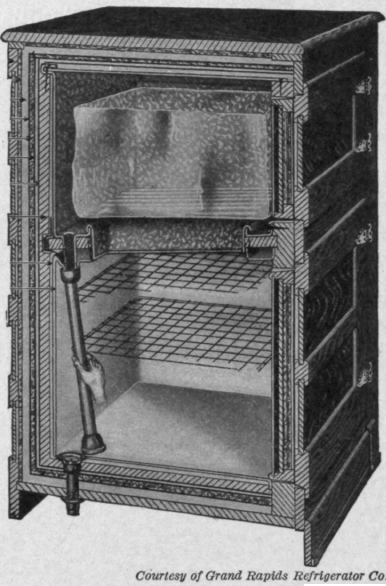
Ice for keeping food. Ice is one of the great comforts in summer, and is a safeguard of our health. Remember in the lesson on preserving fruit that we learned how the bacteria that spoil our food do not flourish in the fold. More and more are farmers planning to cut ice and store it. Mr. Groves of Pleasant Valley dammed up a brook, making a small pond, cleaned out the vegetable matter, and found that he could take enough clean ice from the pond to last all summer. Mr. Groves fenced in his ice pond to keep out the farm animals, and he put in the dam at a spot in the brook above the place where the cows and horses go to drink. He made a double wall and roof to one small building on the place, and packed the ice down in sawdust. Sometimes two or three landowners can combine in ice cutting. One man in Pleasant Valley adds to his income by selling ice to his neighbors.

Fig. 114. - Mrs. Groves has an inexpensive home-made ice box.
Continue to:


My Books

