


Preparing Supper How May We Help In Preparing Supper? Continued
Description
This section is from the book "Food And Health: An Elementary Textbook Of Home Making", by Helen Kinne, Anna M. Cooley. Also available from Amazon: Food And Health: An Elementary Textbook Of Home Making.
Preparing Supper How May We Help In Preparing Supper? Continued
How can we help at the table? When we wait on ourselves, this should be done pleasantly and all should take a share, each person helping to serve one or more dishes. The Allen children take turns as waiter in removing the soiled dishes and the food, and in putting on the dessert. A quick way is to place a tray on a small stand near the table, taking the dishes from one place at a time and sorting them on the tray as you go. The tray can then be carried into the kitchen, with the dishes ready for washing.
One mother uses a plan for having everybody help at breakfast time, by serving himself on a tray.
The breakfast is kept hot on the stove. On the kitchen table are all the dishes needed and a small tray, one for each of the family of four. Even the little boy sets his own tray, helps himself to food, and takes his place at the table. When the meal is ended, each one carries out his own dishes. This plan might not work with a large family, and some people would not like it.
Mollie Stark's older brother made a turntable on a pivot in the center of the table and standing above it. All the dishes of food were placed on this, and each one helped himself. The table has to be round to make this device convenient.
What patterns shall we choose for the table china? We cannot all see beauty in the same kind of thing. Some of us enjoy bright colors and gay patterns. Some things are in good taste in certain places and not in others, however. Although large figures and striking colors may attract our attention when we are buying chinaware, we may become very tired of the design when we see it every day. It is wiser to buy dishes with a simple pattern and quiet color. A narrow border of gold or of gold and green is pretty; and one does not grow tired of such a simple pattern. Notice the two designs on the china in the picture (Fig. 38) and also on the platters in the pictures of cooked food throughout this volume. Of course, if you are fortunate in having some old pieces of china or earthenware that belonged to your grandmother, perhaps, you will prize them and take good care of them; and they make interesting ornaments for the kitchen or dining-room shelf.
If you are not quite happy without gay dishes, then select a good pattern in some pitcher, or plate, or single dish, to be used once in a while. Do you know that a pretty thing interests us more if we do not see it all the time? The Japanese, who have a strong artistic sense, have only a few beautiful objects out at one time, changing one for another to refresh the eyes. In the picture (Fig. 37) you find two pitchers, good in shape and easy to wash. The larger is an old-time pattern in blue. The other picture (Fig. 38) shows a pretty teapot of an antique pattern, but it is so hard to clean that it would better be kept as an ornament. We need to think of other points in our china, in addition to its beauty, you see.
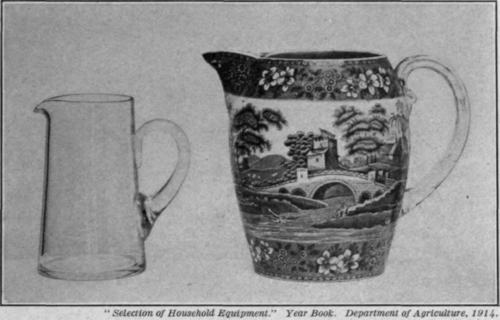
Fig. 37. - Two pitchers, good in shape and easy to wash.
Flowers on the table. In a busy household and with a large family, perhaps we cannot always have flowers on the table; but when the first rose opens, or some other flower is beginning to bloom, put it in a vase in the middle of the table, and see if it is not enjoyed.
Setting the table for company. Of course, the table should be neat and pretty for the home people, but we all like to honor our guests and to show them that we are glad to have them with us. Some of the prettiest dishes may be used that we do not always place on the table; and this is a time for a few flowers arranged in the center of the table.
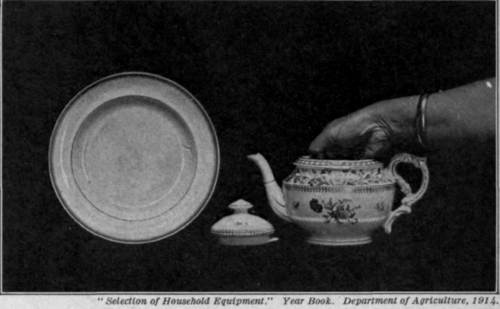
Fig. 38. - A pretty teapot of antique pattern, but so hard to clean that it better be kept as an ornament.
Some people think it necessary to serve their company with several kinds of cake, and preserves; and one wonders sometimes if their friends may not have indigestion from overeating. It is in better taste, and kinder, to have only one of each kind of food, each dish well cooked and daintily served; otherwise, the table may look as if it held a food exhibit instead of a meal. "Gold" and "silver" cake look pretty together on a plate, and are not too much to serve; but one layer cake is enough for any meal.
What shall we say about table manners? One day after the Girls' Club had given a luncheon to their friends in the Ellen H. Richards house, Barbara Oakes said: "It seems to me that it is just as important to know how to use the forks and knives and spoons as it is to lay them straight on the table. Did you notice how differently people use their forks and spoons? I wonder if Miss James would talk it over with us." Their teacher was glad to do so, and she made several helpful suggestions. Miss James said that the use of silver and dishes at the table varies in different countries and at different periods. For instance, in old times in America it was considered quite proper to pour the tea out into the saucer and to drink from that; and knives were made with round ends because the knife was once used for carrying food to the mouth. But there are certain principles of good manners that we all can remember. Eating slowly, drinking either a hot or cold beverage when the mouth is empty, chewing food with the mouth closed and without making a noise, and, of course, not dropping food, are all details that we should learn; because otherwise we make ourselves disagreeable to other people. It is considered better to take soup from the side of the spoon than from the end. Sometimes people are worried as to whether they should hold the fork in the left or the right hand. Which hand to use really is not a matter of great importance, provided the fork is managed nicely. The English custom is to hold the fork in the left hand, lifting it to the mouth; the French are inclined to hold the fork in the right hand, using it somewhat as one would a spoon. The important thing is to use the fork quietly and naturally and without spilling food. When we are invited to a formal luncheon or dinner, where there is quite an array of silver, we, of course, like to do as other people. The soup spoon we can easily know because it is larger. Some people have a small fork with one broad tine for fish. Fish is usually supposed to be eaten with a fork as it does not need cutting. If there are two or three knives, the smallest is probably for the bread and butter, and the largest for cutting meat. If there are two forks, one smaller and one larger, the smaller is probably for the salad and the larger for the meat dish. It is not worth while to be nervous and uncomfortable simply because the way of laying silver is not quite familiar. It is usually the custom to arrange silver at a formal affair in such a way that the outer pieces are used first. If you eat quietly and slowly, making as quiet motions as possible, your manners will be acceptable.

Fig. 39. - Incorrect position for holding knife and fork.

Correct position for holding knife and fork.
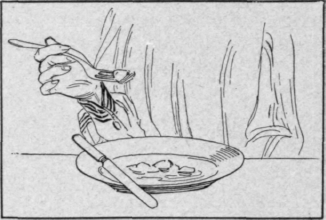
Fig. 40. - The fork is in the right hand ready to carry food to the mouth.
Talking at the table. There is one thing that does more at the meal than the table setting, and almost more than the good food. Do you know what it is? If you happen to be feeling what you call "out of sorts" make yourself tell an amusing story, and see what a flavor it adds to the supper.
Exercises And Problems
1. Discuss together different ways of setting and waiting on the table.
2. Make a list of dishes needed for a family of six or eight.
3. Send for some price list of dishes, and calculate the cost.
4. Make a simple plan for waiting on your home table.
5. Make suggestions for covering the table for breakfast, for a simple and a formal luncheon, and for a family dinner and a dinner when there are guests.
6. Make a drawing of one place laid for dinner.
Continue to:


My Books

