


Geographically. Grains
Description
This section is from the book "Food - What It Is And Does", by Edith Greer. Also available from Amazon: Food: What it is and Does.
Geographically. Grains
The conditions under which grains will grow are such as to make their widely distributed growth possible.
Probable Native Home Of Grains

(Redrawn from Frederic LeRoy Sargent's "Corn Plants."Used by permission and special arrangement with Houghton Mifflin Company, as are the cuts of different grains on pp. 20-21)
Diagram Of Crop-Production In United States - 1909

(From the Thirteenth Census of the United States, 1910)
Cereals Distribution
Wheat Acreage By States - 1909

(From the Thirteenth Census of the United States, 1910)
Corn Acreage By States - 1909

(From the Thirteenth Census of the United States, 1910)
In United States. Cereals
Cereals Acreage By States - 1909
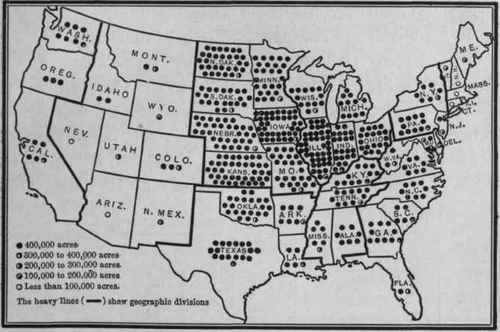
(From the Thirteenth Census of the United States, 1910)
Acreage in | Barley | Buckwheat | Rice | Rye | |
New England | 16,242 | 28,725 | 223,221 | 13,221 | |
Middle Atlantic | 87,733 | 592,159 | 2,518,886 | 472,132 | |
North Central, East | 1,007,102 | 139,971 | 11,225,445 | 968,558 | |
" " West | 4,762,928 | 25,955 | 15,710,495 | 470,582 | |
South Atlantic | 15,561 | 84,864 | 1,368,832 | 27,080 | 157,546 |
South Central East | 5,388 | 4,772 | 870,762 | 560 | 50,091 |
" " West | 14,253 | 121 | 1,276,534 | 582,523 | 5,926 |
Mountain | 313,606 | 316 | 1,164,204 | 32,115 | |
Pacific | 1,475,893 | 1,165 | 801,062 | 25,390 |
(From the Thirteenth Census of the United States, 1910)
On five skeleton maps (or trace maps of the United States if such working-maps are not available) dot in the above facts as in maps shown for wheat and corn. Compare wheat and corn on maps showing acreage with the statement below.
Cereals 191,395,963 Acreage In United States - 1909
Barley | Buckwheat | Corn | Oats | Rice (Rough) | Rye | Wheat |
7,698,706 | 878,048 | 98,382,665 | 35,159,441 | 610,175 | 2,195,561 | 44,262,592 |
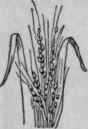
Rice.
Cereals - Composition
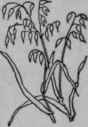
Oats.
Cereals as human foods are grain-seeds.
Grains are harvested when matured.
Seeds are compact and rich in nutrients.
Their richness is due to the germ that renews their life and also much plant-food. This supplies the needs for early plant-development when the seed becomes detached from the plant that has been its living connection with its food-supply. Thus another plant forms and later produces seeds. These reproduce again the part of vegetation the plant is.
Composition Of Cereals
Water | % IN | Protein | Fat | CH | MM |
14.3 | Buckwheat | 6.1 | I. | 77.2 | 1.4 |
12.7 | Rye | 7.1 | •9 | 78.5 | .8 |
12.4 | Rice | 7.8 | 4 | 794 | 4 |
12.9 | Corn meal | 8.9 | 2.2 | 75.1 | •9 |
10.8 | Barley | 9.3 | I. | 77.6 | 1.3 |
12.5 | Wheat, Winter | 10.4 | 1. | 75.6 | •5 |
11.6 | Spring | 11.8 | 1.1 | 75. | •5 |
11.8 | Graham (flour) | 13.7 | 2.2 | 70.3 | 2. |
12.1 | Entire wheat | 14.2 | 1.9 | 70.6 | 1.2 |
7.2 | Oatmeal | 15.6 | 7.3 | 68. | 1.9 |
The concentration of the nourishing substances and the widely distributed growth of grains make them foods of common value wherever humanity lives. The usual palatability of foods made of grain flours or meals makes their constant use in the human diet possible and desirable. Compare composition of cereals with that of other human foods.
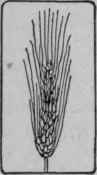
Barley.
General Composition Of Human Foods
Water | % IN | Protein | Fat | CH | MM |
80-90 | 1-14 | 1-2 | 3-85 | 2-5 | |
7-14 | Dry grains | I 5-20+ | 1-3 | 60 | 2-5 |
40-60 | 15-20 | 15-30 | 1-15 |
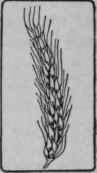
Rye.
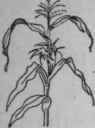
Maize.
Cereals - Preparation
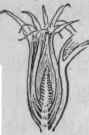
Corn-ear.
Grains are prepared for human food.
Dried they lose water; milled, salts.
Cereals require much water; also cooking.
The cooking-time for cereals not partially cooked indicates the difficulty of breaking up the grain so that its constituents can be made available for food. See table below. Starch is the chief constituent that requires much change. As always, it needs prolonged cooking to make it into the substance (a form of sugar) that is soluble, therefore more digestible.
Cooking Cereals (Adaptation Of Facts From Miss Farmer)
Cereal | Water | Hours | Cereal-Preparation | ||
Corn meal | 1C | 3 1/2 C | 3 | Preparations of corn: samp, maizena, hominy, etc. | |
4C | I | 1 C | |||
Oatmeal (coarse) | 1 C | 4C | Preparations of oats: H - O, Rolled or Quaker Oats, etc., | ||
1 3/4 C | i | 1 C | Rolled Avena (Keep these preparations in glass and stopper. Use promptly) | ||
Rice (steamed) | 1C | 2 3/4 - 3 1/4 C | 3/4 - 1 | ||
(according to age) | |||||
Rye flakes | 1C | 1 1/4 C | 1/3 | ||
Wheat (steamed and rolled) | Wheatlet, Wheatena, Wheat Germ, Wheat Toasted | ||||
1C | 1 1/4 C | 1/3 | |||
3 3/4C | 1/2 | 1 C | |||
Cooking with water changes proportions of ingredients :
Raw oatmeal: W 7.2% - P 15.6% - F 7.3% - CH 68% Cooked: W 84.5% - P 2.8% - F 5% - CH 11.5%
Different cereals, because of different composition, are advisable at different seasons, according to their heat-giving power.
Oatmeal, corn meal, (barley, rye, wheat) ground, gluten, hominy, rice. In winter, use from left to 7'ight. In summer, use from right to left.
Cereals are cooked as gruels for infants and invalids in need of liquid food; as porridge (with less water) for children. For adults in health, cereals are cooked as dry as palatability permits and should be thoroughly masticated to insure digestion.
Continue to:


My Books

