


Purin Metabolism - Gout. Part 3
Description
This section is from the book "The Elements Of The Science Of Nutrition", by Graham Lusk. Also available from Amazon: The Elements of the Science of Nutrition.
Purin Metabolism - Gout. Part 3
Furthermore these authors find that the guanase is absent from pigs' livers, while adenase and xanthin oxidase are present. It is interesting that Mendel and Mitchell1 have found in the liver of the embryo pig at an early age the same specific enzymes as characterize the liver of the adult animal. There was, however, a considerable delay in the appearance of the enzyme which oxidizes uric acid (see below). It is a curious phenomenon that pigs suffer from guanin gout. Their normal urines contain not only uric acid,2 but also large amounts of purin bases.3 The organs of the pig are deficient in guanase.4
Schittenhelm5 reports that human livers have the power to form uric acid from added purins, and he believes that the power to oxidize uric acid exists.
Lauder Brunton6 says that Stockvis, of Amsterdam, in 1860 found that crushed tissue had the power to destroy uric acid. This question has recently come into prominence and it has been shown that different organs have different powers in this regard, and that the same organ in animals of different species may behave quite differently.
Wiener7 showed that dog's liver and pig's liver destroyed uric acid, whereas calf's liver had less power to do so, or none at all. The kidney pulp of various animals also destroyed uric acid.
Schittenhelm8 finds that in cattle the spleen, lungs, liver, intestine, and kidney have the power of converting purin bases into uric acid in the presence of a constant oxygen supply. He finds a complete transformation of adenin, as follows: adenin, hypoxanthin, xanthin, uric acid. Guanin in like manner becomes xanthin and this again is converted into uric acid.
1 Mendel and Mitchell: "American Journal of Physiology," 1907, xx, 97.
2 Schittenhelm and Bendix: "Zeitschrift fur physiologische Chemie," 1906, xlviii, 140.
3Mendel and Lyman: "Journal of Biological Chemistry," 1910, viii, 115.
4 Jones and Austrian: "Zeitschrift fur physiologische Chemie," 1906, xlviii, 110.
5 Kunzel and Schittenhelm: "Zentralblatt fur Stoffwechsel," 1908, iii, 721.
6Lauder Brunton: "Centralblatt fur Physiologie," 1905, xix, 5.
7 Wiener: "Archiv fur exp. Path, und Pharm.," 1899, xlii, 375.
8 Schittenhelm: "Zeitschrift fur physiologische Chemie," 1905, xlv, 145.
He finds also that extracts of the spleen, intestines, and lungs have no power to destroy uric acid as formed within them, but that the kidney, muscle, and liver extracts possess the power to destroy the new-formed uric acid.
It is only recently that evidence has accumulated to show that the long believed physiologic oxidation of uric acid with the production of urea is impossible. To understand the subject it is necessary to consider the significance of allantoin which was first discovered by Wohler in cows' urine in 1849. Salkowski1 reported that the allantoin excretion increased in dogs after the administration of uric acid. The transformation of uric acid into allantoin takes place after the following reaction:
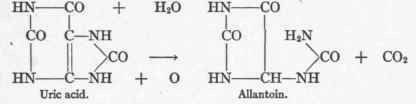
Cohn2 gave large amounts of thymus to a dog and found that the excretion of allantoin was greatly increased, though this did not happen in man, and experiments by Minkowski,3 performed during the same year, showed that when hypo-xanthin was fed to a dog 77 per cent, of it appeared in the urine as allantoin, while 4 per cent, was eliminated as uric acid. Mendel and White4 found that allantoin was eliminated in the urine of cats and dogs after the intravenous administration of urates.
It was long believed that allantoin was an intermediary product of the oxidation of uric acid. It is due to Wiechowski that the subject has become clarified. Wiechowski5 found that uric acid digested with the pulp of dog's liver was oxidized completely to allantoin and no further, and also that uric acid injected subcutaneously into a dog was almost completely eliminated as allantoin in the urine. These results were dependent upon the accurate method for the determination of allantoin which had been devised by the experimenter. It is evident, therefore, that the oxidizing enzyme uricase, which acts upon uric acid, carries its destructive power only as far as the production of allantoin, which is the end-product of purin oxidation.
1 Salkowski: "Ber. d. d. chem. Ges.," 1876, ix, 719.
2 Cohn: "Zeitschrift fur physiologische Chemie," 1898, xxv, 507. 3 Minkowski: "Archiv fur exp. Path, und Pharm.," 1898, xli, 375.
4 Mendel and White: "American Journal of Physiology," 1904-5, xii, 85.
5 Wiechowski: "Hofmeister's Beitrage," 1907, ix, 295; 1908, xi, 109.
An experiment1 made many years ago demonstrated that if an Eck fistula, which excludes the portal blood from the liver, be created in a dog, uric acid appears in increased quantity in the urine. The interpretation long placed upon this was that in the absence of the liver uric acid was not oxidized. Repeating this experiment, Abderhalden, London, and Schittenhelm2 found that the increase in uric acid elimination was compensated for by a decrease in allantoin excretion. The percentage values, contrasted with those in normal dogs' urine as established by Wiechowski, were as follows:
Eck Fistula. | Normal. 94-97 | |
Allantion ................. | 74-87 | |
Uric acid .............. | 12-8 | 2- 4 |
Purin bases ............... | 1-1 | 1- 2 |
1 Hahn, Massen, Nencki, and Pawlow: "Archiv fur exp. Path, und Pharm.," 1893, xxxii, 191.
2 Abderhalden, London, and Schittenhelm: "Zeitschrift fur physiologische Chemie," 1909, lxi, 413.
Continue to:


My Books

