


The Fate Of The Amino-Acids. Glycocoll (Ch2nh2.COOH). Continued
Description
This section is from the book "The Elements Of The Science Of Nutrition", by Graham Lusk. Also available from Amazon: The Elements of the Science of Nutrition.
The Fate Of The Amino-Acids. Glycocoll (Ch2nh2.COOH). Continued
This discussion has shown that one may compute that 35, 37, and 38 per cent, of the total endogenous protein metabolism of man, goat, and pig may pass through a glycocoll stage and be eliminated in the urine. It is certain that no protein contains this quantity of glycocoll. In spite of all the work accomplished there is no solution of the problem from what materials this synthetic production of glycocoll occurs. It arises as does creatinin without having as yet betrayed the secret of its origin. The synthetic production of glycocoll is of undoubted value in making possible the development of body tissue which contains glycocoll from milk proteins which, are free from it.
Glycocoll forms sugar in the organism. Ringer and Lusk1 found that it was completely converted into glucose in the phlorhizinized dog.
The method employed is to give to a dog, rendered diabetic by phlorhizin and then almost glycogen free by shivering, the material to be tested, and to observe the increased output of glucose in the urine. One may give glucose itself and witness its complete elimination,2 as follows:
1 Ringer and Lusk: "Zekschrift fur physiologische Chemie," 1910, Ixvi, 106. 2Taken from Csonka: "Journal of Biological Chemistry," 1915, xx, 543.
Period. | Glucose. | Nitrogen. | D:N. | Extra Glucose. |
Preliminary.......... | 3.68 | |||
Glucose, 16 g. .......... | 25.92 | 2.87 | 9.00 | 15.43 |
After period......... | .... | 3.54 |
There were 2.87 grams of nitrogen in the urine of seven hours. Assuming the customary D:N = 3.65 :1 (see p. 174), then the quantity of glucose derived from the metabolism of protein during the seven hours would be 2.87 X 3.65 = 10.49 grams. Deducting 10.49 grams from 25.92 grams found in the urine, it appears that 15.43 grams of extra sugar were eliminated during the period of experimentation.
In the case of glycocoll the results may be thus analyzed:
Period- | Glucose. | Nitrogen. | D :N. | Extra Glucose. |
Preliminary.......... | 12.82 | 3.40 | ||
Glycocoll, 20 g. ......... | 47.42 | 14.84 | 3.20 | 16.63 |
After period......... | 3.37 |
During a period of fourteen hours following the ingestion of 20 grams of glycocoll containing 3.73 grams of nitrogen12.82 grams of nitrogen appeared in the urine. The difference or 9.11 grams represents the nitrogen of the protein metabolism. Multiplying this by the prevailing D : N = 3.38, one obtains 9.11 X 3.38 = 30.79 grams of glucose which could have arisen from the protein metabolism of the time. Since 47.42 grams were actually eliminated, it follows that the difference or 16.63 grams of glucose derived their origin from glycocoll.
The reaction showing this conversion of glycocoll into glucose may thus be written, carbon dioxid being neutralized by ammonia liberated from glycocoll and the compound converted into urea.
6C2H5 NO2 + 3C02 + 3H20 = 2C6H4206 + 3CH4N2O + 3O2 20 g. glycocoll =16 g. glucose + 8 g. urea.
It should be noted that Cremer1 believes that only three-quarters of the carbon passes over into glucose and holds the following reaction to be the more probable:
4C2H5 NO2 = C6H42O6 + 2CH4N20
20 g. glycocoll = 12 g. glucose + 8 g. urea.
By what method may this reaction be accomplished? It has been shown that deamination results in the formation of either glyoxylic acid, CHO.COOH, or glycollic acid, CH2OH.-COOH. These materials must be reduced if they are to form glucose.
Haas2 could find no evidence of reduction of glyoxylic to either glycollic or acetic acid in the organism, nor was glycocoll formed synthetically from it by union with ammonia. Nor could Honjio3 find any indication of acetic acid formation after perfusing a liver with glycollic acid. Also, the synthesis of glycollic acid into glycocoll in the organism cannot be accomplished.4
If glycollic acid be the product of deamination, as appears most probable, its first reduction product would be glycol aldehyd.
CH2OH.COOH + H2 = CH2OH.CHO + H20
Glycol aldehyd in aqueous solution is polymerized with the formation of sugar,6 C6H42O6. If administered by subcutaneous injection to a rabbit it leads to an output of sugar in the urine.6 When perfused through the liver of a tortoise7 or of a dog8 glycol aldehyd is converted into glycogen. If glycol aldehyd be slowly administered to phlorhizinized dogs, as much as 75 per cent, may escape oxidation and be converted into glucose.9
1 Cremer: "Medizinische Klinik," 1912, viii, 2050.
2 Haas: "Biochemische Zeitschrift," 1912, xlvi, 298.
3 Honjio: Ibid., 1914, lxi, 286.
4 Sassa: Ibid., 1913-14, lix, 353.
5 Neuberg and Rewald: "Biochemische Handlexikon," ii, 266. 6 Mayer: "Zeitschrift fur physiologische Chemie," 1903, xxxviii, 151. 7 Parnas and Baer: "Biochemische Zeitschrift," 1912, xli, 392.
8 Barrenscheen: Ibid., 1913, lviii, 300.
9 Sansum and Woodyatt: "Journal of Biological Chemistry," 1914, xvii, 521.
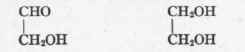
It is suggestive in this connection to remember that Neuberg1 has shown that yeast zymases may reduce this simplest of all the oxy-aldehyds into ethylen glycol:
Continue to:


My Books

