


Chapter 4. Proper Breathing. Part 2
Description
This section is from the book "Reichian Therapy. The Technique, for Home Use", by Jack Willis. Also available as a hardcopy from Amazon.com.
Chapter 4. Proper Breathing. Part 2
Accessory Muscles Of Chest Breathing
Accessory Muscles Of Respiration
pushing the chest up with the diaphragm
measuring the chest with a tape measure
Paradoxical Breathing
There are other muscles which can be used in breathing. If these muscles (see below) are used continuously you must undo this habit. These other muscles — other than those between the ribs — are called accessory muscles of respiration.
The accessory muscles, in healthy breathing, are used only during physical or emotional emergencies. If you are using them all the time it means you are operating at all times as though there were an emergency. You are literally approaching life as though it were an emergency situation. If you have trouble relaxing, trouble with anger, trouble with letting go, you approach sex as a demand performance; that way of being in the world can be explained by the fact that you are dealing with all of life as an emergency.
These accessory muscles are on the upper chest (the pectorals), on the front of the neck (the sternocleidomastoid), on the side of the neck (the scalenes), and on the upper back (the trapezius). Unfortunately, most people, when they breathe into the chest, use these accessory muscles. Later I will tell you how to see if you are using the accessory muscles. If you are using these muscles or can not breathe into your chest, for now simply be aware of the issue and let the exercises do a lot of the correction.
So much is accomplished just by the use of the exercises that you can leave the accessory muscle issue to later. At this point I simply want to explain the accessory muscles so that you can become aware of whether you are using them.
In broad strokes, we have three ways of chest breathing:
a. improper use of the diaphragm
b. improper use of the accessory muscles
c. proper use of the muscles between the ribs
The Diaphragm As An Accessory Muscle
Though it may seem a bit strange, the chest can be pushed up from the bottom by the diaphragm. This is inappropriate. It would really get technical if I tried to explain how this is done, so I will just leave it that it is done by all too many people. Later in Part One of this book I will tell you how to see if you are doing this and what to do to correct it.
The Other Accessory Muscles
You want to learn to breathe with the diaphragm (for the belly part of breathing) and the muscles between the ribs (for the chest part of breathing). You can tell if you are using your diaphragm during the inhale because your belly will balloon out. If you get no movement in the chest then you know you are not using it at all. But if you do have chest movement, then is it with the rib muscles or is it with the accessory muscles?
The first thing to know is whether your chest is or is not moving. If it is moving, then are you pushing it up with the diaphragm? If you are not pushing it up, then are you using the right muscles to expand it or the wrong muscles to only move it?
Breathing Properly Into The Chest?
Measuring The Chest
There are two simple methods to tell if you are expanding your chest rather than pushing it up from the diaphragm or pulling it up using the accessory muscles of respiration.
Footnote 15. In the most extreme case of this that I have seen, this person's lower rib actually flared outward producing what is medically called a "Harrison's sulcus."
The best way to see if you are expanding the chest is to use a simple tape measure, the kind used by tailors and dressmakers to measure the body. You can also use a piece of string but you can tell more if you stop by the store and pick up a tape measure.
Place the tape measure or string around your chest as shown in Figure 17 left and pinch the tape measure (string) against itself with two fingers.
You can also use your hands with the your index fingers touching and you thumb hooked around your ribs as in Figure 17 right.
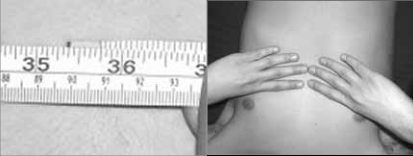
Figure 17
When you do a proper chest inhale, the tape measure (or your hands) should pull apart showing that the chest size is increasing (Figure 18 on page 76 shows use first of the hands and then the tape measure).
If the size of the chest (as measured by your hands or the tape measure) does not increase then either you have no chest breathing or you are using the accessory muscles of respiration or you are using the diaphragm to push the chest up. The issues of using the accessory muscles of respiration or using the diaphragm to push up the chest are discussed in Chapter seven. Also if you can work with a helper, Chapter nine provides extra exercises and techniques to further the work.
The amount of movement, assuming there is some, varies corresponding to your chest shape. There are two basic chest shapes: the long thin shape (like many rock musicians) and the barrel shape (like weight lifters) (see INDIVIDUAL DIFFERENCES on page 66) The amount of the increase in chest expansion will vary with the chest shape. With a long thin chest it may be only one half inch, with the barrel chest it should be at least an inch. Note that the tape measure in Figure 18 shows an expansion from 35 3/16 inches to 36 11/16 or an expansion of 1 1/2 inches. While the expansion in Figure 19 on page 77 is only 5/8 inches.


Figure 18


Figure 19
Paradoxical Breathing
I have emphasized that breathing, both inhale and exhale, is first belly and then chest. Some people breathe with the opposite pattern: they first breathe into the chest and then into the belly. This is called "paradoxical breathing."
If you do breathe in this paradoxical manner, it can take some time to correct; but it is important. The goal of all these exercises is to get rid of the chronic state of tension in your muscles. Getting rid of this chronic tension will result in major changes in you as a person.
Proper breathing will result, over time, in relaxing the diaphragm. Paradoxical breathing will result, over time, with tensing the diaphragm.
If you do find that you are using paradoxical breathing as your normal way of breathing then, without question, your first objective in learning to breathe is learning to breathe in the correct order. That is job one.
There is also a variant of this paradoxical breathing that I need to mention so that you can watch for it. This happens when you breathe into the belly first, but then when you start the chest inhale you draw the belly in (that is, you collapse or tense the belly). After you breathe into the belly it should stay ballooned out during the chest inhale. Figure 20, on the left, shows the proper belly out at the end of the inhale and on the right, the belly was contracted during or after the inhale.
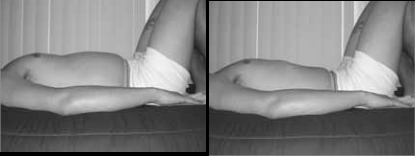
Figure 20
You can test to feel if you are contracting or have a tendency to contract the belly after the inhale by placing your hands on the upper abdomen just below the breast bone. That hand placement will allow you to feel whether you are tensing the abdomen during the inhale to the chest. This is shown in Figure 21.
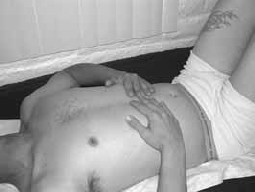
Figure 21
Continue to:


My Books

