


The Brown Top
Description
This section is from the "Blast Furnace Construction In America" book, by J. E. Johnson, Jr.. Also see Amazon: Blast Furnace Construction In America.
The Brown Top
Although I have referred to the persistence of hand-filling as almost universal up to the time of the Duquesne revolution, it is a fact that the first reasonably satisfactory apparatus for mechanical charging had been introduced several years before. The skip which dumps by turning nearly upside down, as described in the second article of this series, has been known for a long time. I am told that it was used two hundred years ago in Sweden. An attempt was made to use skip filling by Fayette Brown, the father of the late Alexander E. Brown. It is said that the furnace so filled worked irregularly in the way in which so many such furnaces have done, and the skip was therefore thrown out. In order to secure symmetrical distribution with hand-filling it occurred to Fayette Brown to put a cover over the entire hopper with a single opening through it large enough to admit of dumping only one barrow, and at a certain definite location. This cover was revolved about the axis of the furnace by a mechanism driven from the hoist sheaves, so that this opening advanced one dumping space at each revolution. This, of course, forced the top fillers to dump correctly.
Many years later it occurred to Alexander E. Brown to combine this controlled system of dumping with the skip hoist by having the skip deliver into a central hopper with an outlet spout on one side, and revolving this hopper and spout around the vertical axis of the furnace by a mechanism driven from the hoisting sheaves. This is the essential principal of the "Brown top," at least one of which was in operation several years before the Duquesne revolution, and has, I think, continued in operation from that time to this.
Fig. 38. Brown Rotating Top.
This top as now built is shown by the line drawings, Figs. 38 and 39, and by the photographs, Figs. 40 and 41. At the bottom of the line drawing are shown the bell and hopper; above these, on the top of the furnace proper, is the conical gas seal which acts as a support for the revolving distributor and the gears which drive it. Above the hopper is seen the skip in its dumped position, and at the top the main rope sheave, with the gears through which it drives the vertical shaft descending to the gear box just outside the distributor cone, through which the latter is revolved. The detail of the sheave and the upper gears is shown in Fig. 39.
The gas seal consists of a flap valve on the spout of the receiving hopper whose normal position is open, as shown in full lines in Fig. 38, but which is closed by the first portion of the movement of the main bell, acting through the bell crank shown in dotted lines. This gas seal is not so tight as a bell and is subject to the objection above described, that its normal position is open, so that if the main bell is leaking to a considerable extent the gas can rise through the spout and burn almost without interruption around the upper portion of the top mechanism.
There is a ratchet in the mechanism which drives the hopper when the sheave runs in one direction, but allows it to stand still when the sheave runs in the opposite direction, on the return trip; thus the hopper is rotated a definite amount with each trip of the skip.
At this point Mr. Brown introduced into the design an admirable feature. Instead of having the distributor rotate through an angle commensurable with 360 deg., so that it would always return to the same position at the end of every complete revolution, he designed it to revolve two or three degrees more or less than a quarter of a revolution, so that at the end of four movements it is about ten degrees one side or the other of the point at which it started, and only after many revolutions, representing a great number of charges, does it return to its initial point. This has the great advantage of giving not only each segment, but each fraction of the circumference of the furnace exactly the same treatment, and this is greatly to be preferred to any system which must always use the same starting point, since in that case any irregularity due to the difference in shape of the first skip load dumped and the last, or the like, is localized in one place and may cause serious trouble, whereas if it went to each point of the circumference in turn it would do no harm.
Any mechanism at the top of the blast furnace has to operate under extremely difficult conditions. It is necessarily surrounded by the dust arising from the different components of the charge, which is sharp, gritty, and destructive to the last degree, and is exposed to temperatures not infrequently above those at which lubrication is possible, and if there be a leak of the main bell so that gas escapes at all freely, the apparatus is entirely likely to be subjected to direct flame. These conditions are so severe that they alone have caused the defeat of many tops, and in the early days they undoubtedly caused many mechanical difficulties in the operation of the Brown top.
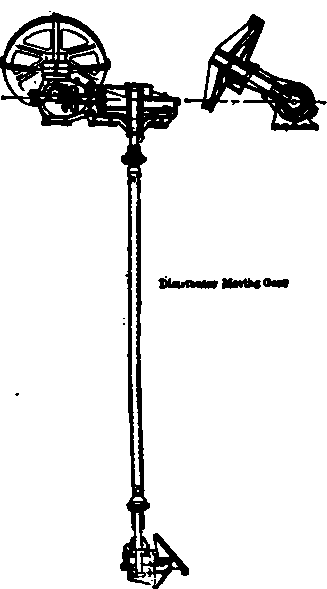
Fig. 39. Rotating Gear for Distributor.
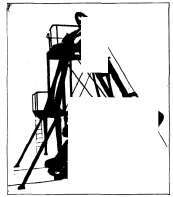
Fig. 40. Brown Top removed from furnace.
With the passage of time many of the features of the design which caused these difficulties have been overcome, and in the North where furnace tops commonly work at quite low temperatures, about 400 deg. or below, these mechanical troubles have not been so severe, but in Southern practice, with greater coke consumption, and much hotter top conditions, the Brown top has in more than one instance been discarded for the purely mechanical reason that it could not be kept in successful operation, the situation frequently being complicated by the fact that mechanics of sufficient skill to operate a mechanism of this kind successfully were, in past years, scarcer in the South than in the North.
In addition to these mechanical difficulties of operation the Brown top in spite of its appearance of perfect symmetry does not give an absolutely symmetrical distribution.
An examination of Fig. 28 will show that the line of the distributor in the position drawn is practically a continuation of the line of the bottom of the skip, so that the material discharging from the latter has only to continue on its way straight through the distributor, and is thereby delivered from it with velocity practically unchecked. But when the discharge spout of the distributor is in the position opposite to that shown, its slope is almost at right angles to the line of discharge from the skip, and material delivered upon it is therefore brought practically to a standstill, and starts again virtually from rest, so that its velocity of delivery from the distributor is very materially less from this position than from the position opposite. The result is that the material is thrown considerably further out in the hopper with the distributor in the position shown, than in its opposite position.
Fig. 41. Brown top on furnace.
Moreover, when the spout of the distributor is at right angles to the position shown, another effect comes in. The spout is not a mathematical line, but is necessarily a broad opening to permit the escape of the stock under any and all conditions, and to pass pieces of scrap of considerable size. The material discharging into the hopper from the skip has a very considerable horizontal component to its velocity when it strikes the distributor, and instead of discharging down the axis of the spout, this horizontal velocity takes it over to the far side of the spout, whether the latter be turned toward or away from the observer.
The effect of this is, of course, to put more material on the side of the bell opposite to the skip than on the side next to it. In other words, in spite of the central location of the axis of the distributor the horizontal velocity of the stock imparted by the skip persists to some extent and carries the center of gravity of the pile of stock, as it rests on the bell, considerably beyond the axis of the furnace. That is, the side of the furnace next the skip receives a considerably smaller portion of every charge than does the opposite side. Unsatisfactory furnace work has been traced directly to this cause in several cases.
Continue to:


My Books

