


The Dry Blast. Part 7
Description
This section is from the "Blast Furnace Construction In America" book, by J. E. Johnson, Jr.. Also see Amazon: Blast Furnace Construction In America.
The Dry Blast. Part 7
Fig. 247 shows the coolers C, D, E, F as if they were arranged in a straight line so as to show the currents through them. C is a heat exchanger in which the cold outgoing air is warmed up almost to inlet temperature by the warm incoming air from the blowing engine. This accomplishes two good results. It sends the air warm to the stoves, and, much more important, it does a part of the cooling which would have otherwise to be done by more expensive means, i.e., direct refrigeration.
From C the blast passes into D, which is simply a spray tower supplied with natural cold water. This continues the refrigeration begun in C, and remembering that cooling-water is generally available at or below the dew-point of the air, and that the density of the air is approximately doubled by compression before entering this system, it is obvious that the temperature produced by such natural cooling-water will precipitate much of the moisture. From D the air passes into the base of E, which like C is a heat exchanger. The cold air coming from the second spray tower presently to be described, and at the lowest temperature reached in the system, enters at the top of E as shown, while the incoming air to be refrigerated enters at the bottom, and passing in counter-current through the tubes of the exchanger is cooled to an important extent, while the outgoing blast is, so to speak, prewarmed for its entrance into C, because of course it is bypassed around D and passes directly from E to C. From E the ingoing air enters the second spray tower F cooled with water refrigerated to a temperature between 32° and 40° F. These spray towers have two great advantages. First, they avoid the use of expensive tubes for heat transmission. Second, they obtain immediate and practically unlimited contact with the air to be cooled, so that the drop in temperattire between the two is practically negligible. The incoming air therefore is reduced virtually to the temperature of the cold rain, or somewhere about 38° F. From Fig. 242 it will be seen that at this temperature the moisture is .38 lb. per cubic foot; from this, remembering the compression of the air under which these conditions prevail, we find .19 lb. per cubic foot as the equivalent moisture in uncompressed air. This corresponds to a dew-point of 22° and is as low as it is economical to go in blast refrigeration.
Fig. 245. Elevation of carrier dry-blast plant (ammonia compressors motor driven).
Fig. 246. Plan of Carrier dry blast plant.
One point of much importance is to be noted here. The temperature of the cold rain is well above the freezing point, while to secure a corresponding degree of refrigeration on the precompression system it is necessary to refrigerate well below the dew-point, and this introduces all the complications caused by ice.
Both the pre-compression and post-compression systems have their advantages and their disadvantages. One of the principal merits claimed for the dry blast in its early days was that it produced a uniformity in conditions, in the quantity of air and the oxygen contained therein, delivered to the furnace per minute, and a considerable number of metallurgists attributed entirely to this fact the improvement in the operation of the furnace which it brought about. To the latter view I have never been able to subscribe. I shall later show what seemed to me conclusive reasons for believing that the great advantage of the dry blast lies in its dryness. At the same time the advantages of uniformity are not for a moment to be ignored. Now it is obvious that if the blast be reduced to a constant temperature, say to 25° F., which was the practice at one time, nearly all the moisture is removed from it, as shown by Fig. 242, and the quantity remaining is made perfectly uniform while the temperature and therefore the density of the air are likewise rendered uniform. It then becomes necessary only to run the blowing engine at a constant speed to secure all the advantages of a constant weight of air per minute to the furnace. If a constant quantity of air be blown it is obvious that its volume after compression must vary from hour to hour and day to day on account of the varying pressure required by the blast-furnace which produces a corresponding variation in the density of the air. Therefore if the quantity of moisture per cubic foot be kept the same by having an absolutely uniform temperature after refrigeration, the variation in the number of cubic feet due to the cause just explained still causes some variation in the actual quantity of moisture delivered to the furnace.
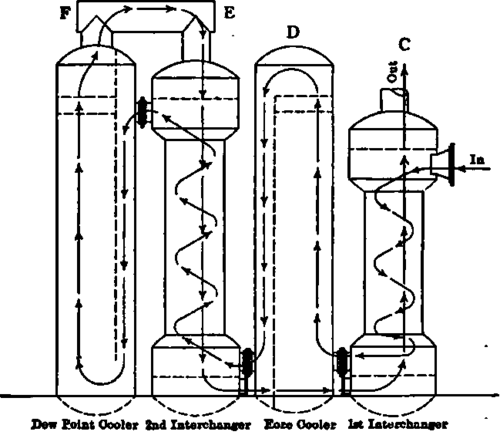
Fig. 247. Diagram showing arrangement of cooling towers and regenerators of carrier plant in proper relation.
In recent years it has become the practice to change the speed of the blowing engine according to changes in the temperature of the inlet air, to compensate for the corresponding variations in its absolute volume. No difficulty is found in keeping constant the weight of air delivered to the furnace by this simple means. The Carrier Air Conditioning Company has applied the same idea to securing a constant quantity of moisture in the blast irrespective of the blast pressure, regulating the dew-point by means of changes in the temperatures of the refrigerating apparatus; it has also developed a mechanism whereby this change is automatically made, thus securing a constant weight of moisture with varying blast pressure.
So far no one has as yet introduced a compensation for variations in barometric pressure, though doubtless that refinement will come at some plants in time.
Continue to:


My Books

