


9. Removing Walls In Sections
Description
This section is from the "Safety In Building Construction" book, by The Travelers Insurance Company Hartford, Connecticut. Also see Amazon: Safety In Building Construction.
9. Removing Walls In Sections
Sections of wall should never be loosened and allowed to fall as single masses upon the floors of buildings that are being demolished, because the shock transmitted to the floor may cause it to give way; and chimneys and large sections of wall should never be pulled down bodily even upon the ground, without taking every possible precaution to avoid accidents, not only to the workmen but also to other persons. When an operation of this nature is about to be performed, a crowd of idle sightseers usually congregates at the nearest place from which a good view may be had, with but slight regard for their own safety. The man in charge of the work should see that all such persons retire permanently to a place well beyond the danger zone, before the wall is disturbed.

Fig. 5. A Metal Chute in Position for Discharging.
(The chute referred to is in the center of the illustration).

Fig. 6. A Metal Chute in the CLOSED Position.
(See also Fig. S).

Fig. 7. Demolishing a Brick Wall.
It is always better and safer to remove walls part by part, rather than to throw them down bodily. The usual method, when destroying brick walls, is for the men to sit or stand on the walls and loosen the bricks by means of pinch-bars, - the bricks then being dropped to the floor. If, however, the walls are so thin or weak as to make it dangerous to stand or sit upon them to remove the bricks and stones of which they are composed, horse scaffolds or stagings should be erected beside them, for the men to work upon.
10. Storing Salvaged Material
In the process of demolition much material can be saved which may be used on the new construction or sold to good advantage. Doors and windows, rafters, floor joists, flooring, and lumber of various other kinds, structural steel, bricks, and stone, are all of considerable value. If such material is to be used in new construction at the same location, arrangements must be made for storing it temporarily. In the congested district of a large city there is usually no storage space available on the job, and the material must then be carted away. In other cases, however, it is often possible to store a part of it at least, in the street, or on an adjoining vacant lot, or even on some part of the property on which the new structure is to be erected. No matter where it is stored, certain precautions should be taken in piling the material, in order to prevent accidents.

Fig. 8. A Dangerous PILE of Bricks.
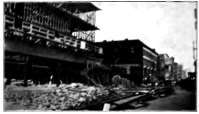
Fig. 9. A Sidewalk Shed which Collapsed from Overloading.
Bricks should be cleaned immediately and stored in orderly piles not more than five feet high. The bricks should not rest directly on the ground, but should be laid on foundations of planks or boards, and the piles should be braced, if necessary, to prevent them from falling over. Nails should be removed from boards, planks, and timbers, and these materials should also be laid up in orderly piles on suitable foundations. Cross strips should be used, whenever necessary, to bind the piles together and provide greater security.
If it is necessary, for any reason, to store old material within the building for a time, great care must be taken to avoid overloading the floors. Old material should not be stored on the tops of sidewalk sheds unless the sheds have been specially designed for such a purpose, and even in such cases strict precautions must be taken to avoid overloading. Storing material in this way should be considered as a temporary measure only, and the material should be removed as soon as possible. (See also paragraphs 21 and 69).
11. Use Of The Oxy-Acetylene Cutting-Flame
In demolishing buildings containing steel beams or other metallic structural elements, the oxy-acetylene flame is now widely used for cutting the metal. Work of this kind should always be done by an experienced man who thoroughly understands the process, and who also has sufficient knowledge of structural principles to avoid cutting off important members that are required for supporting or strengthening the part of the building that still remains standing.
Beams that are about to be cut should first be properly secured by ropes or chains, so that they cannot drop or swing when they have been cut away from the other steelwork to which they were attached. When the cut is completed the two ends are often held together by fused oxide, so that a blow from a sledge is necessary to separate them. However well the beam may have been secured, it is likely to swing slightly when the ends are finally severed, and unless the workman is watchful his hands may be caught and crushed or bruised.
Continued exposure of the unprotected eyes to the acetylene flame acts injuriously upon them, and all operators of acetylene torches should be provided with colored-glass goggles, and should always wear them when working. They should also wear suitable gloves to protect their hands in case of accidental contact with the heated metal.
Commercial acetylene is injurious to the health, even when highly diluted with air, and care should be taken to avoid inhaling it. The ventilation at the workplace should be good, and special care in this respect should be exercised when using the acetylene torch in confined spaces. The torch consumes considerable oxygen, and impoverishes the air in that way also.
Combustible material of every kind should be removed from the immediate vicinity of the acetylene torch, because fires may be started by direct contact with the flame, or by the fall of highly-heated pieces of metal or of oxide. Shields composed of incombustible material should be provided to intercept falling pieces of hot metal and oxide, when persons are working directly beneath places where welding or cutting operations are being performed.
Continue to:


My Books

