


III. Protection For The Public. 16. Sidewalk Sheds And Bridges
Description
This section is from the "Safety In Building Construction" book, by The Travelers Insurance Company Hartford, Connecticut. Also see Amazon: Safety In Building Construction.
III. Protection For The Public. 16. Sidewalk Sheds And Bridges
Sidewalk sheds have been described in paragraph 6, to which the reader is referred. Sidewalk bridges are similar in construction, except that they have no roofs, and are sometimes used when the excavations for new buildings extend out to the street line and require the removal of the sidewalks. The floor of the bridge, in such a case, is usually at an elevation of several feet above the street level, and stairs or steps are provided at each end to give access to it, and thus afford a continuous passageway in front of the property.
A bridge of this kind is preferable to a temporary sidewalk laid in the street, as described in paragraph 6. It affords no protection against falling objects, however, and therefore must be covered over if used on a demolition job; and when employed in connection with construction work, it must also be roofed over as soon as the work has progressed to a greater height than the floor of the bridge. When covered over in this way it is, in effect, a sidewalk shed.
Every sidewalk bridge (whether it be covered or uncovered) should be substantial in construction, and strong guard-rails and toe-boards should be installed on both sides of it. Hand-rails should also be installed on all steps leading to these bridges.
17. Location Of Contractor's Office
The office of the head contractor, in many cases, is constructed on top of the sidewalk shed or bridge, and for some strange reason is often situated in an unnecessarily dangerous place, where it is likely to be struck by stones or by other objects that may fall to the bridge. Convenience requires that the office be near the work, but there is frequently a great difference in the exposure, according as it is built at one part of the sidewalk bridge or at some other part. Needless hazards of this kind should be avoided.
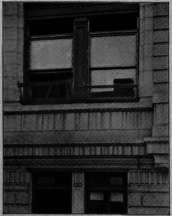
Fig. 14. A Guard to Intercept Falling Tools and Other Objects, when Men are Working about Windows.
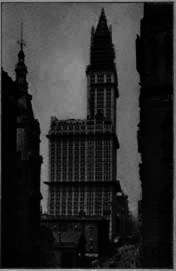
Fig. 15. Catch-scaffolds on the Woolworth Building.
(The purpose of these scaffolds is described in the text. See also Fig. 16).
18. Street Coverings
When the entire adjoining street is roofed over except for openings through which material may be hoisted, hinged hatches composed of two-inch planks should be provided for the openings, and these hatches should be raised and lowered by means of blocks and falls. In addition, guardrails and toe-boards should be installed on all four sides of the openings, and the whole inclosed with heavy wire netting. These guards should be set back at least two feet from the edges of the openings.
19. Protective Platforms
In addition to the sidewalk shed it is sometimes necessary, on a high structure, to extend protective platforms out from the building at different heights, to catch falling material and prevent it from descending into the street. A platform of this description may advantageously be 15 feet or more in width, and it should be protected along its outer edge by substantial wire-mesh screens, similar to those described in paragraph 6.
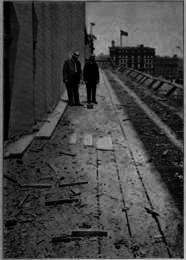
In the erection of the Woolworth Building in New York City special attention was given to the construction of catch-scaffolds of this kind, and platforms 20 feet wide were thrust out from the building at four different heights. These had wire-mesh screens arranged along their outer edges to give still further protection. Fig. 15 shows three of these platforms, and Fig. 16 shows the appearance of the platform at the fifteenth floor, which is the lowest one of those shown in Fig. 15. The amount of debris on this platform should be noted. Some of the fragments would have produced serious injuries if they had struck persons below.
The wire netting at the edge is not supposed to be relied upon for checking the direct fall of materials, but after they have struck the main platform they often rebound somewhat, and the netting is useful in preventing such fragments from bounding or rolling over the edge of the platform.
20. Protecting Pavements
Where heavily-loaded teams or motor-trucks must be driven across the sidewalk, the surface of the walk must be removed or covered over in some way so that it will not be broken. Municipal regulations often require that the street pavement also be protected against damage, particularly when it is of sheet asphalt. It is customary to lay heavy planks over the pavements for this purpose, and care should be taken to see that no holes are left into which persons may step, and that the planks are level and are arranged so that they will not tip up at the ends and cause persons to stumble. It is often advisable to lay beveled planks at the sides and ends of protective coverings of this kind, and it is always important to see that there are no projecting nails or large splinters that might cause injuries.
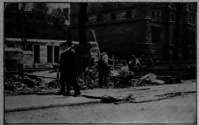
Fig. 17. A Poorly-made Protection for a Sidewalk.

Fig. 18. Unsafe Piling of Heavy Steel Girders.
(These are piled unnecessarily high. Moreover. the pitl leans to the right. as shown by the improvised plumb-line).
21. Storing Materials In The Street
When building material is stored in public highways, great care must be exercised to see that it is properly piled, so that it cannot fall over or collapse. It should be disposed so as to obstruct traffic as little as possible, and should in no case cover more than one-third of the width of any public highway. The piles should also be guarded at night by an adequate number of lights, located at conspicuous points. (See also paragraphs 10 and 69).
22. Excluding Persons From Buildings
All unauthorized persons should be excluded from places where demolition or construction operations are going on, not only because they are likely to be injured, but also because they often interfere with the workmen. When practicable, gates or doors may be installed to keep out all persons not directly connected with the work, or watchmen may be stationed at the entrances for the same purpose. Special arrangements may be made on behalf of persons seeking employment, either by designating certain hours when they will be admitted, or, preferably, by receiving them at some convenient point outside of the region of danger.
Continue to:


My Books

