


IX. Mixing And Pouring Concrete. 57. In General
Description
This section is from the "Safety In Building Construction" book, by The Travelers Insurance Company Hartford, Connecticut. Also see Amazon: Safety In Building Construction.
IX. Mixing And Pouring Concrete. 57. In General
There are a number of different ways of mixing and pouring concrete, and the method employed in any particular case depends largely upon the size and character of the job. The simplest way, of course, is to mix the materials by shoveling them over by hand, after which the concrete is either shoveled directly into the forms, or is transferred in wheelbarrows from the point where it is mixed to the place where it is poured. This method is slow and inefficient and is seldom employed on large operations. It is commendable from the safety engineer's viewpoint, however, because with hand-mixing the possibility of serious accidents is reduced to a minimum.
58. Mechanical Mixers And Their Hazards
Mechanical mixers are now available in a large variety of types, adapted to jobs of every size and description. Many of these are portable or semi-portable, and are mounted either on wheels or on skids so that they may be moved about (some of them are self-propelled), as convenience requires, to various parts of a particular job or from one job to another. The motive power for operating concrete mixers is furnished by steam or gasoline engines or electric motors, and the mixer and the engine or motor are usually mounted on the same base so that they form a complete unit.
It is to be regretted that so little attention is given to the mechanical hazards of concrete mixers, particularly in connection with mixers of the smaller sizes. Guards for the exposed gears, belts, sprockets and chains, flywheels, and other moving parts of the machines are the exception rather than the rule. Projecting set-screws are quite common, and they are always dangerous. All of these moving parts are accident-producers which might be eliminated with comparatively little trouble or expense. As an illustration of the seriousness of the accidents that may result from lack of safety precautions in connection with concrete mixers, we may mention a case where a man's coat was caught by a set-screw on a gasoline engine driving a mixer. The man was unable to release himself and was drawn against the unguarded gears of the mixer. His chest and right shoulder were crushed and he died almost immediately.
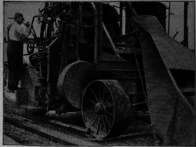
Fig. 82. Guards For A Concrete Mixer.
The hoppers or "skips" on large portable mixers of some types are also sources of danger. With the arrangement that we have in mind a sheet-metal hopper, hinged at the end nearer the mixer, is lowered to the ground and the stone, sand, and cement are deposited on it. When the hopper is full the outer end is raised by means of a hoisting device which forms a part of the machine, and the contents of the hopper slide into the mixing drum. The special danger to which we refer is the possibility of the men working about the mixer being struck by the hopper when it is lowered. Accidents of this kind occur from time to time, and in one case a prominent New York contractor was killed in just this way. Some manufacturers of concrete mixers provide guard-rails which may be placed on either side of the skip, at the base of the machine, which prevent persons from walking under the skip while it is raised. Unfortunately, however, the men in charge of the mixers often fail to use these guards when they are provided. The neglect of such a simple precaution is inexcusable.
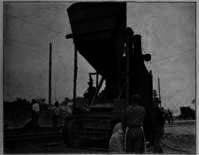
Fig. 83. A Larch Self-propelled Concrete Mixer.
In the absence of guard-rails it is advisable to provide the mixer with a gong, which will be automatically sounded by the mechanism that releases the hopper. It is also advisable to paint a conspicuous danger sign on the bottom of the hopper, warning persons to keep at a safe distance; and the operator of the mixer should invariably see that all the workmen are out of the danger zone before the hopper is lowered.
59. Wheelbarrows And Runways
Wheelbarrows are used for transporting the concrete from the portable mixers to the points where it is to be poured. There are a number of hazards in this part of the work that are too often overlooked or neglected. In the first place, the wheelbarrows should be kept in good condition. If they are constructed of wood, care should be taken to see that there are no splinters in any part of the barrows, that might cause injuries. Metal barrows are more commonly used, and these should also be examined from time to time to discover defects or weaknesses. (See also paragraph 66).
Elevated and inclined runways are required, on many building jobs, to make it possible for the loaded wheelbarrows to reach the points where the concrete is to be poured. The use of these runways may lead to accidents, unless they are constructed carefully and with sufficient strength, and are maintained in good condition. The suggestions contained in paragraph 49 should be carefully followed, in order to make the use of runways as safe as possible.
Continue to:


My Books

