


VII. Ladders, Stairways, And Runways. 47. Ladders
Description
This section is from the "Safety In Building Construction" book, by The Travelers Insurance Company Hartford, Connecticut. Also see Amazon: Safety In Building Construction.
VII. Ladders, Stairways, And Runways. 47. Ladders
As fast as the work progresses, safe means should be provided to give access to all points in the building. For this purpose numerous ladders are necessary, and as too little attention is given, in general practice, to making them strong and substantial, many accidents result. Ladder manufacturers are giving increased attention to this matter, but crude ladders are often made up by the men on the job from any material that is at hand, - cross-pieces being nailed to a pair of stringers of the necessary length, with little regard to the proper strength and spacing of the cross-pieces, or the ultimate safety of the finished structure. The stringers and rungs are often rough and full of slivers and splinters, and projecting nails are also common. The workmen have to go up and down these ladders many times a day, and they are subjected to great and wholly needless danger because of the poor construction. (If temporary cleat ladders must be used, they should be constructed in accordance with the specifications given on page 114).
Every ladder should be strong and substantial, composed of the best materials obtainable, and constructed with great care. For manufactured ladders the stringers should be of spruce, Oregon fir, or selected yellow pine, and the rungs or cross-pieces should be of oak, white ash, maple, or hickory. Special attention should be given to all ladders that are used for connecting the various floor levels prior to the installation of the regular stairways. These ladders should be set in place immediately after each rise of the derrick, and they should not be removed until the stairways are in proper condition for use. On large construction jobs, ladders used for this purpose may be made double the width of an ordinary ladder, with an extra stringer in the center. (A ladder of this kind may be seen in Fig. 84.) Preferably, however, there should be two separate ladders, side by side, - one to be used for ascending and the other for descending. Provide suitable landing platforms at the upper and lower ends of these ladders, and at all other points where the workmen must step on or off them; and see that each ladder is long enough to extend at least 5 feet above the highest platform, to enable the workmen to grasp it firmly before descending. In installing a ladder for any purpose, it is advisable to have one of its rungs come flush with the platform to which the ladder leads. When this is not practicable, care should be taken to have the rung that is nearest the platform stand two or three inches above it, rather than below it, because a better footing can be had in this way.
Builders' Portable Cleat Ladder. Approved Construction

Fig. 73.
LENGTH | Inside Width Bottom Top | Cross section of Rails | Crow section of Cleat |
17'0'to12'0' | 21" 18" | 2" x 4" | 7/6" x3" |
13'0' to 16'0' | 21" 18" | 2" x 4" | 76" x3" |
17'0'to20'0' | 23" 20" | 21/2" x 5" | 7/6" x4" |
21'0' to 24'0' | 26" 23" | 21/2" x 5" | 7/6" x4" |
25'0' to 30'0' | 28" 24" | 3" x 6" | 7/6" x/4" |
Rails should be of straight-grained, sound spruce, Oregon pine. Norway pine, yellow pine, or other wood of equal strength.
Cleats should be of straight-grained, sound spruce, yellow pine, or other wood of equal strength.
Cleats should be housed into rails 1/2 inch, and should be nailed to each rail with three ten-penny wire nails.
Sound knots will be permitted in rails and cleats when they do not exceed 1/2 inch in diameter and are 1/2 inch or more from edges of rails and cleats.
Cleats should be spaced 12 inches apart from center to center on all ladders.

Note - These specifications apply to ladders that are built by contractors for temporary use. It is nut intended that ladders of this type shall be recommended la preference to manufactured ladders.
See that every ladder is securely fastened both at the top and at the bottom, so that it cannot move in any direction; and if necessary, it should also be braced at the middle of its length to prevent it from swaying, bending, or shaking. Do not permit tools or other objects to be left upon the landing platforms.
Take care to place all portable ladders on a firm and level foundation, and see that they are so placed that they can neither tip over, nor slide sidewise, nor slip at the bottom. Ladders should be equipped with safety pads or shoes, or with spurs, whenever they rest upon any material on which they are likely to slip. The shoes may be made of some abrasive substance, or of rubber or other suitable material. Sharp metallic spurs are effective when the ladder rests upon a surface that these spurs can penetrate. Inspect all ladders frequently, replace all worn or missing rungs, and make all other repairs that may be necessary.
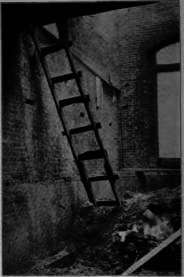
Fig. 74. A Poorly-Constructed Ladder.
Ladders up which materials are to be transported should not be more than 30 or 35 feet in length. If it is necessary to proceed to a greater height than this, two or more separate ladders should be used; but in such a case the successive ladders should not come one over another, and no one of them should extend over a place where men are at work, nor over any passageway. If such an arrangement is impracticable, each ladder should be sheathed underneath in such a way that objects falling from it will be arrested by the sheathing, and prevented from falling upon the ladders or workplaces below, - the sheathing being placed far enough from the under surface of the ladder to insure a good foothold for the men, upon the rungs. Helpers carrying material in hods or otherwise should be instructed not to go upon a ladder when another man is already upon it. Serious accidents frequently occur when this precaution is neglected, because it is not uncommon, when two men are using a ladder at the same time, for the upper one to fall or to drop his load or some part of it, thereby knocking the lower man from the ladder. It is best to have at least two ladderways, one to be used exclusively by men going up, and the other exclusively by men going down. When this plan is in force it is easier to make the men go up one at a time; because when a single ladderway is used for travel in both directions, they naturally form the habit of ascending with their loads, in gangs or groups of three, four, or five, in order to avoid confusion and delay through meeting others who wish to come down.
Workmen using ladders should not be permitted to carry loads that will interfere with the free use of both hands for holding on to the side-bars. Sliding down ladders should be forbidden, and the men should always face a ladder when ascending or descending it.
Except in case of real necessity, ladders should never be extended by joining two of them together. It is far better, whenever practicable, to arrange them in single lengths with a landing platform at the top of each ladder. Whenever it becomes necessary, for any reason, to join ladders together, the operation should be performed with great care, by a person skilled in the work; and the joint should be solidly braced and supported, so that no bending stress can be thrown upon it.
Continue to:


My Books

