


Marble Plunge Bath In A Private Residence
Description
This section is from the book "American Plumbing Practice", by The Engineering Record. Also available from Amazon: Plumbing: A working manual of American plumbing practice.
Marble Plunge Bath In A Private Residence
(Published In 1893.)
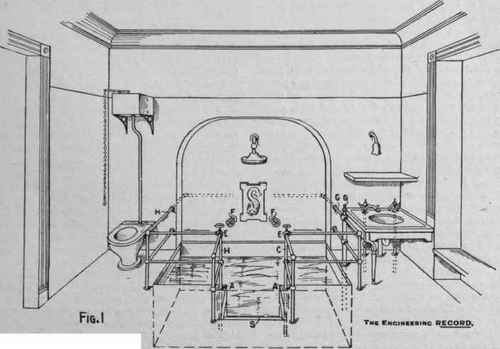
The following description illustrates an arrangement of a sunken bath lately executed by Mr. Paul S. Bolger in a residence in Fifty-eighth Street, New York City. Figure 1 is a perspective view of the owner's private bathroom, which is floored and wainscoted with white marble and contains a 420-gallon sunken bathtub, or pool, which is lined with polished white marble slabs. It is entered by two steps at S, descending from the floor level. The principal clear dimensions of the bath are 7'x3'x3' deep, with an overflow set to permit a depth of about 32 inches of water. Hot and cold water supplies are brought up through the floor at A A, and passing, as indicated by the arrows, through pipes H and C respectively, are carried behind the wall panels to the dolphin's head D. From the dolphin's mouth the stream is delivered which fills the tub. Pipes C and H form part of the silver plated brass posts and rails which inclose and protect the pool. The dolphin's head delivery is controlled by valves E E, which are within easy reach of an occupant of the bath. Valves F F command the shower bath, the connections of which are so arranged that the hot water must pass through the cold-water valve, as shown in diagram, Fig. 2, thus insuring the certainty of cold water being mixed with any hot that may be drawn through the shower. Cold water may be delivered by the shower, but not hot water alone. If the shower hot valve only be opened, no delivery follows, nor can it be secured until the cold valve also is opened, thus preventing any possibility of scalding the bather. G, Fig. 1, is the handle of the waste and overflow for the bath, and Fig. 3 is a detail showing how it passes through a hollow ring I, which carries the cold water from one length to another of the supply pipe rail C. The lower rail sections K K do not serve as water pipes and are connected by ordinary nipples to a solid guide ring J, through which the vertical pipe slips freely. Figure 4 shows the arrangement at a pantry sink between two chambers. Here a square porcelain sink is set in a handsome marble slab 6 feet long, which extends across the full width of the alcove. The curtain panel in front is only about 6 inches deep, and the slab and bowl are supported by a special wrought-iron frame, shown in Figs. 5 and 6, which clearly show in perspective and cross-section the manner of bolting the 2x2-inch angle bars to the wall above and building them into it below.

The hot and cold water supplies were brought up behind the tiling to a point above the slab, where they are brought through and connected to angle pieces N N, to which sink faucets L L are attached, so as to leave an unobstructed surface on the table slab, and incidentally to permit the placing of pitchers, etc. beneath the faucets. The long marble slab of the kitchen sink is supported by an iron frame similar to that shown in Figs. 5 and 6.
Continue to:


My Books

