


Plumbing Fixtures. Part 6
Description
This section is from the book "A Working Manual Of American Plumbing Practice", by William Beall Gray, Charles B. Ball. Also available from Amazon: Plumbing.
Plumbing Fixtures. Part 6
Basin faucets, aside from special designs, are made on three general operating principles - (1) screw-compression; (2) eccentric action without springs; and (3) self-closing. They are also made in two types - with regular and low-down nozzles. All of these are represented in Fig. 28. The regular type has the nozzle some distance above the base flange, and screws into, or is cast on, the body. The low-down type has its nozzle with a flat bottom, hugging the slab as of D-Shaped Lavatory closely as practicable. The objection to the low-down is the inaccessible narrow space between the nozzle and slab, which becomes filthy and is difficult to clean. High, projecting nozzles obstruct the space over the bowl, especially when washing the hair, but are otherwise most satisfactory. The high nozzle gives trouble with patterns of faucets that separate in the body for repairs, such as the Fuller type, which closes rapidly with pressure. The fault, however, is often that the slab is so shallow as to necessitate the faucets being placed too close to the back to turn without removing the nozzles. If these are cast on, removal of the whole faucet is required before it can be separated. Some faucets are made with union joint in the body, thus avoiding such trouble; but these are not widely used.
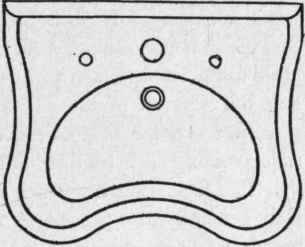
Fig. 26. Plan of Lavatory Slab with Crescent or Kidney-Shaped Bowl..

Fig. 27. Transverse Section.
Bowl.
The false economy which often dictates the purchase of a small slab, generally also prevails in the selection of its trimmings. Compression faucets close against the pressure, and are slow in action, causing practically no reaction. They are generally responsible for the omission of air-chambers on supplies of medium pressure. On account of their slow action, they are suitable for high pressures although but little weight is given this fact by the trade. The features essential to good, lasting service in the compression faucet, are: a cross-handle, a stuffing box, a raised seat, and a swivel disc. Self-closing faucets of various patterns are made with a view to preventing waste of water, the intention being to compel the user to hold the faucet open only as long as water is needed, and to insure automatic closing when it is released. There are none such except the crown-handled, that an ingenious person cannot find means to hold open at will; yet, withal, self-closing faucets are of great value in reducing wastage. A rabbit-eared faucet can be kept open by placing a ring over the handles while squeezed together; the telegraph bibb, by weighting down or tying up the lever; and the T-handled, while not so easily controlled, can be tied open by a lever secured to the handle. The crown-handled design can be operated with ease by the hand of the user, but does not readily lend itself to unauthorized control by means of a mechanical stop. Self-closing faucets require strong and well-designed springs to close them against the force of the water. They have sometimes come into disrepute through leakage for lack of adequacy in this feature of their construction.
Lavatory supports should have positive means of leveling the slab, such as set screws, screw-dowels, or whatever adjustment the kind of lavatory and support may be best suited ,to. Lavatory brackets are generally at fault in having limited bearing at the bottom of the wall-face. This point of the bracket is where all the strain is thrown against the wall, and the effect is noticeable if the upper end springs away ever so little. Full-length brackets are not open to this criticism, but they interfere with the washboard or other finish next the floor.
Sinks. These are made in four general classes according to the purpose to be served - namely, Kitchen, Pantry, Slop, and Factory or Wash-Sinks. The materials used are: - Porcelain; enameled, galvanized, and painted cast iron; enameled, galvanized, and painted wrought iron; brown glazed ware; copper; slate; soapstone; various compositions; and occasionally wood. Porcelain and enameled cast iron are most used, galvanized and painted sinks being confined principally to factory use. Sinks of extreme length, in one piece, or sectional, 6 to 8 inches deep, as shown in Fig. 29, with supply and faucets over the center line or at the side, belong to the factory class. There are roll-rim patterns, with bracket support and iron back, and with faucets fitted through the back. These are generally 8 inches deep and about 20 inches wide. The installation shown in Fig. 29 is particularly good on account of the skeleton character as it will collect little dirt.
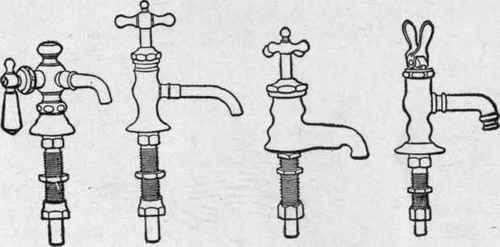
Fig. 28. Common Type3 of Basin Faucets.
Kitchen sinks vary in size according to general requirements. Common sizes are 18 by 30 inches and 20 by 30 inches. The depth ranges from 6 to 7 inches. There are two types of iron sink - flat rim, with outlet at end; and roll-rim, with outlet in center. Neither style of outlet is always desirable as to connection; but the center outlet drains more directly. The flat-rim is not provided with legs. Cast legs were formerly furnished, being attached to the sink by slipping into dovetails. When legs are desired for this type, the plumber provides gas-pipe legs, with or without a top frame. Iron splash-backs are provided for flat-rim sinks, but not of the deep pattern in which air-chambers may be placed. Plumbers drill these sink rims to attach brackets or legs and sometimes also to secure to them hardwood capping or drainboard. Hardwood drainboards are generally provided by the plumber's carpenter. Hardwood splash-backs, set free of the wall to permit circulation of air behind the fixture, are also provided. Sometimes marble splash-backs are provided. Marble is best, but is not in keeping with a flat-rim sink. The back may extend to the end of the drainboard, as represented in Fig. 30, or merely cover the length of the sink. Omitting the back behind the drainboard, is not often done. The drainboard should be free of the wall when the back is not extended. Iron sinks, with roll rim on front and ends, are furnished with drainboards suited to attach to either or both ends. These may be added as an after-consideration, or changed from side to side at will, if there is but one drainboard, or removed entirely, without marring the looks or service of the sink. This interchangeability commends itself to both plumber and customer. . Roll-rim sinks, with the end recessed to receive a drainboard, are also made, but in any subsequent change of location require setting in the original position, so far as the drain is concerned.
Continue to:


My Books

