


Plumbing Fixtures. Part 5
Description
This section is from the book "A Working Manual Of American Plumbing Practice", by William Beall Gray, Charles B. Ball. Also available from Amazon: Plumbing.
Plumbing Fixtures. Part 5
Built-in lavatories similar to Fig. 23 are often used and with appropriate fittings are very effective.
Porcelain and enameled-iron lavatories have bowl, back apron, and soap-cup in one piece. The pedestal of the lavatory illustrated in Fig. 24 is separate, of course, and no back is required, but the general features of integral construction are shown. The only injury possible to them is the marring or fracture of the glaze or enamel. Porcelain and iron lavatories, which can be furnished at reasonable cost, unlike those of marble, are adapted to pedestal support; and some very desirable patterns are therefore made in these materials only. Neither pedestal nor wall lavatories without backs, are suitable, except where the wall or wainscoting is of marble, tile, or other waterproof material.
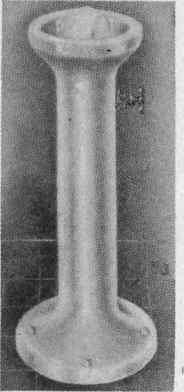
Fig. 22. Enameled-iron Fountain
Courtesy of Federal-Huber Company, Chicago
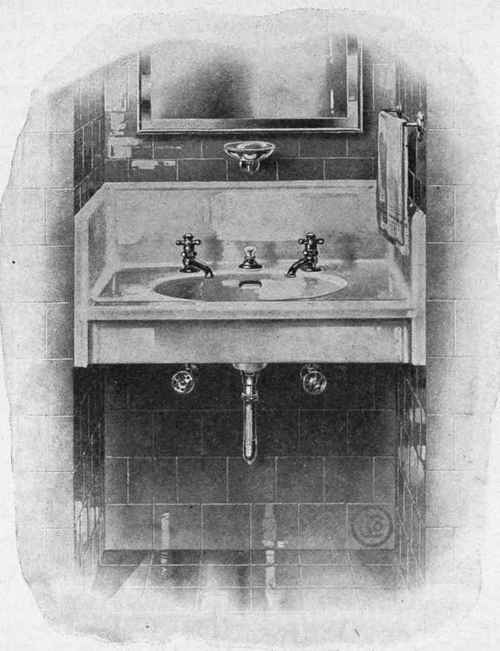
Fig. 23. Solid Porcelain Lavatory with Solf-Closing Basin Faucets and Direct Lift Waste.
Courtesy of Crane Company, Chicago
To provide for leaving the floor clear and free of obstruction, lavatories supported on brackets or hangers, as indicated in Fig. 25, with supply, waste, and ventilating pipes fitted on or into the wall, are best. If found practicable, a neater job results if all pipes leading to and from pedestal lavatories are carried through the pedestal. A supply and waste run to the floor is generally far easier and cheaper to secure than the fitting of all pipes to the wall.
The purchaser seeking iron or porcelain fixtures, has no choice of styles beyond that which the market regularly affords. If he prefers the workable materials, he should insist upon certain features of design which are essential to the best service. Abrupt edges and sharp corners should be avoided; the slab ought to be at least 1 1/2 inches thick, and the back not less than 12 inches high; the general dimensions must be as liberal as space will allow or the service demands (not less than 22 by 32 inches for a 14 by 17-inch bowl); the countersinking must be deep, 3/16 to 1/4 inch; the faucet bosses must not join the general border level at all; the faucets must not be less than 12 inches apart, nor so near the bowl that it will be difficult to secure them to the slab; nor may they be placed so close to the back as to make repairing troublesome with any type of Fuller faucets; the joint surface of the bowl must be ground to fit the slab, and provided with not less than four well-drilled anchor-holes for clamps to secure it.
Round bowls were formerly quite generally in use, but are now almost relegated to memory. The width of slab needed for a roomy, round bowl is too great; and at best the arms of the user must be cramped in a somewhat vertical and awkward position, while the smaller sizes are very uncomfortable in this respect. The sudden opening of the faucet when the bowl is empty, is likely to ricochet water with annoying results. This is caused by the water striking the curved bowl at a tangent; the action is not peculiar to the circular bowl; the oval or crescent, or, indeed, any shape of bowl that presents a curved surface to which the faucet stream is tangent, favors the same result; the ovals in integral fixtures are the most annoying. Marble and onyx have an advantage over porcelain and enameled lavatories so far as ricocheting is concerned. The opening in the slab is not so large as the bowl, and thus a horizontal overhanging ledge is formed all around, above the bowl, which generally intercepts the water in a way to keep it off the floor and person. Porcelain and enameled fixtures have not this virtue. The bowl surface, being integral with the slab, is uninterrupted and continuous; hence ricocheting is more violent with them than is possible with the separate bowl. Oval bowls are now in general use on all types of lavatories. They employ slab space to the best advantage, and are the most convenient for use. The crescent or kidney shape, illustrated in Fig. 26, is, however, as far superior to the simple oval bowl as the oval is to the round. It permits the forearms to lie in a natural and most convenient position when dipping water to lave the face. This form of bowl should be accompanied with a scalloped or recessed front. The D-shaped bowl, and other bowls embracing the prime feature of the D-shape, while not so graceful in appearance, are, without exception, to be preferred, on the score of utter absence of ricocheting when the faucets are properly placed. The D-shape, a transverse section of which is shown in Fig. 27, has a semi-oval front, with the end lines continued parallel some distance past the major axis, and with a straight-line back nearly vertical. This form gives a nearly flat surface in the bottom between the back wall and major axis, on which surface the stream strikes and breaks when the bowl is empty. A depth of water is quickly formed under the stream, which checks any spraying or spattering.
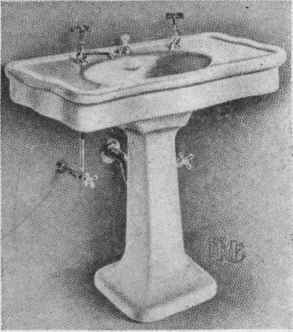
Fig. 21. Lavatory on Pedestal Courtesy of Federal-Huber Company, Chicago.

Fig. 25. Vitreous China Lavatory with Integral Back Courtesy of Trenton Potteries Company, Trenton, New Jersey.
The traps used for lavatories are lead or brass (either cast or tubes), or combinations of these materials, plain or vented or of anti-siphon design. One trouble with lavatory trap ventilation, is the difficulty of obtaining a vertical rise directly above the trap. These vent connections should be carried as nearly vertical as possible, as high at least as the bottom of the lavatory slab, before any horizontal run is made; otherwise the choking of the waste pipe would float solid matters into places from which gravity would not dislodge them. In the absence of water-wash in the vent pipe, these solids would obstruct the vent and defeat its purpose. This danger is not given due attention by many plumbers. The patent and horn overflow bowls, with plug and chain, are the cheapest effective means of controlling the overflow and waste from the bowl. The standing waste, of essentially the same design as the waste fitting for a bathtub, with the body fitting projecting through the slab at the rear of the bowl, is perhaps the most satisfactory waste and overflow arrangement Various schemes for operating basin stoppers by means of levers and swivels, are employed; but none of them has come into more than limited use.
Continue to:


My Books

