


Metals. Continued
Description
This section is from the book "Plumbing Practice", by J. Wright Clarke. Also available from Amazon: Modern plumbing practice.
Metals. Continued
The softness and plasticity of lead is such as to make it most easily worked, and applicable to various forms where it would be almost impossible to use any other metal. These properties, and the low price at which it can be produced, make lead one of the most useful of metals for especial purposes.
Lead has a very brilliant lustre, but it is so readily attacked by oxygen that in some cases its brightness is destroyed in a few minutes, and this takes place more readily when moisture is present.
Chemical Properties
The chemical properties of lead render it useful for some purposes. The following among several combinations with oxygen are all useful: "Litharge," Pb O: "Massicot" (is a superior kind of litharge), and Minium Pb3 O4, commonly called red lead. These are used as the basis of some paints, or else as driers to accelerate the drying or hardening of paint, the red lead facilitating the oxygenation. Litharge is also used in the operation of lead'-glazing some kinds of earthenware.
Oxide of lead and carbonic acid, when in the proper combination, produce "ceruse," or white lead, Pb CO3, so much used, when ground and mixed with oil, for painting. Carbonate of lead, commonly called white lead, is found in a natural state in the form of crystals, but the white lead of commerce is produced by exposing thin sheets of lead to the action of air, vinegar, and carbonic acid in a chamber kept moderately warm by fermenting tan. It is reported that a way for producing white lead so as not to be injurious to the workers has been discovered, but up to now this is a trade secret.
Metallic lead enters into combination with other chemicals, forming plumbic sulphide (galena), plumbic iodide, plumbic nitrate, plumbic chloride, plumbic oxalate, plumbic phosphate, plumbic chromate, and other salts of more interest to the chemist than the plumber.
In addition to being used as paints, red and white lead mixed in certain proportions are used as cement for the joints of iron pipes, and for several other purposes.
Lead Alloys
Lead will alloy with several other metals. Mixed with tin in various proportions plumbers and other tradesmen use it as solder. Some cheap kinds of brass-work have lead as one of the constituents. A little lead added to brass-work makes it better for turning and filing.
Pewter is an alloy of lead and tin in the proportion of about four parts of tin to one of lead. Type-metal, as already mentioned, is composed principally of lead.
Market Forms Of Lead
Lead is bought in the form of cast pigs, sheets, or pipes. The pigs are generally the pure lead as it leaves the furnaces, and weigh from one to one-and-a-half hundredweight each. Sheet-lead is either cast or milled. Milled-lead is manufactured by casting a cake of lead and then passing it to and fro between large rollers until it is reduced to the desired thickness. Milled sheets are made from 20 to 40 feet long, and from 6 feet 9 inches to 9 feet wide. Sheet-lead is described as being five, six, or seven-pound lead; this signifies that one square foot of the lead will weigh such a number of pounds. It is difficult to mill lead to a less thickness than three pounds (.051 of an inch), by reason of its want of tenacity. The weights of sheet-lead vary from three to fourteen pounds per foot superficial; above this weight it is usual to describe the milled-lead as plates.
Cast sheet-lead is generally made by plumbers in the workshop.
Old lead is sometimes used, but unless a certain proportion of new, or pig lead, is added the sheets crack as they cool. The operation of casting is as follows: At one end of the workshop, Figure 2, a large cast-iron pot, B, to hold about fifteen hundredweight, is set in brick-work, with a fire-place beneath, and flues all around to heat the lead. In the centre of the shop the casting-frame should stand, with one end near the casting-pot. The bed of the frame, A, is covered with sand moistened to give it cohesion. This is made as true on the surface as possible, two men, one at each end, passing the strike, G, from end end of the frame, and as they push the strike before them they remove all the superfluous sand and leave the remainder with a true surface. The next operation is to plane the sand so as to make it quite smooth. The plane, H, is made of sheet-copper, and is similar to a large plasterer's trowel. The edges of the copper are slightly curled upward.
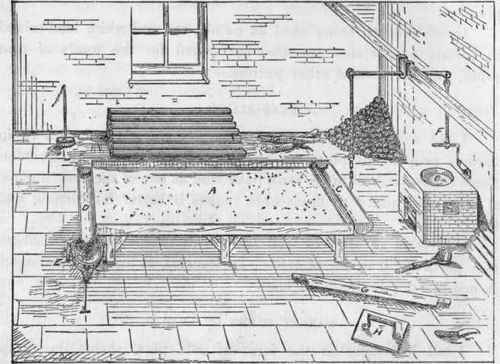
Figure 2.
A little bit of " touch " (or tallow) rubbed on the face of the plane makes it work better. A good lead-caster will so work up the surface of the sand that it will look quite bright when finished and ready for casting. When the frame is ready and the lead heated to the right degree, sufficient is ladled out of the pot into the cast-iron head-pan, C. The lead should be hot enough to allow for cooling by contact with the head-pan, or it would set into a solid mass. The lead in the head-pan should be kept in motion by stirring with a dry piece of wood; if this were not done part of the lead would chill and stick to the sides. As soon as the lead has cooled down to the proper degree of heat - usually judged by dipping in a piece of clean wood and noticing the extent of its charring - the third hand (man) pulls the cord, F, and upsets the head-pan so that the contents flow on to the frame.
The first and second hands stand ready with the strike, and as soon as the lead is upset they push the strike before them, pressing the ends hard on the rim of the frame, and as quickly as possible remove all superfluous lead before it has time to congeal. At the bottom end of the frame is the tail-pan, D, placed to catch the spare lead removed by the strikers, and at the bottom end of the tail-pan is a large cast-iron bowl, E, on wheels, called the "wagon."
All the spare lead runs into this wagon, which is then dragged to and the contents emptied into the pot. If this lead is found to be too much set for ladling out, an iron ring is held half immersed in it, so that when cold, hoisting tackle, with a hook on the end, can be used for bodily lifting the lead out of the wagon into the pot; or, if not too heavy, two men with handspikes can lift it.
The ends are now trimmed, and the sheet of lead rolled up and hoisted off the frame, after which the whole operation is repeated. If the lead is good, twelve or fourteen sheets of lead can be cast in one day, but sometimes, when the lead is hard, half of these sheets have to be cut up again and put into the pot; this being necessary from the number of "sand cracks" found in them, arising, probably, from unequal contraction of the metal as it cools, but this rarely occurs when all new lead is used.
Some lead-casters, but not all, will lay a strip of sheet-lead across the frame on the surface of the sand beneath the lip of the head-pan, to prevent the melted lead from washing a hole in the sand at that point. Cast sheet-lead should never be less than seven or eight pounds per foot superficial. In positions on house-roofs exposed to great variations of temperature, arising from the action of the sun's rays followed by cold, cast-sheet lead is found to last much longer than milled sheet-lead. This probably arises from the fact that cast sheet-lead has all its particles in natural positions, but in milled-lead these particles are squeezed into unnatural contiguity when being passed through the mill.
For lining tanks and. cisterns the milled sheet-lead is the best, as it is more uniform in thickness. Milled sheet-lead also makes the neatest work, and for very fine-chasing the members can be worked up sharper so as to show up distinct-Figure 3 is a specimen of a block of wood covered with one piece of six-pound lead. Figure 4 is-another specimen. In this case the wooden column and base are covered with one piece. The capital was-made separately, and is hollow, not having any wood inside, and it appears to have been a very difficult undertaking. Figure 5 is-another specimen of first-class workmanship. The top portion was bossed up out of sheet-lead. The stem was made out of a piece of drawn-lead soil-pipe. It is intended as a ventilation end for a soil-pipe. These three specimens were made by two young plumbers (students at the Polytechnic in London), in their spare time at their own homes, and each have received prizes for their skill. It would have been very difficult to produce equal specimens of handicraft if cast sheet-lead had been used. Sheets of cast-lead are generally about 14 to 18 feet long by 6 feet wide.

Figure 4. Figure 3.
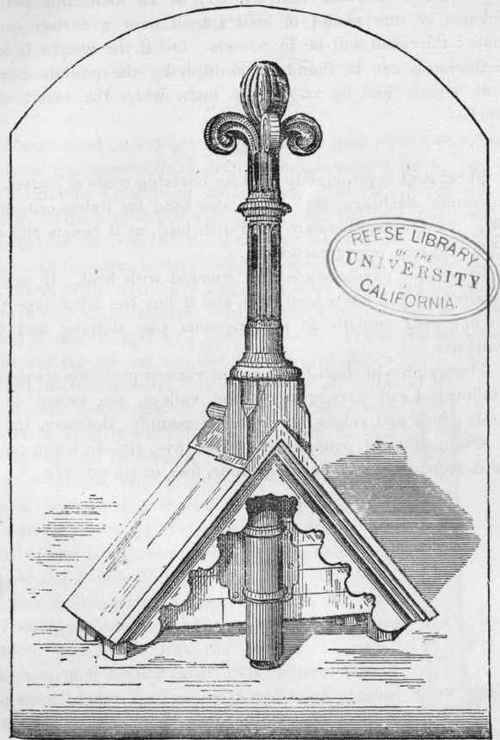
Figure 5.
Laminated lead is a very thin kind of sheet-lead; it is sometimes used for keeping back the dampness in walls. The weight of sheet-lead may be approximately arrived at by measuring the thickness and dividing that by .017 of an inch, this being the thickness of one pound of lead spread over a surface one foot square; the result will be in pounds. Or, if the weight is known, the thickness can be found by multiplying the pounds contained in one square foot by .017 of an inch, when the result will be in inches.
Uses
Sheet-lead is principally used for covering roofs of houses, or for the gutters, flashings, etc. It is also used for lining cisterns and sinks. Vitriol-chambers are lined with lead, as it resists the action of this acid to a very great extent.
Floors and passages are often covered with lead. If well fixed on stairs lead will last a long time, and it has the advantage that it does not wear smooth so that persons risk slipping and falling downstairs.
The weights of sheet-lead used in various positions are generally as follow: Lead flats, gutters, and valleys, six, seven, or eight pounds; hips and ridges, six or seven pounds; dormers, the tops, six, seven, or eight pounds; the sides, five, six, or seven pounds; aprons, step, and cover flashings, four, five, or six pounds.
Continue to:


My Books

