


General Requirements. Part 2
Description
This section is from the book "Plumbing Problems", by The Sanitary Engineer. Also available from Amazon: Plumbing Problems, or Questions, Answers and Descriptions Relating to House Drainage and Plumbing.
General Requirements. Part 2
Pipe-Joints
All joints of iron pipe to be thoroughly calked with oakum and molten lead. Joints between cast-iron and lead pipe to be made with brass or copper ferrules. If of brass, ferrules to be calked into hub of iron pipe, and lead pipe soldered to it by a wiped-joint. If of copper, inside diameter of ferrule to be larger than outside diameter of lead pipe to permit of drawing the lead pipe through the inside of the ferrule, and lapping it over the flange as shown. After being thus protected against corrosion, copper ferrule is to be calked into hub, and the wiped-joint to be made in the usual manner. (See Figure 145.)
Iron pipe lengths, when vertical, to be supported under each hub by strong iron hooks, and when hung from ceiling to be held in place by strong iron hangers, securely fastened to the beams, or, better, to be supported at intervals by brick piers. All changes in direction to be by bends, and all branches to be Y-branches. At intervals of not more than twenty feet insert into the line of drain Y-branches, with brass trap-screws, for cleaning and inspection purposes. Mouths of any soil, waste, or vent pipe above the roof to be located remote from chimney-tops or ventilating-shafts. Wherever any pipe passes through the roof a water-tight joint must be made by providing a flashing of sheet-lead, tin, or copper, eighteen inches square, with a funnel around pipe, the flashing to be securely fastened to the roof, and the funnel turned over and calked into hub of pipe.
Testing Pipes
Alter completion of the piping, and before any fixtures are connected, all openings of waste, soil, and vent pipes to be plugged, and the whole system of piping filled with water, and allowed to stand twenty-four hours, if required by the architect. [This important test is not, however, practicable in winter time, and some other test is in that case to be substituted.] If any leak is shown, the defect to be made good, and pipes again tested until the system is proved gas and water tight to the satisfaction of the architect or superintendent.
The weight of the lead pipes is to be as follows:
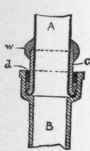
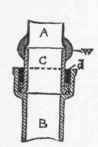
Figure 145.
Lead pipes. - Supply-pipes with street-pressure: | ||||
1/2-inch pipe | 3 lbs. per foot. | |||
5/8 | ,, | 3 1/2 | ,, | ,, |
3/4 | ,, | 4 3/4 | ,, | ,, |
Supply-pipes from tank-pressure: | ||||
1/2-inch pipe | 2 lbs. per foot. | |||
5/8 | ,, | 2 3/4 | ,, | ,, |
3/4 | ,, | 3 1/2 | ,, | ,, |
2-inch pipe, | 4 lbs. per foot. | |||
1 1/2 | ,, | 3 1/2 | ,, | ,, |
1 1/4 | ,, | 2 1/2 | ,, | ,, |
1 | ,, | 2 | ,, | ,, |
All joints between lead pipes to be wiped-joints. All vertical lead pipes to be supported by metal tacks, soldered to the pipe, and fastened with screws to boards put up by carpenter; tacks to be not less than three feet apart. Horizontal lead pipes must be supported throughout their length on boards, to prevent trapping, and be fastened by brass bands and screws. No hooks to be used in fastening lead pipe. Hot-water pipes must not be fastened with tacks; brass bands only should be used to allow for expansion and contraction. Hot and cold water pipes to be kept at least one-half inch apart everywhere. All stop-cocks on supply-pipes to be arranged easy of access.
No supply-pipes to run on outside walls unless absolutely necessary, and in this case pipes to be securely protected in all exposed places. [Here state kind of protection required.]
Continue to:


My Books

