


The Construction Of Turkish And Russian Baths
Description
This section is from the book "Plumbing Problems", by The Sanitary Engineer. Also available from Amazon: Plumbing Problems, or Questions, Answers and Descriptions Relating to House Drainage and Plumbing.
The Construction Of Turkish And Russian Baths
The following description of the Turkish baths at Nos. 16 and 18 Lafayette Place, New York, designed by Mr. Paul J. Schoen, architect, is taken from the Sanitary Engineer of October 18, 1883:
The buildings are 165 feet deep, by 53 feet front, the principal floor and basement being devoted to bath purposes. The principal floor is reached from the street by a flight of stone steps; the level of the basement-floor, where the baths proper are, being two or three feet below the sidewalk.
"The baths" consist of Turco-russian, Russian, and Turkish, with sitz-bath, needle-baths, douche, and warm and cold showers in the different departments. Figure 140 is a section through the Turco-russian and Russian, and Figure 141 is a section on the line A B through the Turkish.
The Turco-russian chamber is a seasoning-room, in which the temperature is kept at 118o to 1200 Fah., and is hot air laden with moisture to the point of saturation. It is warmed by direct radiation; the steam-coils (C) being placed under the marble terraces at the sides, as shown. Two circulations of the air are established; one, which may be called a local circulation, is the revolution of the air of the chamber in through the large register a to the coils to be warmed, returning again to the room through the small round register b. The other circulation is for the renewal of the air, and is in at the arrow under the terrace, where it comes in contact with a coil, and diffusing with the air under the terrace, escapes with it. At the same time a portion of the air which has been through the chamber and which enters the terrace at a escapes through the vent-flues V V.
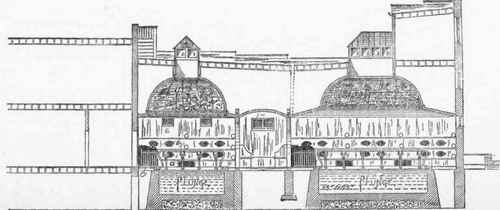
Figure 140.
The Russian bath is similarly arranged with regard to the "local circulation" - i. e., the warming circulation - the coils being under the terrace, with the exception of the circulation for the change of air. The inlets are Z-shaped openings through the walls under the windows, and shown by the arrows, the vents or air-outlets being at the floors under the terraces, and escaping through the flues in the walls marked V V V V. The air here is laden with all the moisture that can be held in suspension at a temperature of 1200, a supply being constantly kept up by an escaping steam-jet within the terrace. The amount of steam-pipe under the terraces in these two chambers could not be obtained with any accuracy, as Dr. Ryan was his own engineer in the matter, and had added surface in many sections until he obtained the desired heat necessary to maintain the temperature when moving air as fast as his flues would remove it.
In the Turkish bath the temperature varies from 1350 to 1400 Fah., and is dry heat. The warming is by direct radiation, exposed in the rooms, the quantity of 1-inch steam-pipe being 4,500 feet, lineal. Air enters through the radiators from the outside, and is drawn off through the vent flues V V, high up in the fire-place chimney, and a large register over the plunge, near the apex of the roof. In addition to the vent-flues skylights above the domes over the plunges can be opened when required. The walls are made double and the windows small, to prevent an unnecessary loss of heat.
The plunge-baths, 7x12 feet and 7 x 22 feet, are supplied with Croton water and the large plunge of the Turkish bath from an artesian well. The method of renewing the water is to draw them off entirely every night and sponge them out, then fill them with fresh water, and let a comparatively small stream flow through them all day, the surplus running off through an overflow in the manner usual to plumbing fixtures. The temperature in the mineral-water plunge is thus maintained at 55° to 6o° Fah.

Figure 141.
There are five tanks of 11,000 gallons capacity for the storage of Croton and artesian well water, and one tank 4x6x9 feet for warm water, to guard against an interruption in the supply from temporary causes.
Croton water is supplied to the building through a 2-inch pipe, with a meter, for the boilers and all purposes for which the artesian water cannot be used. The capacity for pumping artesian water is 240 gallons per minute, and a little less than 100,000 gallons is used in the 24 hours.
A prominent feature of the appointments is the "needle-bath," shown in Figure 142. It is all brass pipe, nickel-plated, with ornamental fittings. The horizontal arms are perforated with fine openings, to discharge a fine spray on the body of the bather. The central vertical pipe is connected with the warm and cold pipes K and N by the cocks A and B, which admit of variable degrees of temperature in the spray. The cocks C and H regulate the shower and control the supply in the same manner. F and G are the liver-sprays, being metallic pads perforated with minute openings, one being cold and the other tepid, and are controlled by the cocks D and E. A douche, L, is in the floor-slab, and is regulated by the cocks J and I.
The floors and walls in the vapor-baths are marble, and the ceilings and domes wood, painted and ornamented in oil. Around the domes slight condensation takes place, and would drop on the bathers were it not that an internal eaves-trough, that is nicely arranged to harmonize with the finish, carries this drip to a convenient down pipe.
Steam is supplied to the building by a boiler 16 feet long by 5 feet 6 inches diameter, with fifty 4-inch tubes, and the water of condensation is returned by an "Albany" trap. A smaller boiler, 14 feet by 48 inches diameter, is kept in reserve.
The principal or parlor floor of the building is for the use of the guests after bathing and resting, preparatory to going into the street. The reception-room is 24 x 60 feet, beyond which is a parlor 22 x 21, in the rear of which is a billiard-room 24 x 30. Adjoining the billiard-room is a cafe 16 x 24.
For those not acquainted with the routine of baths we append the following short description: The bather pays at one desk, passes to another and leaves his valuables, is assigned a dressing-room, and after disrobing is shown to the Turco-russian bath, a seasoning-chamber in which all bathers remain awhile before entering either Russian or Turkish baths. When his skin is slightly moist, he is led to a couch and soaped, scrubbed, and rinsed off with a tepid shower, when he passes to either of the baths. The rest of that time in the bath (which may vary from twenty to forty-five minutes, according to his strength or the doctor's orders) he spends in alternately sweating and showering, finally finishing with a cold plunge or shower bath. He is then passed into the cooling-room and dried with towels, from thence to the rubbing-room, where he is rubbed and manipulated with the bare hand of the attendant until his body is all aglow. He is then placed on a couch in another chamber with a sheet spread over him, and there takes his ease until he feels like resuming his clothing.
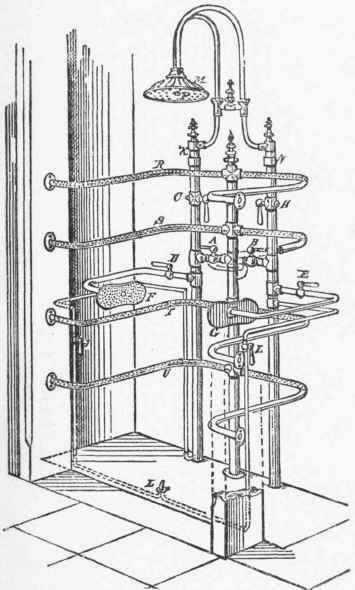
Figure 142.
Continue to:


My Books

