


Commercial Types Of Traps
Description
This section is from the book "Principles And Practice Of Plumbing", by John Joseph Cosgrove. Also available from Amazon: Principles and Practice of Plumbing.
Commercial Types Of Traps
Offset Siphon Trap
A common type of siphon trap is the brass trap, Fig. 36. This form of trap has many advantages, among which are the offset and slip joints, a, which make it adjustable.
The pipe outlet is threaded with a standard iron pipe thread, and may be had either male or female.

Fig. 36
Cudell Trap
One of the oldest types of non-siphon traps on the market is the
Cudell trap, Fig. 37. Besides the large chamber that makes this type of trap non-siphoning, it contains a ball of slightly greater specific gravity than water, which rests upon a seat and forms a seal when water is not flowing through the trap. This ball prevents the seal of the trap being forced by back pressure, effects a seal in case the water is evaporated from the trap and acts as a check, by moving to the position indicated by solid lines, to prevent sewage overflowing a fixture should the drain stop up.
Sanitas Trap
This trap, shown in Fig. 38, depends chiefly upon an inner partition or baffle plate to deflect sufficient water into the side cup to preserve the seal when the trap is subjected to siphonic action. Theoretically, inner partitions in a trap are objectionable on account of their liability to contain holes through which the water forming the seal can escape. In this case, however, the trap is so constructed that a hole in the partition would not cause it to leak, and for that reason the partition is not objectionable.
Centrifugal Trap
Fig. 39 is a drum trap with the waste pipe entering the body at a tangent, so as to give the inflowing water a circular or centrifugal motion to make it self-scouring.
Sure=seal Trap - Fig. 40 is a self-scouring non-siphon trap through which the water flows with a wavy motion due to a bell-mouthed inlet and two baffle rings, a, b. This trap has an inner tube outlet, which generally is considered objectionable, but not when made of heavy seamless drawn brass tubing like in the sure-seal trap.
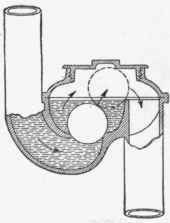
Fig. 37

Fig. 38
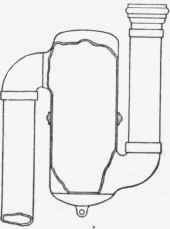
Fig. 39

Fig. 40
Clean Sweep
This trap, Fig. 41, like the centrifugal, is non-siphoning, and is made self-cleaning by the centrifugal force of the flowing water.
Examples Of Installations
Continue to:


My Books

