


Plugs For Traps
Description
This section is from the book "Principles And Practice Of Plumbing", by John Joseph Cosgrove. Also available from Amazon: Principles and Practice of Plumbing.
Plugs For Traps
Special plugs are now made to stop the outlets to traps. Formerly it was common practice to fill the bottom of the main drain trap with Portland cement, or calk a disk of sheet lead into the drainage hub of the main drain trap. Both methods are extremely bad practice. When cement is used it is never thoroughly removed from the trap, and the portion that remains presents a rough surface that prevents the trap from self-scouring. Furthermore, in removing cement from the bottom of a trap, the bar chisel is oftentimes driven through the wall of the trap. When a trap is stopped by means of a sheet lead disk, the lead must be cut out after the system is tested, by inserting an arm through one of the vent openings in the trap and cutting the lead with a knife. Being inconvenient to get at, the lead is seldom all removed, and what remains presents a jagged edge to catch and retain anything of a fibrous nature that comes in contact with it. When a drainage system is to be tested and no trap plug is at hand, the trap can be stopped by puddling it with clay. This will hold the water of a five-story building, and can be easily and completely removed after the test. A plug for stopping traps is shown in Fig. 58. This plug is also provided with a valve for filling and emptying the drainage system, and a short length of hose through which to conduct the water to the sewer side of the trap.
When applying the water test, it is well to fill the system slowly from the bottom and make tight all joints from the house drain up. This avoids trouble and confusion, for when a system is filled to the top, water from a small leak near the roof will follow down the stack, wetting all the hubs, and present the appearance of all the hubs leaking. However, when the system is filled to the roof, the plumber should commence at the top and work down, making each joint tight before leaving it for the one next lower down. Leaks at joints can usually be stopped by gently calking the inner and outer edge of the lead packing with a cold chisel or small calking tool and a light hammer. When split hubs or defective pipes are found, the water should be lowered beyond that point and the defective section of pipe replaced with a good one.
Fig. 57
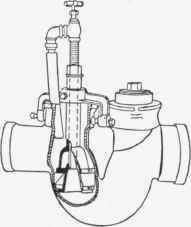
Fig. 58
Continue to:


My Books

