


Refrigerator Wastes
Description
This section is from the book "Principles And Practice Of Plumbing", by John Joseph Cosgrove. Also available from Amazon: Principles and Practice of Plumbing.
Refrigerator Wastes
System Of Piping
In apartment houses, of the better class, refrigerator waste pipes are usually installed to carry off the drip from ice boxes in the several apartments. Fig. 47 shows the general system of piping for refrigerator wastes; the main refrigerator stack does not connect to the drainage system but discharges into a trapped and water-supplied sink in the cellar or basement, and should open to the atmosphere above the roof. Galvanized wrought iron pipe should be used for refrigerator wastes, and the ends should be well reamed to remove the burr formed by cutting the pipe. Fittings should be of the recessed drainage type, well galvanized both inside and out. Full Y fittings should be used for branch connections to the various refrigerator safes, and a Y branch with clean-out plug should be used at all changes of direction of the horizontal mains.
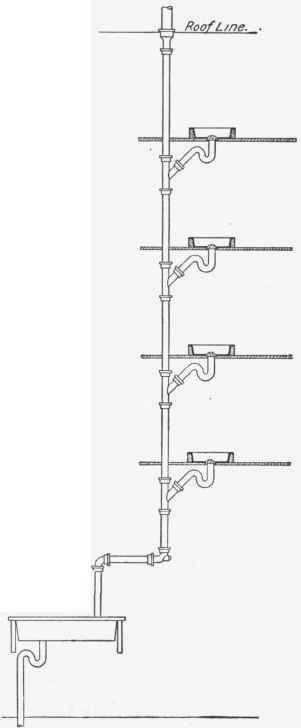
Fig. 47
The main waste pipe from refrigerators should never be less than 1 1/4 inches diameter, and seldom need be over 1 1/2 inches. Branch connections to the refrigerator safes, also refrigerator wastes in private houses, need not be over 1 inch in diameter.
Refrigerator Safes
The manner of constructing and lining refrigerator safes is shown in Fig. 48. Beveled supporting strips are nailed to the floor to form a shallow pan, about 1 1/2 inches deep, which should be made water-tight by lining with sheet lead or sheet copper. The outlet from the pan should be countersunk, and the opening protected by a removable strainer secured in place by a cross bar„
Trapping Refrigerator Safes
Each refrigerator safe should be separately and properly trapped and connected to the main refrigerator waste stack. The best type of trap to use for this purpose is a plain siphon trap of 3/4 S pattern. The angle of the outlet leg of a 3/4 S trap permits the slime that accumulates in the waste pipe from an ice box to slide into the vertical stack and thence to the sink. It is not necessary to back-vent refrigerator waste traps, nor use non-siphon traps, because a flush of water of sufficient volume to siphon a trap is never discharged into a refrigerator waste; even if it were, the constant drip from the ice box would soon seal the trap again.

Fig. 48
In private houses the refrigerator waste need only extend from the refrigerator safe to the drip sink, where it should terminate with a light swing-check valve to prevent cellar air entering the living rooms through the waste pipe. No trap is required where only one refrigerator connects to a waste, nor is it necessary in such cases to extend the pipe through the roof.
Continue to:


My Books

