


Steam Pumps
Description
This section is from the book "Principles And Practice Of Plumbing", by John Joseph Cosgrove. Also available from Amazon: Principles and Practice of Plumbing.
Steam Pumps
Single Direct-Acting
The type of steam pump most commonly used for house pumps is a single direct-acting pump shown in Fig. 100. The operation of the pump is as follows: Steam enters the cylinder, a, from the steam chest, b, through the port, c, and pushes the piston, d, to the left, the steam exhausting from the left side of the piston through the port, e, and exhaust, f, to the atmosphere. When the piston has almost reached the end of its stroke, the arm, g, link, h, and rod, i, reverse the auxiliary piston j, and slide valve, k, so that steam is now admitted to the left side of the piston through port, e, and as the piston travels to the right the exhaust steam escapes through port, c, and exhaust, f, to the atmosphere. The reciprocating motion of the steam piston is transmitted to the pump piston, l, in the water end of the pump by means of the piston rod, m, to which it is direct connected. Then, as the pump piston travels to the left, water flows through the suction valve, n, into the pump cylinder, while the water to the left side of the piston is forced through the valve, n, into the discharge pipe. On the reverse stroke of the piston, water flows through the suction valve, p, into the pump cylinder, while water on the right side of the piston is forced out through discharge valve, q, into the discharge pipe. An air chamber, r, on top of the valve chamber reduces shock from water hammer and promotes steady flow. Two drip cocks, s s, serve to drain water of condensation from the steam cylinder and a lubricator, t, oils the working parts in the steam chest. This pump is known as a double stroke pump, as it both lifts and forces with each stroke of the piston. For low pressure service the piston in the water end of a pump may be packed with a fibrous packing; for high pressure service, however, the packing should be of metal.
Capacity Of Pumps
The diameter of cylinder for a single-acting pump required to deliver a certain quantity of water per minute can be found by the formula:
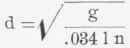
In which l =length of stroke in feet g = number of gallons to be delivered per minute n = number of strokes per minute d = diameter of pump in inches
Example
What diameter of pump plunger will be required to discharge 114 gallons of water per minute; speed of pump, 90 strokes; length of stroke, 1 foot?
Solution
Substituting values given in the example,

When the diameter of a cylinder and the length of piston travel per minute are known, the quantity of water a pump will discharge can be found by the formula: q = l a s In which q= cubic feet of water delivered per minute 1 = length of stroke in feet a = area of piston or plunger in feet s = number of strokes per minute
Example
What will be the discharge in cubic feet per minute from a single direct-acting pump with water piston 6 inches in diameter and length of stroke 8 inches, when running at a speed of 30 strokes per minute?
Solution
The area of a 6-inch piston is .2 square foot. An 8-inch piston stroke equals .666 foot. Then,
.666X30X.2=3.99 cubic feet of water per minute. - Answer.

Fig. 101
Continue to:


My Books

